
DRD Pool Management Lifeguard Practice Test
$69.00
- Buy to unlock unlimited access to all Quiz questions and Answers in this Quiz.
- After purchase you can print a PDF of the whole quiz at any point. The PDF will contain the questions and the correct answers.
About this Exam
Prepare to dive into your career as a professional rescuer with our comprehensive DRD Pool Management Lifeguard Practice Test study guide. This course is specifically designed for responsible individuals—minimum age 15—who want to master the skills necessary to keep aquatic facilities safe. Whether you are looking to work at a community pool, a fitness center, or a waterpark managed by DRD, this certification validates your ability to recognize and respond to emergencies. It is a highly respected credential that demonstrates your commitment to safety, professionalism, and rapid response in high-pressure situations.
Ready to test your knowledge?
Buy Now to Access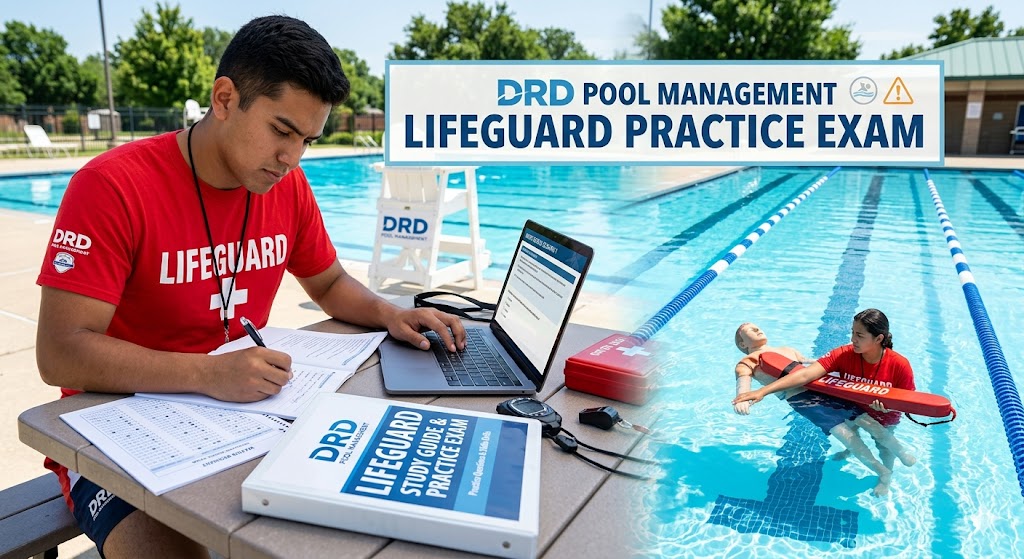
Additional Information
What the Course Entails and Exam Details
This training program blends rigorous classroom instruction with hands-on water skills practice. Over the course of the training, you will be immersed in a curriculum based on the latest standards in aquatics.
Core topics covered in the training include:
Professionalism and Responsibility: Learning the ethical standards and public relations skills required to be a trusted lifeguard.
Water Safety and Surveillance: Techniques for proactive scanning, recognizing a distressed or drowning swimmer, and managing facility risks.
Rescue Skills: Mastering both shallow and deep water rescue techniques for conscious and unconscious victims.
Spinal Injury Management: Learning specialized procedures for rescuing victims with suspected head, neck, or back injuries.
CPR/AED and First Aid: Comprehensive training in cardiopulmonary resuscitation (CPR) for adults, children, and infants, as well as the use of Automated External Defibrillators (AEDs) and essential first aid skills.
The DRD Pool Management Lifeguard Exam requires a demonstration of competence in both knowledge and physical ability. Candidates must pass prerequisite swimming tests just to qualify for the training, which often include a 300-yard continuous swim, a 2-minute tread using legs only, and a timed 20-yard swim to retrieve a 10-pound brick from deep water.
What to Expect in the Final Exam
The final certification exam is a standardized test divided into two primary components: a written examination and a practical skills evaluation. To earn your certification, you must succeed in both areas.
Written Exam Details: The written section is usually in a multiple-choice format. It assesses your theoretical knowledge of lifeguarding protocols, first aid procedures, and emergency response. You must achieve a passing score of at least 80% on each section of the test to move on. These sections are typically split into a "Lifeguarding" component and a "CPR/AED/First Aid" component.
Practical Skills Evaluation: This section requires you to perform rescues and medical procedures in front of an instructor. You will need to execute real-life scenarios flawlessly to prove you are ready for the job.
Key practical skill checks usually include:
Rescue Scenarios: A "passive" (unconscious) victim rescue and an "active" (conscious) victim rescue.
Spinal Management Scenario: Effectively stabilizing a victim in deep water who has a suspected spinal injury.
CPR/AED Scenarios: Demonstrating one-rescuer and two-rescuer CPR on adult and infant manikins, incorporating the use of an AED.
You will have time limits for certain rescues, and you must adhere to correct techniques without significant errors to receive a passing grade from the instructor.
How to Study and Exam Centers
Preparation is critical. Do not underestimate the difficulty of either the physical requirements or the written material. Here are actionable strategies for your study:
Effective Study Strategies:
Use Practice Tests: Leverage our DRD Pool Management Lifeguard Practice Test multiple times. Identify your weak areas and review those sections of your lifeguard manual thoroughly.
Study the Manual: Read the comprehensive Lifeguard Manual provided during the course from cover to cover. Pay close attention to definitions, lists of steps (like the initial assessment), and CPR ratios.
Visualize Skills: For the practical component, close your eyes and visualize every step of a deep water rescue. Walk through the scenario, from jumping in with the rescue tube to the initial assessment on the deck.
Practice with Peers: If possible, meet with fellow students to practice your CPR skills or to quiz each other on first aid procedures.
Exam Centers and Locations: DRD Pool Management conducts its own training courses and testing at various aquatic facilities. Rather than searching third-party providers like Pearson VUE, you should register directly through the DRD Pool Management website. They schedule multiple courses leading up to the summer season. These exams take place at the same physical locations (pools and community centers) where the in-person training is provided.
Job Opportunities from the Course
A DRD Pool Management Lifeguard Certification doesn't just give you a summer job; it unlocks a professional pathway in aquatics and management. This certificate is widely recognized by facility managers and municipalities.
Potential career paths and job opportunities include:
Summer Lifeguard: The primary entry-level role at community, apartment, or fitness center pools.
Year-Round Lifeguard: Working at indoor facilities, including YMCAs and local community centers.
Head Lifeguard: A promotion involving a leading role in a lifeguard team, including scheduling and in-service training assistance.
Pool Supervisor/Manager: A leadership position overseeing a facility, managing a large team of lifeguards, and handling facility operations.
Water Safety Instructor (WSI): A separate but related certification (also taught by DRD) that allows you to teach swimming lessons.
Lifeguard Instructor (LGI): With enough experience and further training, you can become certified to teach the lifeguard course yourself.
Frequently Asked Questions
Reviews
5.0
Based on 0 reviews
Leave a Review
No reviews yet. Be the first to review!