
Drinking Water Treatment Operator Class 1 Practice Exam
$69.00
- Buy to unlock unlimited access to all Quiz questions and Answers in this Quiz.
- After purchase you can print a PDF of the whole quiz at any point. The PDF will contain the questions and the correct answers.
About this Exam
The Drinking Water Treatment Operator Class 1 certification represents the essential first step into the vital field of water treatment. It is the entry-level credential required for professionals who operate and maintain water treatment plants, ensuring that the final output is safe for public consumption. This course is specifically designed for individuals looking to begin a new career in environmental science, public works, or water utility management. By earning a Class 1 certification, a candidate proves they possess a foundational understanding of water quality, treatment processes, basic scientific principles, and regulatory requirements. This credential validates your ability to protect public health through the production of safe drinking water.
Ready to test your knowledge?
Buy Now to Access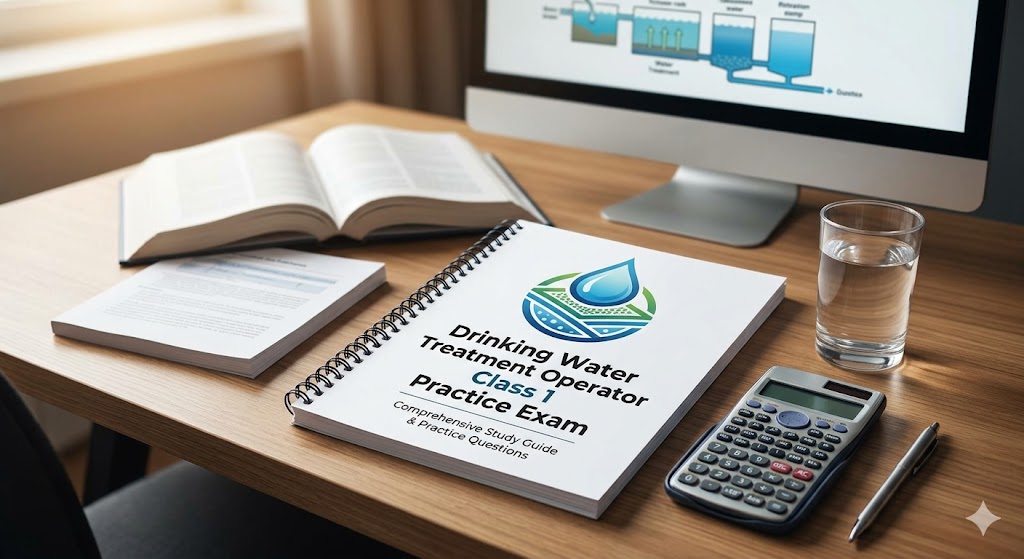
Additional Information
What the Course Entails and Exam Details
This course covers a broad range of fundamental topics essential for an operator's success. Candidates must demonstrate competence in several core areas to pass. Key topics included in the Class 1 syllabus are:
Source Water Quality and Protection: Understanding the characteristics of groundwater and surface water, identifying potential contamination sources, and implementing watershed protection measures.
Water Mathematics and Calculations: A significant portion of the exam focuses on practical math. You must perform calculations for flow rates, volumes of tanks and pipes, geometric calculations, detention times, chemical dosages, and feed rates, as well as handle unit conversions between different systems of measurement.
Water Treatment Processes: Comprehensive knowledge of the multi-stage treatment process is required. This includes coagulation, flocculation, clarification/sedimentation, and filtration (both rapid and slow sand). You must understand how to monitor and adjust these processes for optimal performance.
Disinfection Methods: In-depth knowledge of disinfection, particularly with chlorine, is crucial. The course covers breakpoint chlorination, maintaining desired residuals, and other methods such as UV or ozone treatment.
Equipment Operation and Maintenance: This covers basic hydraulics and the mechanical operation of key plant components, including pumps, motors, valves, and chemical feed systems. Candidates must also know how to troubleshoot and perform routine maintenance.
Laboratory Analysis and Sampling: The ability to collect representative samples and perform basic analyses (such as turbidity, pH, free and total chlorine residual, alkalinity, and hardness) is vital for process control and compliance monitoring.
Safety and Regulations: Understanding safety procedures and personal protective equipment (PPE) is paramount. You must also have knowledge of key regulations, particularly the fundamental requirements of the Safe Drinking Water Act (SDWA).
What to Expect in the Final Exam
The final exam is typically a comprehensive, standardized written test. It most commonly consists of multiple-choice questions. Depending on the specific certifying body, the exam might include up to 10 additional "pre-test" questions that are unidentified and unscored, used only for statistical data collection for future tests. The questions are often categorized by cognitive level, focusing on simple Recall of facts and the Application/Calculation of problems. While time limits and passing scores can vary by state or provincial jurisdiction, candidates generally have 2 to 3 hours to complete the exam. A common required passing score is around 70%. It is essential to check with your specific local certifying authority to confirm their precise format and requirements. Most exams do not include a practical, hands-on component at this level; your practical competence is usually evaluated during on-the-job training.
How to Study and Exam Centers
Effective preparation requires a structured and consistent approach. Here are actionable study strategies and information on where you can take the exam.
How to Study
Master the Math: Focus heavily on the "Need-to-Know Criteria" and practice all types of math problems listed in your syllabus. Creating a custom formula cheat sheet can be highly beneficial, as some formulas may be provided but knowing when and how to use them is key.
Use Practice Exams: Continuously take a [Drinking Water Treatment Operator Class 1 Practice Exam] to build speed and confidence. Practice tests help you identify weak areas where you need additional review.
Study Official References: Use approved reference manuals from reputable organizations like the American Water Works Association (AWWA) or Water Professionals International (WPI). The standard handbooks are your best source of authoritative information.
Create Flashcards: Flashcards are excellent for memorizing definitions, chemical names, regulations, and safety symbols. Use them for quick, repeated review.
Join a Study Group: Collaborating with peers can provide new perspectives and motivation. You can quiz each other and work through complex problems together.
Exam Centers and Testing Methods
You can take the certification exam in several ways, and the options available depend entirely on your certifying authority's policies and location.
Computer-Based Testing (CBT): This is increasingly common and is often offered through dedicated testing centers such as Pearson VUE or other computerized portals managed by your jurisdiction's environmental department. These centers provide a secure, standardized environment.
In-Person Testing: Some states or provinces still organize large-scale, in-person exam sessions on specific dates at central locations like convention centers or government buildings.
Authorized Schools and Colleges: In some cases, the certification exam is offered as the final step of a specific entry-level water operator course taken at an authorized community college or specialized training school.
To find your nearest testing center or discover available online options, contact your state’s environmental protection agency, department of public health, or official operator certification board.
Job Opportunities from the Course
Earning your Class 1 Drinking Water Treatment Operator certification opens the door to a secure and meaningful career path. This foundational credential qualifies you for several key roles within the water utility industry. Specific job titles and career paths this certification unlocks include:
Water Treatment Plant Operator (Class 1 or OIT)
Water Plant Operator
Water Utility Worker
Public Works Operator
Water Quality Technician
Environmental Technician
Water Service Technician
Pump Station Operator
Frequently Asked Questions
Reviews
5.0
Based on 0 reviews
Leave a Review
No reviews yet. Be the first to review!