
Driver Education/Traffic Safety Classroom Practice Test
$69.00
- Buy to unlock unlimited access to all Quiz questions and Answers in this Quiz.
- After purchase you can print a PDF of the whole quiz at any point. The PDF will contain the questions and the correct answers.
About this Exam
Driver Education and Traffic Safety training is the foundational gateway to becoming a responsible, licensed driver. This program is specifically designed to educate new drivers, typically teenagers or adults seeking their first license, on the essential rules of the road and safe vehicle operation. The classroom practice test serves as the crucial final hurdle in this academic phase, evaluating whether a student has retained the critical safety information required to move on to the practical, behind-the-wheel training. This test ensures that everyone entering public roadways possesses a standardized level of theoretical knowledge necessary to keep themselves and others safe.
Ready to test your knowledge?
Buy Now to Access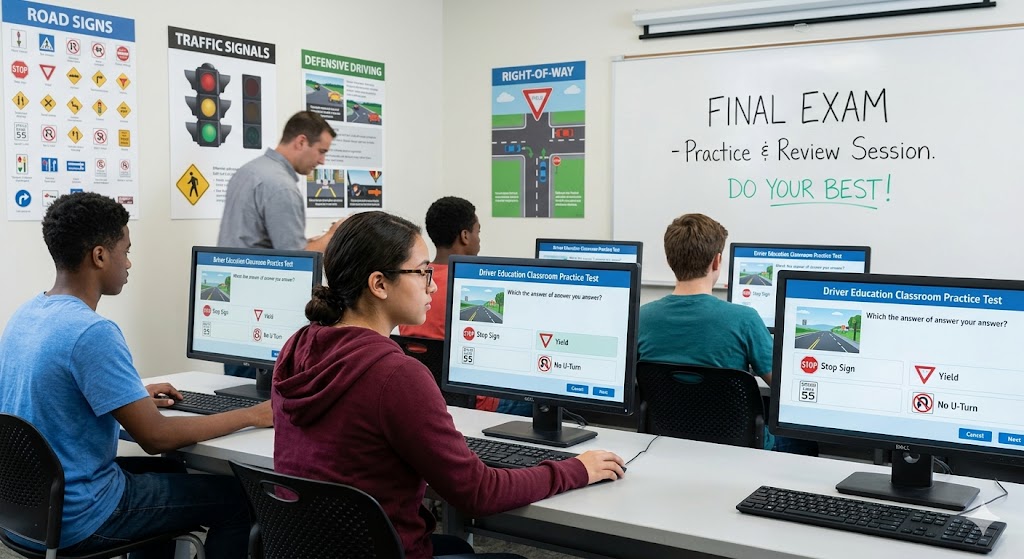
Additional Information
What the Course Entails and Exam Details
The classroom portion of Driver Education covers a vast curriculum focused on legal requirements and safety protocols. Students can expect to study the definitions of various road signs by color, shape, and symbol. The course delves deeply into the right-of-way rules for intersections, roundabouts, and pedestrian crossings. It covers specific speed limits for different zones, such as residential areas, highways, and school zones. Instructors spend significant time discussing the legal and physical consequences of Driving Under the Influence (DUI) and understanding Blood Alcohol Concentration (BAC) limits. Other essential topics include proper procedures for passing other vehicles, defensive driving strategies, hazardous weather adjustments, basic vehicle mechanics, and the administrative steps for vehicle registration and insurance.
What to Expect in the Final Exam
The final classroom exam typically mirrors the structure of a standardized academic test. It is primarily presented in a multiple-choice format, although true/false questions are also common. Depending on the state or province, the exam often contains between 30 and 50 questions, divided into sections specifically targeting road signs and sections targeting general traffic laws. To pass, students generally must achieve a score of at least 75% to 80%. There is usually a time limit, often around 45 to 60 minutes, which is ample for prepared students. This is a closed-book examination, meaning the use of the driver's manual, personal notes, or mobile devices is strictly prohibited during the test.
How to Study and Exam Centers
Effective study strategies are essential for success. The official state or provincial driver's manual is the primary and most important resource; reading this comprehensive guide thoroughly is non-negotiable. Students are highly encouraged to take multiple classroom practice tests, as repeating these simulations builds confidence and highlights areas needing more review. Creating flashcards to memorize the specific meanings of various regulatory and warning signs is also very effective. Finally, applying the knowledge in real-time by observing traffic scenarios as a passenger can reinforce classroom learning.
Where to take the exam depends on the type of course you completed. If you took Driver's Education as part of a high school curriculum or through a private, state-certified driving school, the classroom practice test is usually administered directly by the instructor in that specific classroom setting. However, if you are challenging the exam independently or after taking an authorized online course, you may be directed to a specific state Department of Motor Vehicles (DMV) office or equivalent agency (such as the BMV, MVD, or Secretary of State). Some online course providers are also authorized to proctor the exam via their secure portals.
Job Opportunities from the Course
While this specific classroom course is a step toward a standard driver's license (Class D/E), rather than a specialized professional certification, it serves as the essential prerequisite for many career paths that require vehicle operation.
Specific job titles and career paths this foundational step unlocks include:
Pizza/Food Delivery Driver
Local Courier/Messenger
Valet Parking Attendant
Mobile Service Technician (e.g., cable repair, appliance installation)
Rideshare Driver (e.g., Uber/Lyft - prerequisites vary)
Prerequisite for Commercial Driver's License (CDL) Training (Truck or Bus Driver)
Non-Emergency Medical Transport Driver
State or Municipal Government Fleet Vehicle Operator
Law Enforcement/First Responder (Almost universally requires a valid driver's license before hiring)
Frequently Asked Questions
Reviews
5.0
Based on 0 reviews
Leave a Review
No reviews yet. Be the first to review!