
Driver Operator / Fire Apparatus Operator (FAO) Practice Test
$69.00
- Buy to unlock unlimited access to all Quiz questions and Answers in this Quiz.
- After purchase you can print a PDF of the whole quiz at any point. The PDF will contain the questions and the correct answers.
About this Exam
The Driver Operator / Fire Apparatus Operator (FAO) certification is a crucial professional credential for firefighters ready to take on the responsibility of operating multi-ton emergency vehicles. This certification validates that a first responder has the specialized knowledge and practical skills required to safely drive, position, and operate complex fire apparatus, such as pumpers, aerial devices, and tillers. It is designed specifically for career and volunteer firefighters who are looking to promote within their department, transition into an engineer role, and master the technical aspects of emergency hydraulics and vehicle maintenance.
Ready to test your knowledge?
Buy Now to Access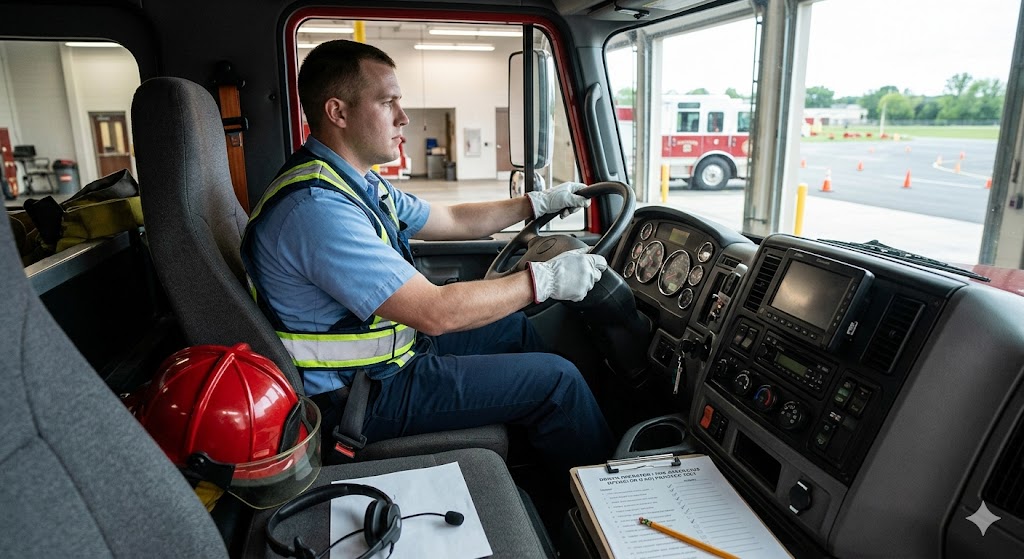
Additional Information
What the Course Entails and Exam Details
This course provides the technical foundation required to move a fire engine from the station to the scene and effectively support fire suppression operations. Candidates learn the mechanics of defensive emergency driving, intricate positioning strategies for various fire scenarios, and advanced preventative maintenance protocols. A significant portion of the course is dedicated to fire hydraulics, where students master the science of calculating friction loss, engine pressure, and nozzle flow rates.
NFPA Standards (primarily NFPA 1002).
Vehicle inspection and preventative maintenance.
Safe emergency vehicle driving operations.
Basic and advanced fire hydraulics calculations.
Static and pressurized water supply operations.
Pump theory and practical pump operations.
Aerial apparatus positioning and stabilization.
What to Expect in the Final Exam
The final FAO examination is typically a comprehensive process divided into two core components: a cognitive (written) test and a psychomotor (practical) skills evaluation. The written portion generally consists of 100 multiple-choice questions designed to assess a candidate's mastery of the theoretical material, including NFPA standards, hydraulics formulas, and maintenance procedures. Candidates usually have between 90 and 120 minutes to complete this section, and a passing score of 70% or higher is commonly required.
The practical evaluation is a hands-on test where candidates must demonstrate proficiency in real-world scenarios. This often includes a detailed "pretrip" vehicle inspection, navigating a driving obstacle course within a set time limit, and demonstrating flawless setup and operation of the fire pump from both a static (drafting) and pressurized (hydrant) source.
How to Study and Exam Centers
Preparation for the FAO exam requires a blended approach of rigorous book study and hands-on practice. We recommend building a foundation by deeply reviewing the primary textbook used in your jurisdiction, typically IFSTA’s Pumping and Aerial Apparatus Driver/Operator Handbook or J&B Learning’s Fire Apparatus Driver/Operator. Utilize practice tests to memorize hydraulics formulas and familiarize yourself with the phrasing of regulatory questions.
For the practical, maximize your "seat time" in the apparatus. Practice driving maneuvers, especially backing and tight turns, and rehearse the pump operator sequence until it becomes muscle memory.
Written exams are frequently scheduled through the office of your State Fire Marshal or an equivalent state training agency. These may be offered at physical state fire academies, specific regional training centers, or, in some jurisdictions, via secure proctored online portals or testing systems like Pearson VUE. Psychomotor skills evaluations are almost always conducted in person at an authorized fire department training facility or the state fire academy.
Job Opportunities from the Course
Earning the Driver Operator / FAO certification is a powerful career accelerator, unlocking several key promotion and specialization paths. Here are the specific job titles and career opportunities available to certified personnel:
Fire Apparatus Operator (FAO)
Fire Engineer
Fire Chauffeur
Driver/Operator, Pumper
Driver/Operator, Aerial
Tiller Operator
Mobile Water Supply (Tanker) Operator
Wildland Apparatus Operator
Frequently Asked Questions
Reviews
5.0
Based on 0 reviews
Leave a Review
No reviews yet. Be the first to review!