
Driver Operator Mobile Water Supply Practice Test
$69.00
- Buy to unlock unlimited access to all Quiz questions and Answers in this Quiz.
- After purchase you can print a PDF of the whole quiz at any point. The PDF will contain the questions and the correct answers.
About this Exam
The Driver Operator Mobile Water Supply certification is designed for fire service personnel who are responsible for operating fire apparatus equipped with a water tank and pump, specifically those units used to transport and dispense water in areas where a reticulated water supply is unavailable or insufficient. This critical role is the backbone of rural and semi-rural firefighting, ensuring that a continuous and reliable flow of water is available at the emergency scene. The certification validates that the operator possesses the knowledge and practical skills necessary to safely and effectively manage these large vehicles and their complex water delivery systems. This exam is ideal for firefighters looking to specialize, department engineers, and anyone aspiring to operate water tenders or tankers.
Ready to test your knowledge?
Buy Now to Access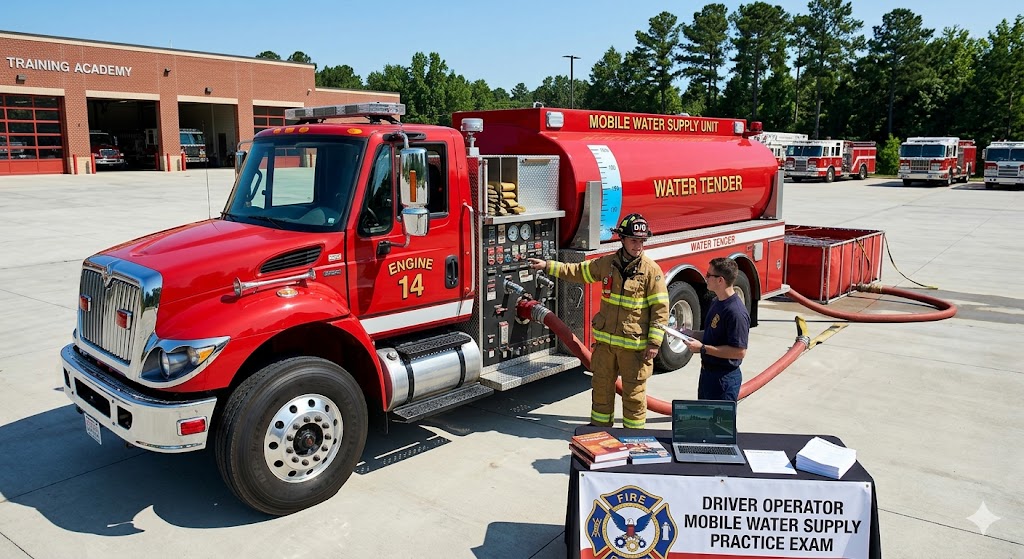
Additional Information
What the Course Entails and Exam Details
This comprehensive course and subsequent exam cover a wide range of essential topics, ensuring proficiency in all aspects of mobile water supply operations. The syllabus typically aligns with NFPA 1002, Standard for Fire Apparatus Driver/Operator Professional Qualifications. Key areas of focus include:
Apparatus Inspection and Maintenance: Understanding pre-trip and post-trip inspection procedures, identifying mechanical issues, and performing routine maintenance tasks to ensure the vehicle is mission-ready.
Safe Driving Operations: Master the physics and handling characteristics of large, high-center-of-gravity vehicles, defensive driving techniques, and navigating various road and traffic conditions safely.
Water Source Operations: Techniques for effectively filling the tender from various sources, including pressurized hydrants, static water sources (lakes, ponds), and other apparatus.
Water Tender Shuttle Tactics: Strategies for establishing and managing efficient water shuttle operations to provide a continuous water flow to the incident scene.
Pumping Operations: While some tenders rely on gravity dump, many are equipped with fire pumps. The course covers pump theory, hydraulic calculations, and the safe operation of the pump to deliver water through discharge lines.
Unloading and Transfer Methods: Proficiency in rapid unloading techniques, including gravity dumping, jet assisted dumping, and using the onboard pump to transfer water to other apparatus or portable tanks.
What to Expect in the Final Exam
The final certification exam typically consists of two distinct components: a written knowledge test and a practical skills evaluation.
Written Knowledge Test:
Format: Multiple-choice questions designed to assess your understanding of the theoretical concepts, regulations, and procedures covered in the course.
Time Limit: Generally ranges from 1 to 2 hours.
Passing Score: Typically requires a minimum score of 70% or higher.
Content: Questions will cover all areas of the syllabus, including hydraulics, vehicle safety, maintenance, and water supply tactics.
Practical Skills Evaluation:
Format: Hands-on demonstration of key skills under the observation of certified evaluators.
Skills Tested: These often include driving exercises (cone course, backing, etc.), apparatus inspection, setting up for a water shuttle, drafting from a static source, and pumping operations (if applicable).
Scoring: Evaluated on a pass/fail basis for each specific skill station. You must pass all required skills to achieve certification.
How to Study and Exam Centers
Effective preparation is key to success on both the written and practical exams. Consider the following strategies:
Utilize Official Textbooks: Study the primary textbooks recommended by your certifying agency (e.g., IFSTA, Jones & Bartlett).
Take Practice Exams: Engage with sample questions and simulated exams, such as the one described by this title, to familiarize yourself with the question format and identify areas for improvement.
Form Study Groups: Collaborating with peers allows for discussion, clarification of complex topics, and mutual support.
Hands-on Practice: Spend significant time operating the apparatus under the guidance of experienced instructors. Practice every skill required for the practical evaluation repeatedly.
Understand Hydraulics: Master basic hydraulic principles and formulas, as this is a common area of challenge for many candidates.
Exam Centers and Testing Locations:
The delivery method and location for the exam can vary significantly by state and certifying body. Common options include:
State Fire Training Academies: Many states have centralized facilities where both written and practical exams are administered.
Local Fire Departments: Large departments with authorized training divisions may host exams for their members and regional partners.
Online Testing Portals: Some theoretical portions of the exam may be offered via secure online platforms, although practical evaluations always require in-person attendance.
Community Colleges: Institutions with fire science programs often serve as authorized testing sites.
Third-Party Testing Services: In some regions, specialized testing organizations may be contracted to administer the exams.
Check with your local or state fire training agency for specific details on how to register and where to take the Driver Operator Mobile Water Supply exam.
Job Opportunities from the Course
Obtaining this certification opens several career paths and specialty roles within the fire service.
Fire Department Driver/Operator
Water Tender/Tanker Operator
Apparatus Engineer
Rural Firefighter
Special Operations Firefighter (Water Supply/Logistics)
Fire Service Instructor (Water Supply Operations)
Private Sector Fire Brigade Member
Frequently Asked Questions
Reviews
5.0
Based on 0 reviews
Leave a Review
No reviews yet. Be the first to review!