
Drug Recognition Expert Practice Exam
$69.00
- Buy to unlock unlimited access to all Quiz questions and Answers in this Quiz.
- After purchase you can print a PDF of the whole quiz at any point. The PDF will contain the questions and the correct answers.
About this Exam
The Drug Recognition Expert (DRE) certification is a highly specialized program designed for law enforcement officers. This intensive training empowers officers to identify impairment in drivers that may be caused by drugs other than, or in addition to, alcohol. It is a critical certification for traffic safety, allowing officers to determine the specific category of drug that is causing impairment, which is essential for successful prosecution. If you are a dedicated law enforcement professional looking to enhance your impaired driving enforcement skills and contribute to safer roads, this certification is for you. Mastering this material is vital, and a high-quality Drug Recognition Expert Practice Exam is an indispensable tool in your preparation.
Ready to test your knowledge?
Buy Now to Access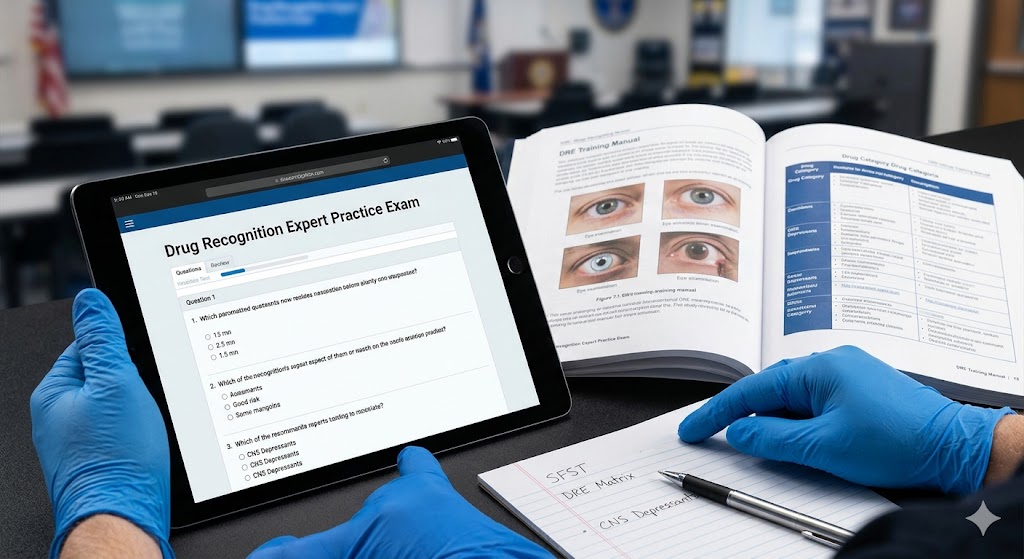
Additional Information
What the Course Entails and Exam Details
This comprehensive training involves a multi-phase program that combines extensive classroom instruction with critical field evaluations and a final certification phase. The core syllabus covers several critical areas essential for a DRE, which you will need to master for any comprehensive practice exam and the final evaluation. Key components of the curriculum include:
Physiology of Drugs: Understanding how the human body processes various substances and the resultant physiological effects.
Drug Classification: Deep knowledge of the seven drug categories: CNS Depressants, CNS Stimulants, Hallucinogens, Dissociative Anesthetics, Narcotic Analgesics, Inhalants, and Cannabis.
The 12-Step DRE Evaluation Process: Mastering the systematic, standardized examination protocol for assessing an impaired individual.
Eye Examinations: Learning to perform and interpret horizontal gaze nystagmus (HGN), vertical gaze nystagmus (VGN), and lack of convergence.
Physical Signs and Symptomology: Recognizing the specific, observable signs associated with each drug category, such as pupil size, pulse rate, muscle rigidity, and injection sites.
Toxicology: Understanding the basics of biological sample collection and laboratory analysis as it relates to the DRE evaluation.
Case Law and Report Writing: Mastering the legal and procedural requirements for documenting and testifying to DRE findings.
What to Expect in the Final Exam
The culmination of the DRE training is a rigorous final evaluation process. While a "practice exam" helps prepare for this, the actual final certification involves multiple components. The knowledge-based assessment typically features a detailed written examination, which may be multiple-choice and requires a high passing score, often around 80% or more, to demonstrate strong proficiency in the classification and effects of drugs.
However, the final certification is primarily about practical application. You will be expected to conduct numerous full DRE evaluations in the field, including actual impaired subjects. An evaluator will observe your ability to accurately follow the 12-step process, correctly identify signs of impairment, and reach the proper toxicological conclusion. Your written reports for these evaluations will also be critically reviewed. Certification is not just about passing a test; it's about consistently and accurately applying the protocol in a high-stakes, real-world setting.
How to Study and Exam Centers
Preparation for the DRE certification requires dedication and a structured study approach. Utilize high-quality practice exams, like the Drug Recognition Expert Practice Exam, to test your knowledge and identify weaknesses. Use flashcards to memorize the drug categories, their key indicators, and the 12-step process. Participate in mock evaluations with colleagues to practice the physical examinations and the systematic protocol. Understanding the underlying physiology is key to accurate assessment, so focus on the 'why' behind the symptoms.
DRE training and final certification are typically administered through authorized police academies or specialized training facilities. The program is often coordinated by a state's Highway Safety Office or a similar traffic safety agency. While you can find study materials and practice exams online for self-study, the official certification requires completion of authorized training courses. Contact your department or state’s traffic safety coordinator to find information on the official DRE training schedule and locations for your jurisdiction.
Job Opportunities from the Course
Earning your DRE certification can significantly enhance your law enforcement career and open specialized opportunities. This designation showcases advanced skills that are highly valued in traffic safety and impaired driving enforcement. Some common career paths and roles that benefit from DRE certification include:
Drug Recognition Expert (as a specialized duty)
Traffic Safety Officer/Coordinator
DUI/DRE Task Force Member
Impaired Driving Enforcement Specialist
Traffic Accident Investigator
DRE Instructor or Training Officer
Forensic Toxicology or Crime Lab Liaison
Expert Witness in Traffic Safety/DUI cases
Specialized Patrol Officer (Focusing on impaired driving)
Frequently Asked Questions
Reviews
5.0
Based on 0 reviews
Leave a Review
No reviews yet. Be the first to review!