
Drugs Affecting Blood Pressure Practice Test
$69.00
- Buy to unlock unlimited access to all Quiz questions and Answers in this Quiz.
- After purchase you can print a PDF of the whole quiz at any point. The PDF will contain the questions and the correct answers.
About this Exam
The Drugs Affecting Blood Pressure Practice Test is a critical self-assessment tool designed for students and professionals preparing for healthcare pharmacology examinations or licensure.
This comprehensive resource evaluates your understanding of the diverse classes of medications used to manage hypertension and other conditions impacting blood pressure.
It is specifically tailored for nursing students (RN, LPN/LVN), pharmacy technician trainees, medical assistants, and anyone requiring a strong grasp of cardiovascular pharmacology in a clinical setting.
Ready to test your knowledge?
Buy Now to Access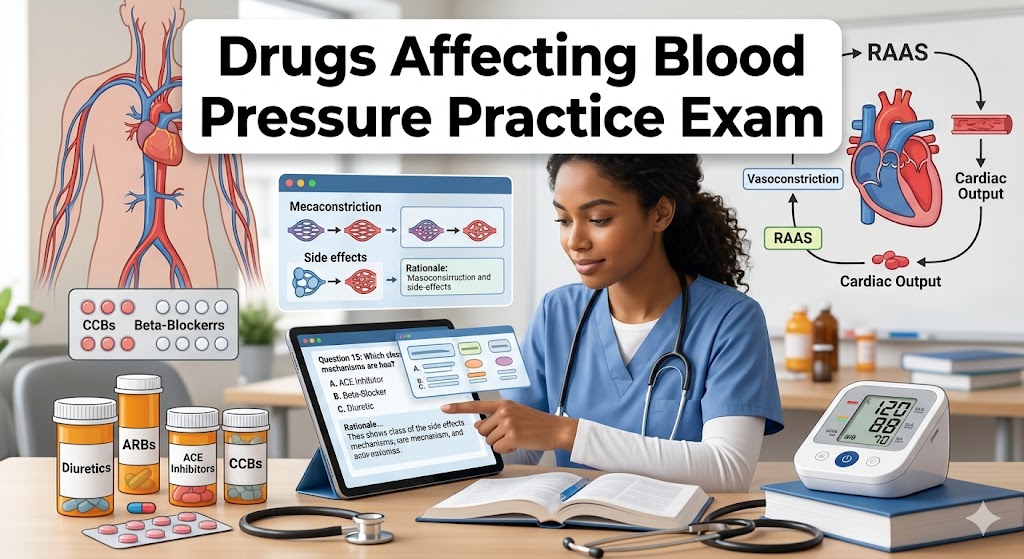
Additional Information
What the Course Entails and Exam Details
This practice test dives deep into the complex world of antihypertensive agents.
You can expect questions that test your knowledge across the following key areas:
Key Drug Classes: Comprehensive coverage of major categories including Diuretics (Thiazide, Loop, Potassium-Sparing), Angiotensin-Converting Enzyme (ACE) Inhibitors, Angiotensin II Receptor Blockers (ARBs), Calcium Channel Blockers (CCBs), Beta-Blockers, Alpha-Blockers, Central Alpha-2 Agonists, Direct Vasodilators, and Renin Inhibitors.
Mechanisms of Action: Understanding how each drug class works to lower blood pressure, whether by reducing fluid volume, relaxing blood vessels, decreasing heart rate, or impacting hormonal systems.
Specific Drug Examples: Recognition of common generic and potential brand names within each class (e.g., Lisinopril, Losartan, Metoprolol, Amlodipine, Furosemide).
Therapeutic Indications: Knowing when a particular class of drug is the preferred first-line therapy or used in specific compelling indications (like heart failure, diabetes, or chronic kidney disease).
Major Side Effects and Adverse Reactions: Identification of critical side effects to monitor, from common issues like dizziness and cough to severe reactions like angioedema or electrolyte imbalances.
Essential Nursing Considerations & Patient Education: Practical clinical knowledge, including crucial assessments before and during therapy (e.g., blood pressure, heart rate, lab monitoring), and vital points for patient teaching (e.g., proper administration, lifestyle modifications, managing side effects, when to seek medical attention).
What to Expect in the Final Exam
While the exact format of your specific final comprehensive pharmacology or licensure exam (such as the NCLEX for nurses) may vary, it is crucial to prepare for a multi-faceted evaluation:
Format: Most major healthcare exams are computer-based and primarily consist of multiple-choice questions. However, be prepared for alternative item types, including multiple-response (select all that apply), drag-and-drop, ordered response, and fill-in-the-blank (calculation questions).
Time Limit: Expect a timed assessment, often with a generous window (e.g., several hours for a full licensure exam, or 1-2 hours for a course-specific pharmacology section) but requiring focused pacing.
Passing Score: Requirements differ vastly by institution and licensure body. Research the specific minimum score needed for success in your program or jurisdiction.
Practice for Reality: The Drugs Affecting Blood Pressure Practice Test is an excellent simulation of the types of questions and cognitive levels (recall, application, analysis) you will encounter, although it is for self-assessment and not a official graded final exam itself. Utilizing resources like this one allows you to build confidence, identify knowledge gaps, and refine your test-taking strategies.
How to Study and Exam Centers
Effective preparation for this critical pharmacology topic demands a multi-pronged approach:
Active Recall & Spaced Repetition: Don't just read your textbook. Use flashcards (digital or physical) to master drug classifications, generic names, mechanisms, side effects, and key nursing points. Employ spaced repetition software or schedules to ensure consistent review.
Practice Questions – Like This One!: Regularly engaging with practice tests, especially comprehensive ones like the Drugs Affecting Blood Pressure Practice Test, is invaluable. Review not only your correct answers but also the detailed rationales for all choices (even the incorrect ones) to solidify understanding and prevent reoccurring mistakes.
Understand, Don't Memorize: Strive to understand the underlying pathophysiology of hypertension and how each drug mechanism directly interacts with that process. Connect the side effects logically to the drug's action.
Study Groups & Teaching: Collaborate with classmates. Explain concepts to each other, quiz each other, and discuss clinical scenarios. Teaching a topic is one of the most effective ways to master it yourself.
Create Visual Aids: Draw diagrams of the heart, circulatory system, and the renin-angiotensin-aldosterone system (RAAS), annotating where different drugs act.
Where to Take the Exam:
This Practice Test: Access the Drugs Affecting Blood Pressure Practice Test through authorized online educational platforms, specific course portals provided by your school, or dedicated test preparation websites. It can usually be taken anywhere with internet access, allowing for flexible study sessions.
Final Comprehensive/Licensure Exams: Your official final examinations or professional licensure assessments are typically administered in controlled, physical testing centers. Common authorized providers include specialized testing centers (e.g., Pearson VUE, Prometric), authorized schools, or designated secure areas within educational institutions. Register through your academic program or licensing board, who will provide precise information on location, scheduling, and required identification.
Job Opportunities from the Course
A strong understanding of cardiovascular drugs, particularly those affecting blood pressure, is fundamental to numerous essential healthcare roles. Mastering this content unlocks diverse career paths:
Registered Nurse (RN)
Licensed Practical/Vocational Nurse (LPN/LVN)
Nurse Practitioner (NP)
Pharmacist (Requires Doctor of Pharmacy degree and separate comprehensive exams)
Pharmacy Technician
Medical Assistant
Cardiovascular Technologist
Clinical Research Coordinator (especially in cardiovascular trials)
Pharmaceutical Sales Representative (typically requires additional business/sales training and often a degree)
Health Educator (focused on heart health and hypertension management)## Drugs Affecting Blood Pressure Practice Exam Study Guide
Frequently Asked Questions
Reviews
5.0
Based on 0 reviews
Leave a Review
No reviews yet. Be the first to review!