
Dry Needling Practice Exam
$69.00
- Buy to unlock unlimited access to all Quiz questions and Answers in this Quiz.
- After purchase you can print a PDF of the whole quiz at any point. The PDF will contain the questions and the correct answers.
About this Exam
The Dry Needling Practice Exam is a comprehensive preparatory tool designed for licensed healthcare professionals, such as Physical Therapists, Chiropractors, Athletic Trainers, and Occupational Therapists, who are seeking specialized certification in dry needling. Dry needling is a skilled intervention that uses thin, filiform needles to penetrate the skin and stimulate underlying myofascial trigger points, muscular, and connective tissues for the management of neuromusculoskeletal pain and movement impairments.
This practice exam mimics the rigor and scope of final certification tests, offering a safe environment for clinicians to assess their readiness. It is crafted for those who have completed required foundational coursework and seek to validate their understanding of the theoretical principles, critical safety protocols, advanced surface anatomy, and practical application skills necessary to integrate dry needling into their clinical practice seamlessly and safely.
Ready to test your knowledge?
Buy Now to Access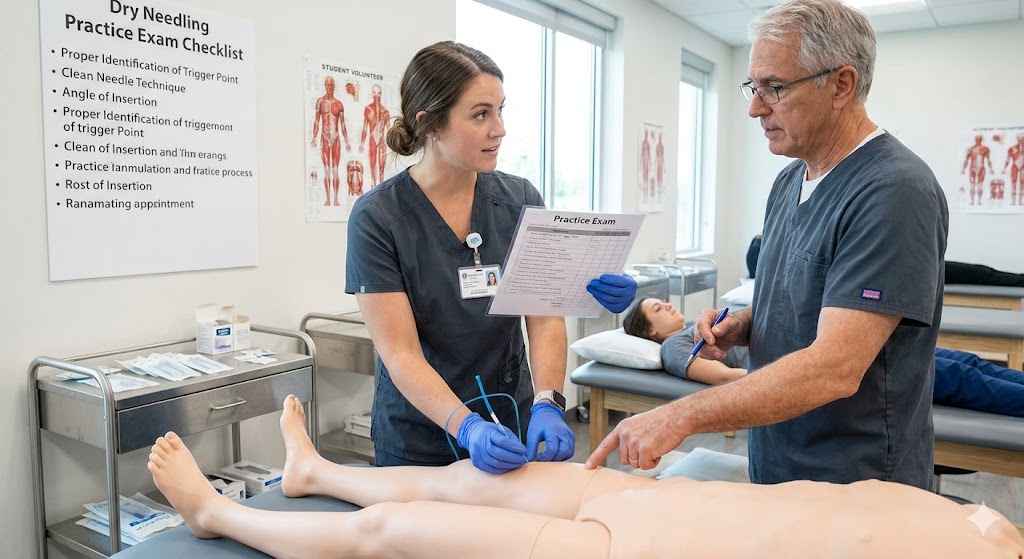
Additional Information
What the Course Entails and Exam Details
A standard dry needling certification curriculum, which this practice exam mirrors, bridges theoretical knowledge with intensive hands-on lab experience. The final assessment is typically a two-part exam encompassing both a written and a practical component, occurring at the conclusion of comprehensive training (often divided into levels like Upper Quadrant, Lower Quadrant, and Advanced).
The core topics and skills covered include:
Theoretical Foundations: Understanding the pathophysiology of myofascial trigger points, motor point therapy, the physiological effects of dry needling, and evidence-based practice guidelines.
Safety and Hygiene: Rigid adherence to OSHA compliance, clean needle technique, blood-borne pathogen safety, and emergency procedure protocols.
Surface Anatomy and Palpation: Mastery of musculoskeletal anatomy to ensure accurate location of relevant regional anatomy, vital structures to avoid, and precise identification of trigger points.
Indications and Contraindications: Clearly defining absolute and relative contraindications, as well as recognizing appropriate clinical indications for different body regions.
Needling Techniques: Proficiency in various superficial and deep needling methods, including pistoning and electrical stimulation with needling, across all quadrants of the body.
Clinical Reasoning and Case Management: Applying differential diagnosis and critical thinking to integrate dry needling into a holistic patient treatment plan.
What to Expect in the Final Exam
The actual dry needling certification exam is a two-pronged evaluation to ensure both knowledge and psychomotor competence. You must typically pass both components to earn certification. While specifics vary by certifying body (e.g., NAIOMT, DGS Academy, Evidence In Motion), you can generally expect:
The Written Exam
Format: This section is usually comprised of multiple-choice questions, ranging from 50 to 100 queries. It may include case studies requiring clinical reasoning.
Coverage: It assesses theoretical knowledge, anatomical relationships, safety standards, contraindications, and physiological principles.
Time Limit: Expect a strict time limit, often between 60 to 120 minutes.
Passing Score: A passing score of 70% to 80% is common.
The Practical (Lab) Exam
Format: This is a competency-based, hands-on demonstration of skill. You will be assigned specific muscles or regions and must perform dry needling on a live volunteer (often a classmate) while being observed by an examiner.
Coverage: You must demonstrate impeccable hygiene, proper patient positioning, accurate palpation, selection of the correct needle length, safe insertion and angulation, effective treatment technique, needle removal, and post-treatment handling.
Criteria: This is often graded on a pass/fail basis or a detailed rubric assessing safe and efficient technique. Any safety violation usually results in an automatic failure.
How to Study and Exam Centers
Preparation for the dry needling final exam requires a blend of intense study and extensive physical practice.
Actionable Study Strategies
Master Surface Anatomy: The practical exam is won or lost on anatomy. Spend hours palpating different muscle groups on multiple people. Visualize the deep structures, nerves, and arteries under your hands. Use anatomical models and dissection apps.
Review the 'Why' (Theory): Create flashcards for contraindications, physiological mechanisms, and clean needle techniques. Do not just memorize names; understand the rationale behind every rule.
Engage in Hands-on Practice: You cannot study for the practical exam from a book. Arrange practice sessions with colleagues to drill needling techniques for every muscle covered. Practice clean needle technique until it is second nature.
Take Practice Quizzes: Utilize practice exams to get used to the wording of theoretical questions and to identify your weak areas.
Watch Video Demonstrations: Review demonstration videos provided during your coursework, focusing on the instructors' hand placement, body mechanics, and needle control.
Exam Centers and Access
Since dry needling certification is granted by private educational institutions and not a single national board, the final exam is typically administered at the physical location of the authorized training center or school where you completed your coursework. These centers may be specialized physical therapy clinics, university labs, or dedicated continuing education facilities.
While theory-only practice exams might be accessible through your training provider’s online learning portal, the required final certification exam must be taken in person to validate your safe clinical application skills. Contact your specific course provider for exact dates, locations, and registration procedures.
Job Opportunities from the Course
A certification in dry needling is not a standalone license but rather an advanced skill qualification that significantly enhances the employability and earning potential of existing licensed healthcare practitioners. It unlocks specialized career paths within clinical and athletic settings.
Completion of this training empowers professionals to fill roles such as:
Licensed Physical Therapist (with specialized Dry Needling qualification)
Certified Athletic Trainer
Chiropractor
Occupational Therapist
Specialized Pain Management Practitioner
Sports Medicine Clinician
Orthopedic Manual Therapist
Rehabilitation Clinic Director
Frequently Asked Questions
Reviews
5.0
Based on 0 reviews
Leave a Review
No reviews yet. Be the first to review!