
DSM-5 for ASWB Practice Exam
$69.00
- Buy to unlock unlimited access to all Quiz questions and Answers in this Quiz.
- After purchase you can print a PDF of the whole quiz at any point. The PDF will contain the questions and the correct answers.
About this Exam
The Diagnostic and Statistical Manual of Mental Disorders, Fifth Edition (DSM-5), is the critical reference guide for mental health professionals across the United States and Canada. For social workers preparing for their essential licensure examinations administered by the Association of Social Work Boards (ASWB), a thorough understanding of the DSM-5 is paramount. This specialized "DSM-5 for ASWB Practice Exam" serves as an invaluable preparatory resource, specifically designed for individuals pursuing various levels of social work licensure, including Master's (LMSW), Clinical (LCSW), and, depending on specific jurisdiction requirements, potentially relevant sections of the Bachelor’s level exam. This practice tool is meticulously crafted to simulate the diagnostic reasoning and knowledge application required for success in the real exam, empowering candidates with the confidence, accuracy, and detailed familiarity with DSM-5 criteria essential to both achieving licensure and providing high-quality client care.
Ready to test your knowledge?
Buy Now to Access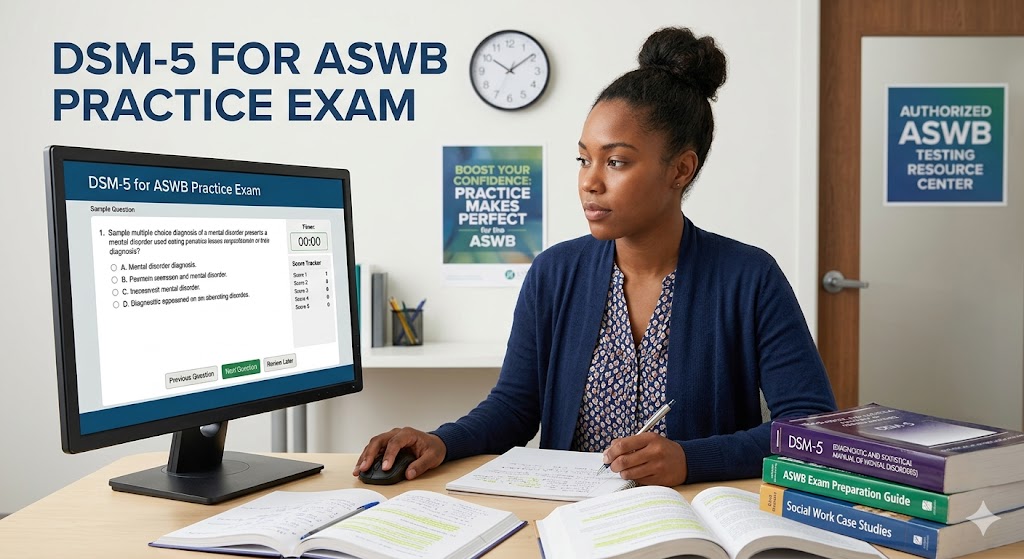
Additional Information
What the Course Entails and Exam Details
While not a standalone credential in itself, "DSM-5 for ASWB Practice" represents the focused study and test simulation critical to mastering the DSM-5 component of the actual ASWB licensure process. This comprehensive practice tool covers the entire range of mental health disorders detailed in the DSM-5, including neurodevelopmental, schizophrenia spectrum, bipolar, depressive, anxiety, obsessive-compulsive, trauma- and stressor-related, dissociative, personality disorders, and many others. It assesses proficiency in recognizing key symptoms, determining appropriate diagnostic criteria (including specifiers and differential diagnoses), and understanding the structural changes and dimensional approach introduced in the fifth edition. The actual mock exams or practice modules typically consist of multiple-choice questions, which vary in number depending on the specific preparatory resource, ranging anywhere from a substantial section within a full ASWB practice test to dedicated boosters focusing solely on dozens to hundreds of DSM-5 questions. The content is explicitly aligned with the domains of assessment, diagnosis, and treatment planning that feature heavily in the official ASWB exam, particularly for Clinical and Master's levels.
What to Expect in the Final Exam
It is crucial to understand that the "DSM-5 for ASWB Practice Exam" itself is a study aid and is not the official licensure examination. The final exam candidates must pass is the actual ASWB exam relevant to their licensure level (e.g., Master’s or Clinical). These formal examinations are conducted under highly standardized conditions. Candidates can typically expect a four-hour timeframe to complete approximately 170 multiple-choice questions (the vast majority are scored, with some unscored questions used for pretesting future exam items). The percentage of questions related to diagnosis and the DSM-5 is substantial, particularly on the Clinical and Master's exams, covering both direct knowledge of criteria and, significantly, the application of that knowledge to complex client scenarios and differential diagnoses. While specific raw passing scores vary by jurisdiction and are determined using statistical weighting and equating methods (typically equating to roughly 93 to 106 correct answers for the scaled score), candidates should strive for high proficiency in the entire curriculum. Rules in the actual testing centers are strict, prohibiting any external materials and requiring clear identification.
How to Study and Exam Centers
Preparation for the DSM-5 on the ASWB exam requires structured and comprehensive methods. Effective study strategies include creating flashcards for major disorder criteria, specifiers, and key distinctions; engaging in thorough review sessions with study groups or partners, especially applying case vignettes and differential diagnosis reasoning; and, fundamentally, utilizing robust practice tests like this one. Regularly taking practice exams not only builds confidence and stamina for the testing environment but also helps identify weak areas for further targeted study. Candidates should focus on the underlying structure of the manual and the practical application of criteria rather than just rote memorization. The official ASWB licensure exams are administered year-round at authorized Pearson VUE testing centers located throughout the United States, Canada, and various international locations. There are generally no specific accredited schools required solely for test-taking; instead, the entire process—including obtaining authorization from the local jurisdiction social work board, registering with the ASWB, and scheduling the exam at a physical testing center—is standard practice for licensure candidates.
Job Opportunities from the Course
Passing the ASWB examination, with a strong performance supported by comprehensive DSM-5 proficiency, unlocks significant career paths and diverse job opportunities. Successful licensure generally qualifies individuals for a wide range of roles. Here is a list of job opportunities that are directly accessible or significantly enhanced after obtaining ASWB licensure:
Licensed Clinical Social Worker (LCSW)
Licensed Master Social Worker (LMSW)
Licensed Social Worker (LSW) (level names and specific job descriptions vary by region)
Mental Health Therapist
Clinical Social Worker
Diagnostician/Clinical Assessor (often in clinical settings)
Case Manager (with advanced diagnostic and intervention roles)
Psychiatric Social Worker
Addictions Counselor (requiring thorough dual diagnosis understanding)
Family & Child Social Worker (often involving assessment and support)
Private Practice Psychotherapist (upon attaining independent, clinical licensure)
Healthcare/Hospital Social Worker (assisting with discharge planning and mental health supports)
Veterans Affairs Social Worker (diagnosing and treating veterans' unique mental health needs)
Community-Based Social Service Provider
Policy Analyst or Program Director within mental health and social service organizations
These career opportunities span diverse settings including hospitals, outpatient clinics, private practice, community health centers, government agencies, correctional facilities, and non-profit organizations, illustrating the widespread demand and varied impact of social work professionals with specialized diagnostic and licensure credentials.
Frequently Asked Questions
Reviews
5.0
Based on 0 reviews
Leave a Review
No reviews yet. Be the first to review!