
DSST Computing and Information Technology Practice Exam
$69.00
- Buy to unlock unlimited access to all Quiz questions and Answers in this Quiz.
- After purchase you can print a PDF of the whole quiz at any point. The PDF will contain the questions and the correct answers.
About this Exam
Are you ready to turn your existing tech knowledge into real college credit? The DSST (DANTES Subject Standardized Tests) program offers a powerful opportunity to fast-track your degree, and the Computing and Information Technology exam is your gateway. This examination validates foundational understanding often acquired through entry-level coursework or hands-on experience in IT environments. It is specifically designed for military personnel, adult learners, and traditional college students looking to save thousands of dollars in tuition and months of classroom time by demonstrating proficiency in critical technical concepts. By passing this comprehensive assessment, you prove your competence in the theoretical and practical applications that drive the modern digital world.
Ready to test your knowledge?
Buy Now to Access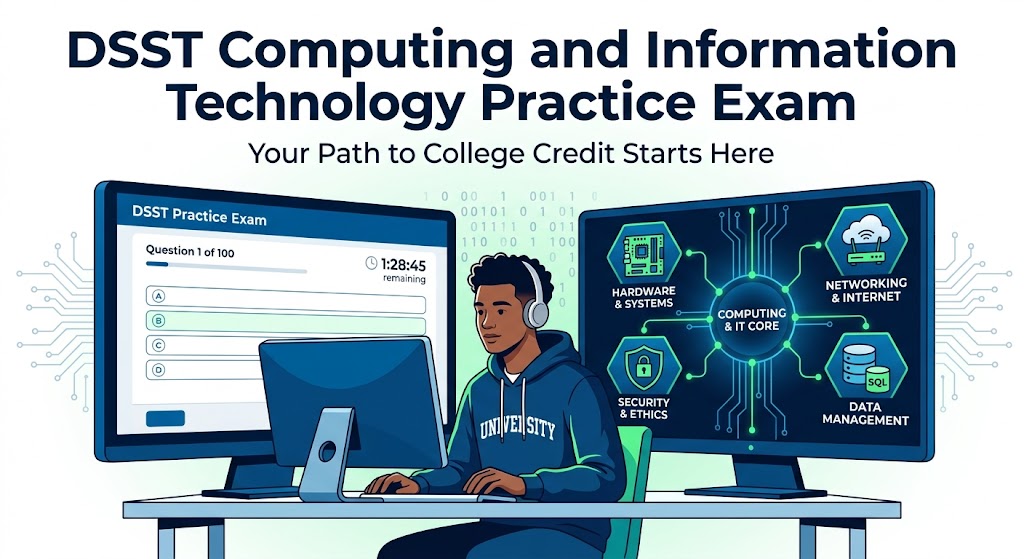
Additional Information
What the Course Entails and Exam Details
To master this material and succeed on the DSST exam, you must demonstrate a broad command of information technology principles. The curriculum coverage is extensive, designed to reflect an introductory-level college computing course. This practice guide mimics the comprehensive structure of the official exam, ensuring you are prepared for every content domain.
Candidates preparing for the final exam must master these six core knowledge areas, which represent the approximate weighting of the actual test:
1. Hardware and Systems (20%): This section covers the physical components of a computer, including input/output devices, memory types (RAM, ROM), processing units, and the concepts of computer architecture and system performance optimization.
2. Software and Operating Systems (20%): Here, you will study the critical functions of operating systems (Windows, macOS, Linux), software types (application vs. system software), utilities, and concepts like multitasking and resource management.
3. Networks and the Internet (19%): This domain includes fundamental networking concepts (LANs, WANs, VPNs), protocols (TCP/IP, HTTP), network hardware (routers, switches), and the history and architecture of the internet and web.
4. Security and Legal/Ethical Issues (15%): A vital section focusing on data security, threats (malware, phishing), protective measures (firewalls, encryption), privacy rights, copyright, and ethical responsibilities of IT professionals.
5. Programming and Data Management (14%): This area tests your understanding of the software development lifecycle, basic programming constructs (algorithms, flowcharts), and fundamental database concepts, including structures and SQL basics.
6. Information Systems and Technology in Society (12%): This final section focuses on the practical application of IT, exploring concepts like cloud computing, artificial intelligence, system development methodologies, and the impact of technology on productivity and society.
What to Expect in the Final Exam
When you arrive for your scheduled official DSST exam, you will not be facing a traditional pencil-and-paper test. The actual official exam is a computerized, high-stakes assessment administered under strict testing protocols.
Here is what you need to expect:
Format: The exam consists entirely of multiple-choice questions. Depending on the current version administered, there are typically around 100 questions.
Time Limit: You will be given exactly 90 minutes (1.5 hours) to complete the exam. Time management is critical; you have less than one minute per question on average.
Scoring: To earn college credit, you must achieve the minimum passing score required by your institution. For DSST exams, standard scores are reported on a scale of 200 to 500. A score of 400 is generally considered passing, equivalent to a "C" grade in a corresponding college course.
Difficulty: While the exam is "introductory," the broad scope requires a solid understanding of both terminology and application.
How to Study and Exam Centers
Preparation is the only reliable path to success for this comprehensive test. Effective study strategies include:
Use Practice Exams: Start your preparation by taking this DSST Computing and Information Technology Practice Exam. Use it as a diagnostic tool. Your results will instantly highlight which of the six major content domains require the most focused study.
Utilize Study Guides: Invest in or access specific DSST study guides. The official DANTES program often provides fact sheets and content outlines. Combine these with reputable textbook materials covering introductory Management Information Systems (MIS) or Computer Science content.
Focus on Terminology: This exam is vocabulary-heavy. Create flashcards for every key term, protocol, and concept (e.g., SDLC, SaaS, TCP/IP, SQL) until you can define and apply them instantly.
When you are confident in your practice results, you must take the official exam at a physical, authorized location. DSST exams are administered through a vast network of testing centers, primarily hosted at colleges, universities, and military bases globally.
You must register and pay the testing fee through the Prometric online portal (the official administrator of DSST), where you can also select your specific testing center, date, and time. Ensure you check your target college’s credit-acceptance policy before scheduling.
Job Opportunities from the Course
Earning credit for the DSST Computing and Information Technology exam proves more than academic knowledge—it signals foundational tech literacy valuable to any modern organization. This academic achievement, combined with appropriate follow-up certifications or a relevant degree, unlocks a wide range of job opportunities and career paths. Here are the specific entry points and future trajectories validated by this baseline competence:
Direct Entry Roles
Help Desk Technician
Technical Support Specialist (Tier 1)
IT Support Assistant
Junior Systems Administrator
Junior Network Technician
Data Entry and Verification Specialist
Pathways and Progression
Network Administrator
Database Administrator
Information Security Analyst
IT Project Coordinator
Web Developer
Business Systems Analyst
Cloud Support Specialist
Frequently Asked Questions
Reviews
5.0
Based on 0 reviews
Leave a Review
No reviews yet. Be the first to review!