
DSST Lifespan Developmental Psychology Practice Exam
$69.00
- Buy to unlock unlimited access to all Quiz questions and Answers in this Quiz.
- After purchase you can print a PDF of the whole quiz at any point. The PDF will contain the questions and the correct answers.
About this Exam
The DSST Lifespan Developmental Psychology exam is a rigorously structured competency test designed to measure a student's understanding of human growth from conception through death.
This assessment validates knowledge that is equivalent to what is taught in a lower-level undergraduate course in the same subject matter.
It is primarily designed for adult learners, military personnel, and traditional college students who are looking to accelerate their degree path by earning college credit for existing knowledge.
By successfully passing this examination, candidates demonstrate their understanding of major theories, principles, and concepts related to cognitive, physical, and emotional development throughout the life cycle.
This approach provides a flexible and cost-effective alternative to traditional classroom education.
Ready to test your knowledge?
Buy Now to Access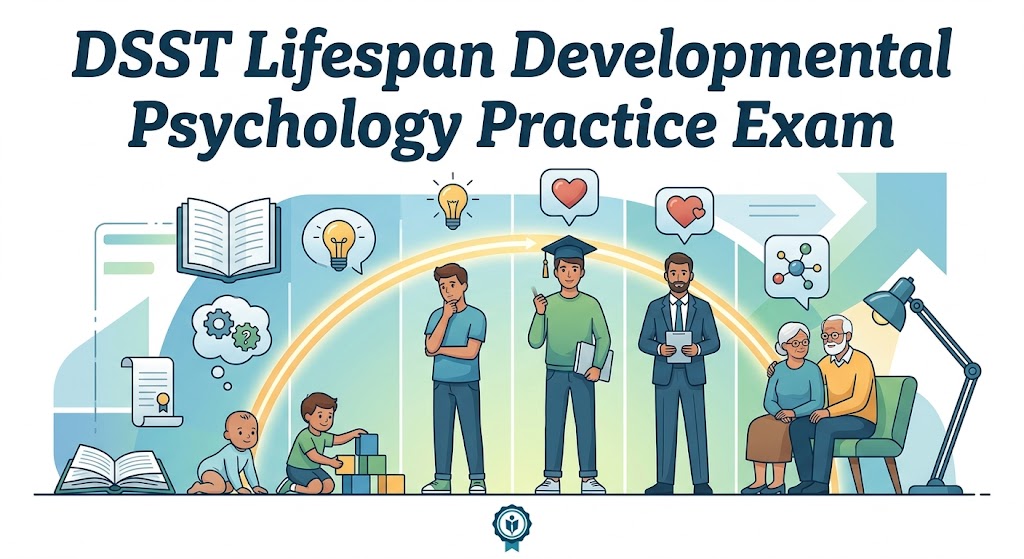
Additional Information
What the Course Entails and Exam Details
Preparing for this examination involves a comprehensive review of the psychological changes that occur at various stages of human life.
The course content covers foundational theories in developmental psychology, research methods, and the complex interactions between genetics and the environment (nature vs. nurture).
The syllabus for study typically spans key life phases, including:
Prenatal Development and Birth: Examining genetic influences, stages of pregnancy, and the process of birth.
Infancy and Toddlerhood: Focus on physical growth, motor skill development, attachment theories, and early language acquisition.
Early and Middle Childhood: Covering cognitive leaps (e.g., Piaget's stages), social development, and the impact of schooling.
Adolescence: Analyzing the transition from childhood to adulthood, identity formation, and the effects of puberty.
Early, Middle, and Late Adulthood: Investigating career choices, relationship formation, cognitive changes, the physical signs of aging, and social life in retirement.
Death and Dying: Examining the emotional, social, and psychological processes surrounding the end of life.
What to Expect in the Final Exam
The DSST Lifespan Developmental Psychology Exam is administered in a computer-based format.
Candidates can expect approximately 100 multiple-choice questions that must be completed within a specified time limit, usually around 90 minutes.
The scoring for the DSST is scaled.
While different institutions may have varying requirements, the American Council on Education (ACE) generally recommends a credit-granting score of 400.
Students should be prepared to answer conceptual questions, apply theories to real-world scenarios, and identify significant findings from classic developmental psychology studies.
There is no official penalty for guessing, so students should attempt to answer all questions.
How to Study and Exam Centers
Effective preparation for this exam requires a structured study plan rather than passive reading.
Candidates should utilize high-quality practice exams early in their review to identify knowledge gaps.
Creating detailed flashcards for key psychologists (such as Freud, Erikson, Piaget, and Vygotsky) and their theories is essential for quick recall.
Textbooks recommended by Prometric (the administrator of DSST) are invaluable resources, and online study communities can provide peer support and additional study materials.
The examination itself is taken at authorized testing centers.
Hundreds of colleges and universities across the country act as DSST test centers.
Additionally, military bases often provide testing facilities for service members.
When you are ready to schedule your test, use the official DSST website to find a testing location near you and inquire about their specific appointment procedures and any applicable administration fees.
Job Opportunities from the Course
While passing the DSST Lifespan Developmental Psychology exam grants college credit and does not serve as a job certification on its own, it is a crucial component in accelerating degrees that lead to essential human-services careers.
The deep understanding of human behavior and development gained through studying for this exam is vital in numerous professional roles.
A strong foundation in lifespan development accelerates career paths toward the following job titles:
Caseworker: Applying knowledge of developmental stages to assess the needs of individuals and families in social service programs.
Human Resources Specialist: Utilizing understanding of adult development to manage employee relations, training, and career progression.
Mental Health Aide: Supporting therapists and counselors by understanding the developmental context of clients’ challenges.
Childcare Program Director: Designing age-appropriate curricula and managing developmental environments for young children.
Activity Director in Senior Care: Creating engaging programs that meet the social and cognitive needs of older adults in retirement communities or assisted living facilities.
Admissions Counselor: Understanding the development of adolescents and adults to guide potential students toward appropriate educational paths.
Frequently Asked Questions
Reviews
5.0
Based on 0 reviews
Leave a Review
No reviews yet. Be the first to review!