
DSST Organizational Behavior Practice Exam
$69.00
- Buy to unlock unlimited access to all Quiz questions and Answers in this Quiz.
- After purchase you can print a PDF of the whole quiz at any point. The PDF will contain the questions and the correct answers.
About this Exam
The DSST Organizational Behavior exam is a rigorous prior learning assessment designed to measure a candidate’s knowledge equivalent to that of a student who has completed a lower-level college course in the subject. This comprehensive test offers an efficient and cost-effective pathway for adult learners, military service members, and traditional students to earn three semester hours of college credit without attending a full semester of classes. It is ideal for individuals who have acquired a strong understanding of human dynamics, leadership principles, and team interactions through professional work experience, self-study, or military training.
Ready to test your knowledge?
Buy Now to Access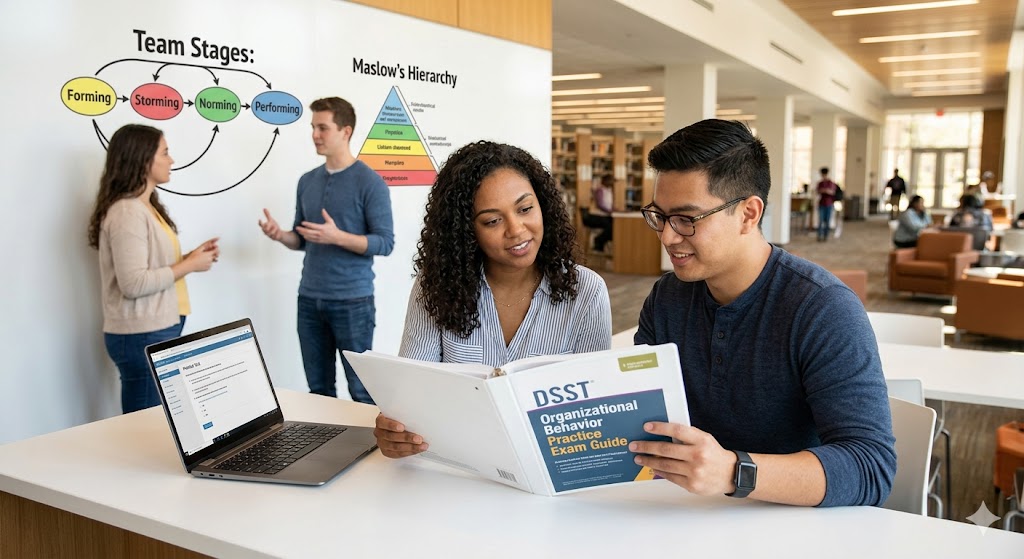
Additional Information
What the Course Entails and Exam Details
The content of the DSST Organizational Behavior exam covers a wide spectrum of behavioral and psychological concepts as they apply to a workplace environment. The official test content outline typically breaks down into five primary domains, each accounting for a specific percentage of the total material. The main areas of focus include:
Organizational Behavior Overview (5-10%): This section covers the fundamental definitions, the historical development of the field, and key theoretical perspectives.
Individual Processes and Characteristics (30%): You must demonstrate a deep understanding of personality, perception, attribution, motivation theories, attitudes, and the learning process.
Interpersonal and Group Processes (30%): A major portion of the exam focuses on group dynamics, team development, communication barriers, leadership styles, power, and conflict management.
Organizational Processes and Characteristics (15%): This section examines organizational structure, design, decision-making, and organizational culture.
Change and Development Processes (15%): Candidates must grasp the concepts of organizational change, resistance to change, and strategies for successful implementation.
What to Expect in the Final Exam
When you sit for the DSST Organizational Behavior final exam, you should be prepared for a two-hour session of focused testing. The exam typically consists of 100 multiple-choice questions, which evaluate your ability to not only recall definitions but also apply theoretical models to real-world scenarios. Each question will have one correct answer and three incorrect options. The American Council on Education (ACE) recommends a minimum passing score of 400 on a scaled score that ranges from 200 to 500. This is roughly equivalent to a grade of 'C' in an actual college course.
How to Study and Exam Centers
To ensure success, your study strategy should be comprehensive and varied. Begin by obtaining the official DSST content outline and referencing multiple lower-level college textbooks. Utilize full-length practice exams to simulate the testing environment and identify weak areas. Online resources like Peterson’s offer diagnostic tools, detailed answer explanations, flashcards, and instructional videos to reinforce key concepts. Focus your time on memorizing definitions, understanding the major leadership and motivation theories, and practicing application-based scenarios. The exam is administered year-round at authorized testing locations worldwide. You can find a complete list of these official sites, which include college testing centers and Prometric locations, by visiting the official GetCollegeCredit website. Be sure to contact your preferred center in advance to check for appointment availability, verify their current testing fees, and confirm their identification requirements.
Job Opportunities from the Course
Earning credit for DSST Organizational Behavior provides a strong foundation for a variety of roles across multiple industries, as every company relies on understanding human behavior for operational success. This knowledge is crucial for management, leadership, and HR pathways.
Human Resources Specialist
Employee Relations Manager
Team Leader or Supervisor
Department Manager
Training and Development Specialist
Project Manager
Organizational Development Consultant
Corporate Recruiter
Talent Management Coordinator
Change Management Specialist
Customer Success Manager
Frequently Asked Questions
Reviews
5.0
Based on 0 reviews
Leave a Review
No reviews yet. Be the first to review!