
DSST Principles of Public Speaking (CLEP) Practice Test
$69.00
- Buy to unlock unlimited access to all Quiz questions and Answers in this Quiz.
- After purchase you can print a PDF of the whole quiz at any point. The PDF will contain the questions and the correct answers.
About this Exam
The DSST Principles of Public Speaking exam is a valuable credit-by-exam opportunity that allows students and professionals to earn college-level credit for mastering the essential principles of effective communication. Designed for individuals seeking to accelerate their degree completion, save tuition costs, and enhance their professional communication skills, this exam serves as a direct alternative to a semester-long public speaking course. Successfully passing this comprehensive assessment demonstrates to accredited institutions that you possess the confidence, knowledge, and practical ability required for powerful and persuasive oral presentations in any academic or professional setting.
Ready to test your knowledge?
Buy Now to Access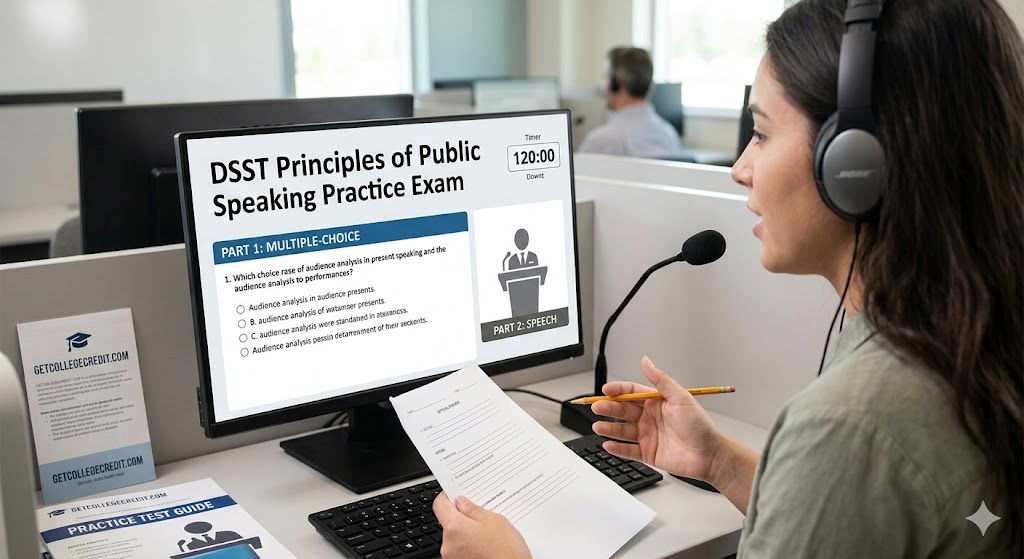
Additional Information
What the Course Entails and Exam Details
This examination covers the core theoretical and foundational elements of public speaking, as well as the practical application of those principles. While it is an exam, not a course, a standard college-level 'Introduction to Public Speaking' syllabus provides the perfect roadmap for preparation.
The key skills and domains covered include:
Audience Analysis: Learning techniques to assess, understand, and adapt speeches to diverse audiences.
Speech Preparation and Organization: Understanding how to select topics, conduct effective research, and structure introductions, bodies, and conclusions logically.
Speech Delivery: Mastering verbal (pitch, pace, articulation) and non-verbal (eye contact, posture, gestures) communication techniques.
Persuasive Speaking: Utilizing logic, emotion, and credibility (logos, pathos, and ethos) to influence audience beliefs and actions.
Communication Process and Ethics: Understanding the model of communication, overcoming speech anxiety, and upholding ethical standards of presentation.
The entire DSST Principles of Public Speaking exam is structured to assess your competence in two distinct phases, completed in order. It is crucial to understand that both sections must be passed to receive credit.
What to Expect in the Final Exam
The unique structure of this exam combines an objective multiple-choice test with a live, timed performance component, requiring candidates to prove they not only know how to speak but can do it under pressure.
Exam Format:
Part 1: Multiple-Choice Section: This is an online, internet-based assessment consisting of approximately 100 questions. You are given a total of 120 minutes (2 hours) to complete this section. The questions cover the theoretical principles, historical context, ethics, and concepts of audience analysis, speech construction, and delivery.
Part 2: Speech Presentation Section: Immediately following the multiple-choice section, you will proceed to the performance part of the exam. This is a crucial timed segment. You are given an unknown, debatable topic and a target audience on the screen. You then have 20 minutes to prepare, write a brief outline, and record an impromptu persuasive speech directly into the computer system. The recording of the speech itself must be a minimum of 3 minutes and a maximum of 5 minutes in duration.
Scoring:
Both parts of the exam are required for credit. Part 1 (Multiple-Choice) is scored immediately, while your recorded speech (Part 2) is sent for human evaluation by experienced university faculty. A minimum passing score is required for both the multiple-choice section and the speech portion. Candidates must pass both sections of the exam within six months to receive credit.
Rules and Passing Requirements:
Speech Timing: Strict adherence to the speech timing (3 to 5 minutes) is non-negotiable. Speeches under 3 minutes or over 5 minutes will result in an automatic failure of the performance section.
Retakes: If a student fails to achieve a passing score on either or both parts of the exam, they must wait 30 days before retaking it.
How to Study and Exam Centers
Effective preparation requires a two-pronged approach, targeting both the theoretical multiple-choice section and the practical performance part.
Actionable Study Strategies:
Master the Theory: Utilize introductory college public speaking textbooks, reputable online video lessons, and digital flashcards to solidify your understanding of core concepts like speech structure, non-verbal cues, and rhetorical analysis.
Practice MC with Purpose: Take numerous high-quality practice tests that provide detailed answer explanations. Review every question you missed to understand the underlying principles and common traps.
Practice Impromptu Outlining: Dedicate timed practice to outlining a persuasive speech in under 15 minutes for various debatable topics. This simulates the preparation time you will have in the actual exam.
Record and Critique Your Speeches: Regularly record yourself delivering impromptu speeches on randomly chosen topics. Focus on structure, clarity, vocal variety, and staying within the critical 3-to-5-minute window. Watch your recordings to identify and eliminate fillers, unnatural gestures, or monotone delivery.
Speak with a Live Audience: Practice in front of a small group of friends, colleagues, or family. Ask for constructive feedback on your organization, eye contact, and overall effectiveness.
Exam Centers and Location:
The DSST Principles of Public Speaking exam is delivered through Prometric's secure testing platform. Exams can only be taken at officially authorized National Test Centers (NTCs). These are often located on college and university campuses across the United States. Furthermore, numerous Government Test Centers (GTCs) on military bases worldwide facilitate this exam for service members.
To locate a specific test center, you should visit the official DSST website to access their searchable directory. Once you find a convenient location, contact them directly to confirm exam availability, fees, and to register.
Job Opportunities from the Course
A strong foundation in public speaking is a transferable, highly-prized skill in virtually every industry. While not a direct vocational certificate, mastering these principles, validated by the DSST Principles of Public Speaking exam, provides a critical advantage in several career paths, including:
Communications Specialist
Corporate Trainer or Coach
Public Relations Associate
Human Resources Coordinator
Sales Representative
Account Manager
Legislative Aide or Advocate
Non-Profit Program Coordinator
Educator or Instructor
Event Host or Presenter
Frequently Asked Questions
Reviews
5.0
Based on 0 reviews
Leave a Review
No reviews yet. Be the first to review!