
DSST Substance Abuse Practice Exam
$69.00
- Buy to unlock unlimited access to all Quiz questions and Answers in this Quiz.
- After purchase you can print a PDF of the whole quiz at any point. The PDF will contain the questions and the correct answers.
About this Exam
The DSST Substance Abuse exam offers students a valuable pathway to earning college credit by demonstrating college-level knowledge in substance use disorders and dependency. This prior learning assessment is designed for individuals with real-world experience, prior study, or a deep personal interest in addiction recovery. It allows candidates to skip traditional coursework and accelerate their degree completion by showcasing their mastery of the psychological and social aspects of substance abuse. This test is ideal for students pursuing degrees in healthcare, counseling, social work, or criminal justice. By preparing for and taking this exam, you can significantly save on tuition costs and graduate sooner.
Ready to test your knowledge?
Buy Now to Access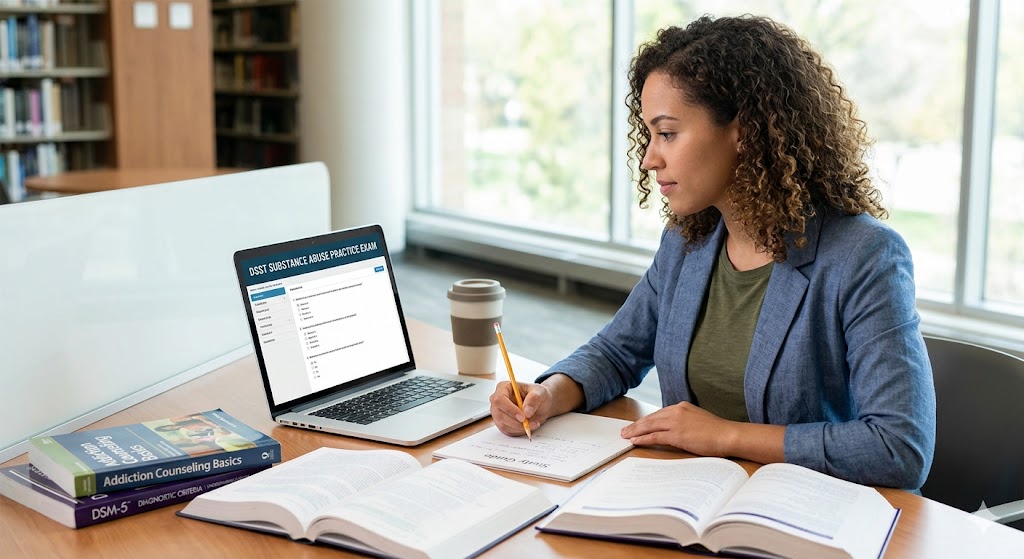
Additional Information
What the Course Entails and Exam Details
This examination covers content typically taught in a three-credit undergraduate course focused on the study of substance abuse and dependency.
Preparing for this exam requires a thorough understanding of diverse, interconnected topics.
The core syllabus encompasses the history of drug use in society and the various sociological perspectives surrounding addiction.
A significant portion of the material focuses on pharmacology: understanding how different categories of drugs interact with the human brain and body.
Candidates must study specific substances, including depressants, stimulants, hallucinogens, cannabinoids, and anabolic steroids.
Furthermore, the exam tests knowledge of the theories of addiction, various treatment modalities, and essential prevention strategies.
Lastly, you will encounter questions regarding the societal impact of drug abuse on family dynamics, the workplace, and the criminal justice system.
What to Expect in the Final Exam
When you step into the testing center, you should be prepared for a standardized, computer-based assessment.
The final exam primarily consists of approximately 100 multiple-choice questions, which must be completed within a two-hour time limit.
Some questions may feature unscored "pretest" items that are being evaluated for future exams; these do not affect your final score.
DSST utilizes a scaled scoring system ranging from 200 to 500.
To obtain college credit, candidates generally need to achieve a passing score of 400 or higher, although this requirement can vary slightly depending on the specific institution receiving the credit.
It is highly recommended that you verify the required passing score with your university or college prior to taking the exam.
How to Study and Exam Centers
Preparation is the cornerstone of success for the DSST Substance Abuse test.
We recommend utilizing official DSST fact sheets to understand the specific weight given to each topic area.
The most effective study strategy involves taking a high-quality DSST Substance Abuse Practice Exam.
A practice test allows you to gauge your current knowledge base, identify weak areas, and become familiar with the phrasing of exam questions.
Complement your practice testing with a thorough review of undergraduate-level textbooks on drug education or the sociology of addiction.
To register for and take the actual exam, you must use an authorized testing location.
Most candidates take the test at college or university testing centers or at authorized Prometric testing centers globally.
Additionally, military personnel can often access these exams at base education offices.
Job Opportunities from the Course
While passing the DSST Substance Abuse exam directly provides college credit rather than a professional license, it validates knowledge that is crucial for numerous career paths.
Accelerating your degree in a relevant field opens doors to diverse and rewarding opportunities in human services.
Potential career titles and paths enhanced by this foundational knowledge include:
Substance Abuse Counselor (Requires licensure/certification in most states)
Addiction Treatment Specialist
Case Manager
Community Health Worker
Social Service Assistant
Chemical Dependency Professional
Probation or Parole Officer
Prevention Specialist
Health Educator
Mental Health Technician
Crisis Intervention Counselor
Frequently Asked Questions
Reviews
5.0
Based on 0 reviews
Leave a Review
No reviews yet. Be the first to review!