
DSW Undersea Rescue Practice Test
$69.00
- Buy to unlock unlimited access to all Quiz questions and Answers in this Quiz.
- After purchase you can print a PDF of the whole quiz at any point. The PDF will contain the questions and the correct answers.
About this Exam
The [DSW Undersea Rescue] certification is a high-level credential designed for professional divers, military personnel, and specialist maritime responders tasked with executing life-saving operations in complex, deep-sea environments. This elite qualification validates an individual's proficiency in advanced diving physics, decompression management, and the operational procedures unique to sophisticated submarine rescue systems.
Unlike standard rescue certifications, the DSW focus is on deep-submergence rescue vehicles (DSRVs), specialized launch and recovery systems, and the hyperbaric stabilization of distressed submariners. This study guide and practice exam are engineered to help you master the intensive knowledge base required to serve as a critical asset in worldwide undersea rescue missions.
Ready to test your knowledge?
Buy Now to Access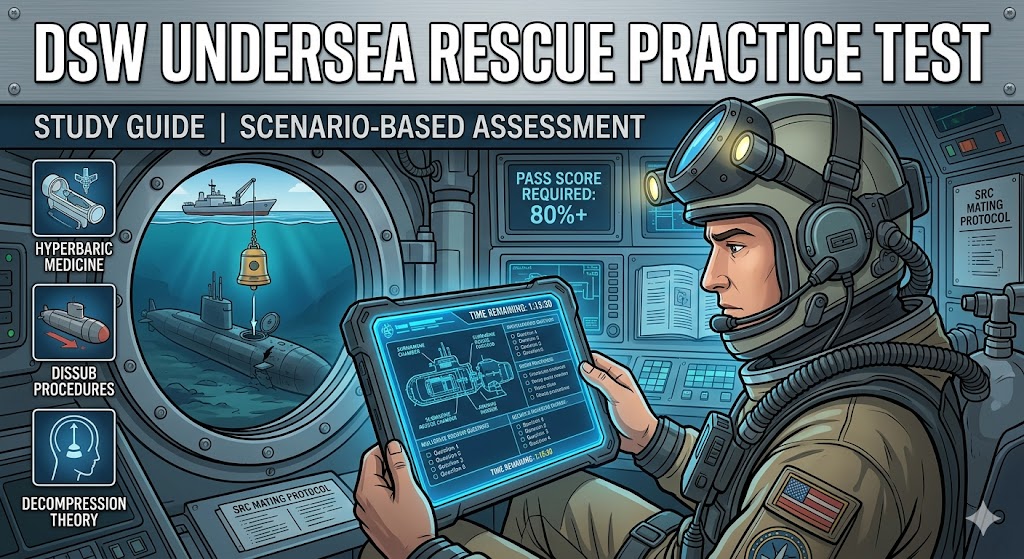
Additional Information
What the Course Entails and Exam Details
The DSW curriculum is notoriously rigorous, ensuring candidates are prepared for the physical and mental demands of real-world emergencies. Mastering the syllabus requires dedication and a thorough understanding of advanced principles. The core topics covered in the training course and verified by the practice test include:
Deep-Sea Physiology and Hyperbaric Medicine: Advanced decompression theory, gas toxicity, identifying and treating recompression illnesses, and life support stores replenishment for trapped crews.
Submarine Rescue Assets: Comprehensive operational procedures for the Submarine Rescue Chamber (SRC), the Pressurized Rescue Module (PRM), and associated launch and recovery systems (LARS).
Operational Tactics: DISSUB (Disabled Submarine) assessment techniques, mating operations between rescue vehicles and distressed submarines, internal submarine stabilization, and crew ingress/egress protocols.
Environmental Challenges: Understanding deep currents, thermal management in cold water operations, acoustic navigation, and risk mitigation in Sea State III conditions.
Command, Control, and Communications: International ISMERLO (International Submarine Escape and Rescue Liaison Office) doctrine, coordinating multi-national rescue forces, and the role of the Senior Survivor.
What to Expect in the Final Exam
The final certification exam is a challenging hurdle that demands both rote memorization and practical problem-solving. This is not a generalized water safety quiz; it is a critical assessment of operational knowledge where the margin for error is zero.
The final exam is a proctored, closed-book test administered either on-site at authorized military or commercial training facilities or through secure, high-stakes online portals. The typical format includes 100 multiple-choice questions, which may include intricate scenarios derived from real-world operations. Candidates are usually given a strict time limit of two hours to complete the examination. To achieve the DSW Undersea Rescue designation, a score of 80% or higher is required. The test is designed to probe your instant-recall and critical-thinking skills under time pressure, simulating the high-stress environment of a true rescue operation.
How to Study and Exam Centers
Effective preparation is the single most important factor in your success. Passive reading is insufficient. You need an active, structured study plan to internalize the complex protocols of the DSW Undersea Rescue program.
Start by sourcing the most recent, official manuals, technical publications, and US Navy Diving Manual (relevant to advanced salvage/rescue) through your training provider. Utilize this DSW Undersea Rescue Practice Test repeatedly. Focus on the explanation for every answer, understanding why a procedural choice is correct, not just which one it is. Create physical flashcards for complex topics like gas mixture formulas and ISMERLO communication codes. Study groups are highly recommended for simulating scenario-based questions and operational decision-making.
The DSW certification exam cannot be taken in just any location. Due to its high-stakes nature and proprietary content, testing is strictly controlled. Examinations are primarily administered through:
Official Military Training Commands: Primarily Navy bases with dedicated diving and submarine school pipelines, such as those in Groton, Connecticut, or San Diego, California.
Authorized Defense Contractor Facilities: Specialized centers operated by defense organizations involved in Submarine Rescue.
Accredited Deep-Submergence Diving Schools: Select high-level commercial diving facilities that are authorized to run advanced professional development courses.
Job Opportunities from the Course
A DSW Undersea Rescue certification is an elite credential that unlocks some of the most challenging and prestigious roles in the professional diving and defense sectors. This qualification signals to employers that you possess advanced technical expertise and can be trusted with critical responsibilities under extreme pressure.
Specific job titles and career paths this certification enables include:
Navy Diver (ND) Specialist / DSRV Operator: Serves on the front line of military submarine rescue and deep-salvage operations.
Submarine Rescue Specialist / Technician (Contractor): Civil roles working for authorized defense companies, operating and maintaining proprietary rescue systems.
Hyperbaric Technologist (Rescue): Managing the medical stabilization of survivors rescued from pressurised environments.
Commercial Deep-Salvage Diver / Supervisor: Leading high-risk recovery projects that utilize sophisticated deep-submergence equipment.
Life Support Supervisor: Ensuring the safety and gas mixture management for deep-water diving operations and saturation systems.
Underwater Search and Recovery Supervisor: Commanding specialized teams for recovering high-value assets and conducting accident investigations.
Maritime Rescue Coordinator (ISMERLO Joint Forces): Coordinating complex international response efforts for distressed submarines.
Frequently Asked Questions
Reviews
5.0
Based on 0 reviews
Leave a Review
No reviews yet. Be the first to review!