
EAQ Leadership/Management: Disaster Planning Practice Test
$69.00
- Buy to unlock unlimited access to all Quiz questions and Answers in this Quiz.
- After purchase you can print a PDF of the whole quiz at any point. The PDF will contain the questions and the correct answers.
About this Exam
The [EAQ Leadership/Management: Disaster Planning Practice Test] is a essential resource designed for current and aspiring leaders, managers, and emergency professionals across all sectors who are responsible for navigating critical planning and response efforts. Whether in healthcare, infrastructure, government, or a corporate setting, effective disaster planning is a cornerstone of organizational resilience and community safety. This practice test serves as a crucial learning and assessment tool, providing a robust framework to build, refine, and validate the specific leadership skills needed to steer teams and resources in high-stakes environments before, during, and after a crisis. It empowers professionals with the confidence and competence to develop and execute comprehensive strategies for disaster prevention, mitigation, preparedness, response, and recovery.
Ready to test your knowledge?
Buy Now to Access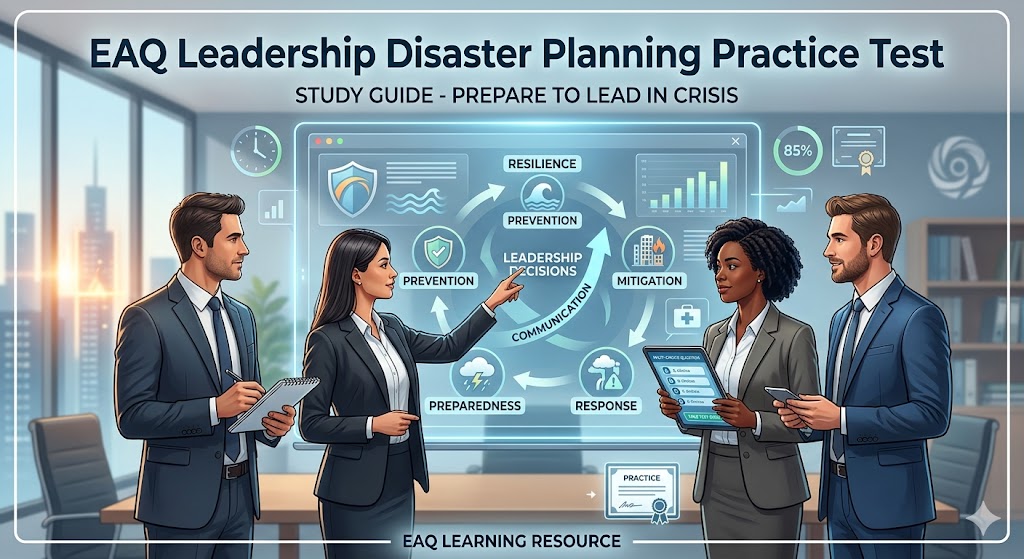
Additional Information
What the Course Entails and Exam Details
This comprehensive assessment and the underlying knowledge areas it covers encompass a multi-faceted curriculum, focusing on:
The Disaster Management Cycle: A thorough understanding of the five key phases: Prevention, Mitigation, Preparedness, Response, and Recovery, with a strong emphasis on leadership roles within each stage.
Risk Assessment and Vulnerability Analysis: Methodologies for identifying potential hazards, evaluating organizational and community vulnerability, and prioritizing preparedness efforts.
Leadership and Crisis Decision-Making: Core leadership theories and practical application in complex, rapidly changing environments, including ethical considerations and delegation of critical tasks.
Effective Communication Strategies: Developing and executing robust communication plans, addressing media inquiries, and providing clear guidance to internal and external stakeholders during a crisis.
Resource Management: Logistical planning and coordination of personnel, materials, equipment, and finances to ensure optimal use during a disaster response.
Legal and Ethical Frameworks: Understanding relevant laws, regulations, and ethical guidelines that govern disaster planning and response actions.
Case Studies and Simulation: Analysis of real-world disaster scenarios and the practical application of planning principles to various mock emergency situations.
The [EAQ Leadership/Management: Disaster Planning Practice Test] itself typically reflects these core areas through a series of multiple-choice and scenario-based questions designed to simulate the challenges faced by leaders in the field.
What to Expect in the Final Exam
While the exact structure may vary slightly depending on the specific source or platform offering this practice material, a professional final exam or substantial practice assessment for leadership in disaster planning typically features:
Multiple-Choice Questions: A significant portion of the test will assess your knowledge of key concepts, definitions, legal frameworks, and leadership principles.
Scenario-Based Problems: These questions present complex, realistic disaster scenarios, requiring you to apply your leadership and planning knowledge to make sound, timely decisions. You might be asked to outline a response plan, delegate resources, or communicate critical information.
Time Limits: To simulate the pressure of a real crisis, the test is usually timed, often ranging from 60 to 90 minutes for a comprehensive set of questions.
Passing Score Requirements: A typical passing score for such a professional assessment is often in the range of 70% to 80%, indicating a high level of competency and readiness for real-world applications.
Specific Rules: In professional testing scenarios (especially with proctoring), rules often include no unauthorized materials, closed-book format, and adherence to time limits. For self-directed practice tests, these rules may be self-enforced for optimal results.
How to Study and Exam Centers
Maximize your performance and learning by employing active study strategies:
Utilize the Practice Test as a Study Tool: Don't just take the test once. Review each question, especially those you missed, and understand the detailed rationales provided for both correct and incorrect answers. This iterative process is key to reinforcing knowledge and identifying weak areas.
Study the Core Curriculum: Delve into standard disaster management frameworks (such as those provided by FEMA or relevant professional bodies), leadership textbooks, and crisis communication guides. Understanding the foundational principles is crucial.
Simulate Exam Conditions: For practice, attempt the test under timed, uninterrupted conditions with no access to study materials. This helps build test-taking confidence and stamina.
Review weak areas: Focus your study on the specific phases of the disaster cycle or leadership components where you feel least confident. Use diverse resources for a well-rounded understanding.
Engage with Scenarios: Actively think through real-world scenarios and past events. How would you apply the principles learned to lead effectively in those situations?
Exam access for the [EAQ Leadership/Management: Disaster Planning Practice Test] is typically obtained through dedicated online educational platforms, professional development portals, or within specific academic courses. Consult the official source of your study materials to determine the correct online portal. For real certification exams that this practice test might prepare you for, you can expect to find scheduling and location information on the websites of professional credentialing bodies, which may utilize both secure online proctoring and established physical testing centers (like Pearson VUE or specialized school-based centers) depending on the specific certification.
Job Opportunities from the Course
A strong command of leadership and management principles in disaster planning, as demonstrated by success in this practice assessment and further professional development, can unlock a wide range of career opportunities. Graduates and certified professionals may pursue roles such as:
Emergency Management Director/Manager (Local, State, or Federal level)
Disaster Recovery Coordinator
Organizational Resilience and Business Continuity Manager
Crisis Communication and Public Information Officer
Public Health Emergency Preparedness Coordinator
Humanitarian Aid Manager/Team Leader
Corporate Disaster Preparedness and Response Specialist
Disaster Planning and Mitigation Consultant
Safety and Security Director with a focus on emergency response
Healthcare Emergency Preparedness Manager
Frequently Asked Questions
Reviews
5.0
Based on 0 reviews
Leave a Review
No reviews yet. Be the first to review!