
EAQ- QESN Teamwork Practice Test
$69.00
- Buy to unlock unlimited access to all Quiz questions and Answers in this Quiz.
- After purchase you can print a PDF of the whole quiz at any point. The PDF will contain the questions and the correct answers.
About this Exam
Welcome to your essential study guide for the EAQ- QESN Teamwork Practice Exam! In today's dynamic professional landscape, effective collaboration is a non-negotiable skill. This comprehensive practice assessment is designed specifically to help you understand and excel in teamwork principles, communication strategies, and the vital interpersonal skills that power successful, cohesive teams. Drawing inspiration from recognized quality and safety standards, particularly within the healthcare and nursing sectors (where QESN often signifies Quality and Safety Education for Nurses), this exam allows you to test your abilities against real-world scenarios.
Whether you are a student, a professional aiming to boost your career, or preparing for a broader professional certification that incorporates teamwork as a core competency, this practice test offers invaluable insights and preparation. Succeeding here indicates you possess the interpersonal acumen to communicate effectively, resolve conflicts constructive, and contribute meaningfully to shared objectives.
Ready to test your knowledge?
Buy Now to Access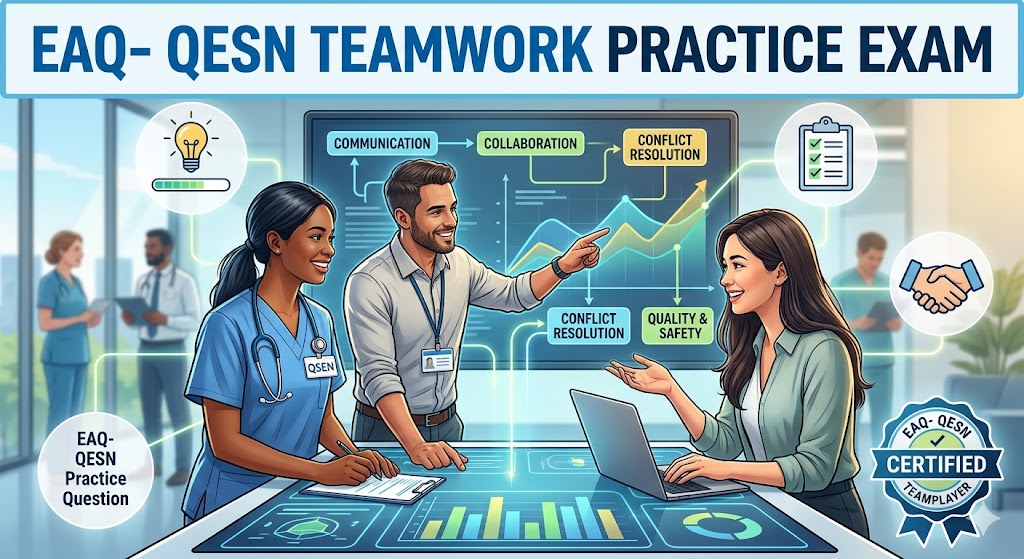
Additional Information
What the Course Entails and Exam Details
The broader EAQ- QESN Teamwork framework—which this practice exam aims to assess your preparedness for—covers several core competencies, knowledge, skills, and attitudes (KSAs) vital for any collaborative environment. While the exact details of any associated "course" will vary, the following topics are typical reflections of what you can expect to master and what the practice exam will evaluate:
Core Syllabus / Skills Covered:
Effective Communication: Understanding principles of clear, accurate communication, adapting your style to the team and situation, practicing active listening, and recognizing the impact of your communication on others.
Collaboration: Working efficiently and respectfully with diverse teammates, aligning individual efforts with collective goals, contributing to mutual decision-making, and understanding differing team roles and dynamics.
Conflict Resolution: Identifying potential areas of conflict, initiating and participating in constructive conflict resolution processes, and managing differing opinions professionally.
Mutual Respect & Trust: Building and maintaining positive relationships based on trust, respect for all contributions, and appreciation of diverse perspectives and cultural backgrounds.
Patient-Centered Care (Healthcare Context): If taking the exam within the common QESN/nursing context, understanding how the entire team's collaborative efforts center on ensuring quality, safety, and well-being.
Problem-Solving & Innovation: Contributing to creative problem-solving as a team and potentially participating in quality improvement initiatives.
Practice Exam Details (Typical):
Format: Primarily scenario-based multiple-choice questions. You will be presented with realistic workplace or interprofessional scenarios and asked to choose the best (or sometimes the worst, in "actions to avoid" questions) course of action, communication approach, or conflict resolution strategy.
Assessment Style: Interactive challenges that require application of theoretical knowledge to practical situations rather than simple recall.
Focus: Evaluation of how effectively you can collaborate, communicate, and contribute within a team setting.
What to Expect in the Final Exam
It's crucial to understand that the EAQ- QESN Teamwork Practice Exam is a powerful preparation tool for a potentially larger, formal certification or assessment in professional teamwork and collaboration. When you move towards a final certification exam, here’s what you can typically expect, using the practice exam format as a reflection of the assessment style:
Likely Format of a Final Certification Exam:
Comprehensive Assessment: A full exam may be longer than the practice test, featuring a larger set of scenario-based questions covering all the core competencies detailed in section 2.
Diverse Question Types: Expect a majority of multiple-choice questions (as in the practice test), but some exams may incorporate other interactive formats like:
Simulations: More complex, potentially dynamic branching scenarios.
Case Studies: An overarching scenario with multiple related questions.
Short Answer/Essay (Less common): Brief explanations for choices or analysis of team dynamics.
Passing Score: Professional certifications typically have a set passing percentage (e.g., 70-80%). The specific requirements will depend entirely on the certifying body.
Time Limits: Full certification exams will be timed, requiring you to read scenarios, analyze options, and make decisive choices efficiently.
Rules & Proctors: Formal exams, unlike self-guided practice tests, will likely be taken in controlled environments (either online with remote proctoring or at physical test centers), following strict identity verification and exam conduct rules.
How to Study and Exam Centers
Effective preparation for both the EAQ- QESN Teamwork Practice Exam and any eventual final certification is key. This practice test itself is a cornerstone of your study strategy!
How to Study & Practice Strategies:
Take the Practice Test Multiple Times: This is your best action. Experience the scenarios, learn from correct and incorrect answers, and become comfortable with the assessment style. Time yourself on subsequent attempts to build efficiency.
Review Scenarios Analytically: When taking the practice test or reviewing sample scenarios, don't just pick an answer. Consider why a certain choice is correct (e.g., "this promotes clear communication and resolution," "that approach might escalate conflict"). Draw from real-world experiences or reflect on effective teamwork you've observed.
Study Core Materials: Refer back to the core competencies listed in section 2. If available, review materials related to effective communication (active listening, non-verbal cues), collaboration, conflict resolution models, and the importance of respect and diverse perspectives. For healthcare/nursing students, lean heavily into the QSEN (Quality and Safety Education for Nurses) framework and materials.
Reflect & Discuss: Think about real-life teamwork situations you’ve experienced. What worked well? What didn't? Discuss these scenarios or theoretical concepts with peers to gain different perspectives.
Build Interpersonal Skills: Actively practice effective communication, collaboration, and conflict resolution in your daily interactions, studies, or workplace projects.
Where to Take the Exams & Centers:
Taking the EAQ- QESN Teamwork Practice Exam:
This practice exam is typically available through specific online educational portals or platforms. Check the specific details provided on the platform where you access this guide for the exact access link or portal. There are generally no physical exam centers for a self-guided practice test.
Taking a Final Certification Exam:
Should you pursue a formal, recognized professional certification that this practice test supports, the location and process will be determined by the specific certifying body (e.g., professional associations, specialized training providers). Common options include:
Online Proctoring: Taking the timed, proctored exam from your own computer through a secure browser and webcam connection.
Authorized Testing Centers: Scheduling and taking the exam in person at established physical centers (examples include Pearson VUE, Prometric, or specific educational institutions authorized to administer the exam).
Specific Organizations/Schools: Some specific programs or employers may hold authorized in-house testing or connect you with their preferred certification partners.
Always verify the specific logistics, costs, and locations for any final certification with the official certifying organization and within the context of your chosen program or career path.
Job Opportunities from the Course
Earning certification or demonstrating mastery in the EAQ- QESN Teamwork competencies, especially when viewed through the QSEN (Quality and Safety Education for Nurses) framework, significantly boosts your career prospects. The ability to collaborate effectively is consistently ranked as one of the most desired soft skills by employers across almost every sector, and it is explicitly vital in healthcare to ensure quality and prevent errors.
Specific Job Titles and Career Paths This Skillset Unlocks (with a focus on the common QSEN/Healthcare connection):
Registered Nurse (RN) & Specialized Nurse Roles: All levels of nursing require intense collaboration with diverse healthcare teams. Advanced skills in communication, conflict resolution, and shared decision-making are critical for RNs in critical care, pediatrics, emergency medicine, oncology, etc.
Healthcare Team Member / Clinician: This includes roles like Nursing Assistants, Physical Therapists, Occupational Therapists, Respiratory Therapists, Social Workers, and many others who must all work seamlessly in interprofessional teams.
Nurse Educator & Faculty: Teaching future nurses the core competencies of safety, quality, and effective teamwork.
Nurse Manager / Leader: Leading teams effectively, resolving interprofessional conflicts, and ensuring safe, quality care at the unit or organizational level.
Project Manager (especially in Healthcare or Quality Improvement): Organizing and leading diverse teams to execute projects efficiently. Understanding team dynamics and fostering effective communication are crucial for success.
Human Resources Specialist / Learning & Development (L&D) Professional (General or Healthcare-focused): Recognizing and cultivating these vital soft skills within an organization, developing training programs, and ensuring effective team functioning.
Consultant (Process Improvement, Team Dynamics): Helping organizations optimize team performance, improve communication, and enhance quality.
Scrum Master / Agile Team Leader: Facilitating teamwork and communication within dynamic, iterative product or project development environments.
Any Professional Role Requiring Strong Interpersonal Skills: From business analysts and marketers to customer service representatives and engineers, being an exceptional team player is universally valued.
Frequently Asked Questions
Reviews
5.0
Based on 0 reviews
Leave a Review
No reviews yet. Be the first to review!