
EarSketch Vocabulary Practice Test
$69.00
- Buy to unlock unlimited access to all Quiz questions and Answers in this Quiz.
- After purchase you can print a PDF of the whole quiz at any point. The PDF will contain the questions and the correct answers.
About this Exam
The EarSketch Vocabulary Practice Test is an essential study tool designed for students enrolled in computer science (CS) and music technology courses that utilize the innovative EarSketch platform. Developed at Georgia Tech, EarSketch teaches fundamental programming principles (in Python or JavaScript) through the medium of music composition and remixing.
This practice test is specifically crafted to help you assess your understanding of the foundational terminology, API functions, and core computational thinking concepts unique to the EarSketch environment. Mastering this vocabulary is the first step toward becoming proficient in creating complex, algorithmic music and successfully completing your course's official assessments.
Ready to test your knowledge?
Buy Now to Access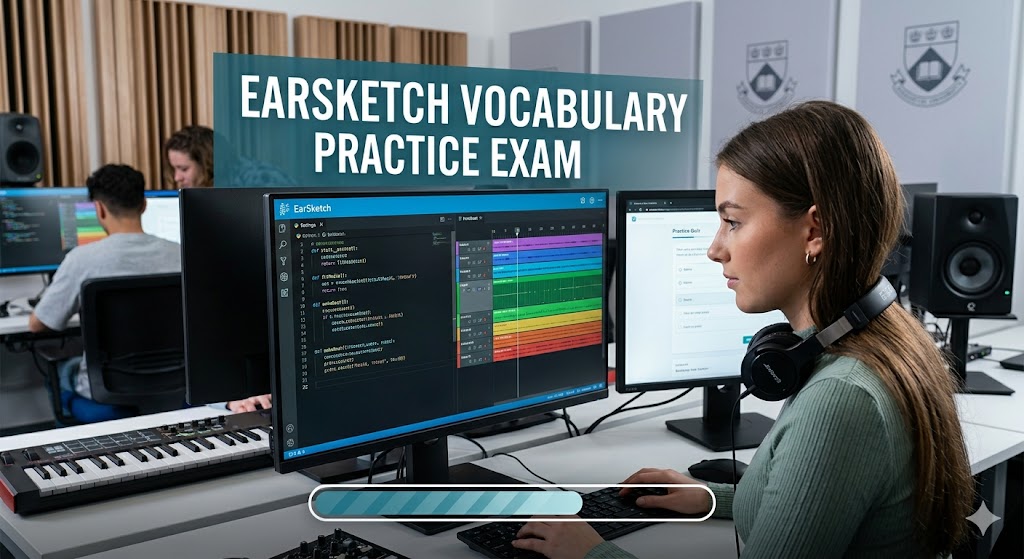
Additional Information
What the Course Entails and Exam Details
This practice test mirrors the content covered in comprehensive EarSketch curriculum modules. To succeed, students must develop strong competency in a wide range of computational and music technology topics. The core syllabus includes, but is not limited to:
Computational Thinking: Understanding key concepts like algorithms, abstraction, sequencing, pattern recognition, and control flow.
The EarSketch API: Deep familiarity with specific functions to manage tracks, time, and composition. This includes, for instance, knowing the purpose and parameters for functions such as init(), finish(), fitMedia(), makeBeat(), println(), and setEffect().
Programming Fundamentals: Practical application of fundamental coding structures using EarSketch vocabulary, including variables, lists, string manipulation, 'for' loops, and conditional (if/else) statements.
Music Technology Principles: Understanding the intersection of code and sound, including working with measures, tracks, tempo, and applying audio effects.
What to Expect in the Final Exam
While the final, high-stakes exam format will be determined by your specific course instructor or school district (e.g., as part of an AP Computer Science Principles or introductory college course), this EarSketch Vocabulary Practice Test is designed to simulate a major curricular assessment.
The practice test typically consists of:
Format: 100% Multiple-Choice, matching, or short-answer questions. It is a closed-book test administered digitally.
Number of Questions: 50-70 questions.
Time Limit: Approximately 60 to 90 minutes.
Passing Score: A score of 70% or higher is generally recommended on this practice test to demonstrate strong readiness for your final curricular assessment.
NB: This practice test does not produce an official grade or certification. Its purpose is purely to prepare you for the real exam administered in your classroom.
How to Study and Exam Centers
Preparation is key to succeeding on the final exam and mastering the skills taught. Since the EarSketch Vocabulary Practice Test is an educational assessment, it is not administered at third-party test centers like Pearson VUE.
Where to Take the Practice and Final Exam:
Practice: This tool is accessible online via authorized learning platforms and within the EarSketch environment.
Final Exam: The official exam is proctored directly by your course instructor, either in your physical school classroom or through your school's authorized online portal.
Recommended Study Strategies:
Immerse in the API: The single best way to study is to actively use the EarSketch API. Log into EarSketch regularly and code musical sketches using all the main functions.
Review Official Documentation: Study the integrated EarSketch curriculum and API reference guides available within the platform. Pay close attention to function names, parameters, and return types.
Flashcards: Use digital tools or physical flashcards to memorize key API functions and their corresponding actions. Focus on terms like fitMedia(), makeBeat(), list, string, and parameter.
Practice Questions: Work through multiple versions of this practice test to become comfortable with the question types and formatting you will encounter. Analyze why correct answers are correct.
Study Groups: Collaborate with classmates. Quiz each other on terminology, explain core functions to one another, and debug small scripts together.
Job Opportunities from the Course
While this specific vocabulary test is a component of a class, completing a comprehensive course utilizing EarSketch builds a valuable hybrid skill set in both coding and creative technology. This foundation serves as a critical first step towards several modern career paths.
Below are key job roles and industries where proficiency in computational music and introductory programming, as validated by strong course performance, is essential:
Software Developer (Junior/Entry Level): Mastering logic, loops, and data structures in Python or JavaScript is a fundamental requirement for all software development careers.
Music Technologist: Roles at the intersection of production and programming, such as building tools for digital audio workstations or creative apps.
Audio/Sound Engineer: Utilizing code for advanced mixing, sound design, and automating complex tasks in studio environments.
Audio App Developer: Programming creative tools for artists, including synthesizers, effects plugins, or new musical instruments.
Front-End or Full-Stack Web Developer: Utilizing the JavaScript skills learned in EarSketch to build interactive and media-rich web applications.
Educational Technology (EdTech) Developer/Curriculum Specialist: Developing coding-for-creative platforms and educational materials for the next generation.
Game Audio Programmer: Using code to integrate, manage, and dynamically trigger sound effects and music in video games.
Frequently Asked Questions
Reviews
5.0
Based on 0 reviews
Leave a Review
No reviews yet. Be the first to review!