
Earth in Space Practice Test
$69.00
- Buy to unlock unlimited access to all Quiz questions and Answers in this Quiz.
- After purchase you can print a PDF of the whole quiz at any point. The PDF will contain the questions and the correct answers.
About this Exam
The Earth in Space Practice Test is designed for students and educators seeking a comprehensive tool to evaluate knowledge in astronomy and earth science. This practice exam is ideal for middle to high school students, introductory-level college students, and anyone preparing for standardized science tests or pursuing a deeper understanding of our planet's place in the universe. It serves as a valuable resource for self-assessment and targeted study.
Ready to test your knowledge?
Buy Now to Access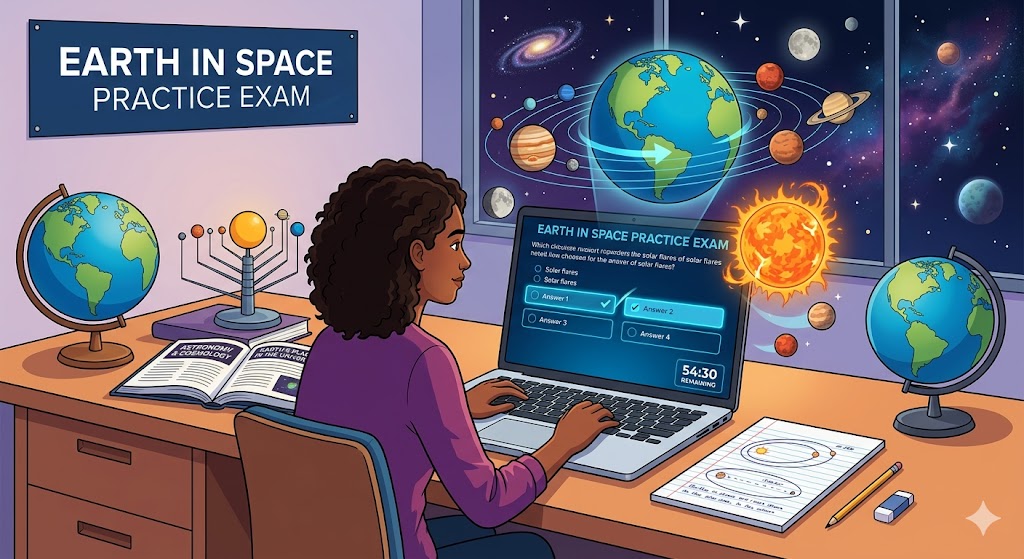
Additional Information
What the Course Entails and Exam Details
This course and its corresponding practice test cover the fundamental concepts governing the relationship between Earth and the cosmos. The content is structured to align with standard earth science and astronomy curricula, focusing on several core areas. Participants should be prepared to demonstrate understanding of the following:
Earth's Motion: Details on Earth's rotation and revolution, including the causes and effects of days, nights, years, and seasons.
The Earth-Moon-Sun System: Mechanics of the Moon's phases, solar and lunar eclipses, and the primary causes of oceanic tides.
The Solar System: The structure and components of our solar system, including the properties of inner and outer planets, asteroids, comets, and meteors.
The Sun as a Star: Understanding the Sun’s structure, energy production through nuclear fusion, and its overall influence on Earth.
Stars and Galaxies: Basic lifecycle of stars, classification using the Hertzsprung-Russell diagram, and types of galaxies.
The Universe: An introduction to cosmology, including evidence supporting the Big Bang theory and the concept of a constantly expanding universe.
What to Expect in the Final Exam
The practice exam mimics the format of typical comprehensive final exams in earth science or introductory astronomy courses. It consists of multiple-choice questions, which may be supplemented by true/false questions, matching exercises, or the labeling of key diagrams. While this is a practice test, a corresponding official examination would typically require a passing score of 60% or higher, depending on the educational institution. It is designed to be completed within a time limit, often between 60 and 90 minutes. Users should approach this practice test with the goal of identifying knowledge gaps to better focus their subsequent study efforts.
How to Study and Exam Centers
Effective preparation for this subject requires a combination of review, visualization, and active testing. Here are actionable study strategies to improve performance:
Review Textbooks and Notes: Systematically go through class materials and textbooks, focusing on key terms, definitions, and concepts.
Use Visual Aids: Earth in Space is highly visual. Use diagrams to understand the angle of Earth's tilt, the phases of the moon, and the order of planets.
Take Multiple Practice Tests: Use this practice test and others to simulate the exam environment and identify areas where you consistently struggle.
Watch Educational Videos: Leverage reputable science channels and documentaries to gain a clearer understanding of complex topics like the Big Bang or solar physics.
Form Study Groups: Explaining concepts to peers is one of the best ways to solidify your own understanding.
For the practice test, you are currently in the ideal location. This is an online resource designed for immediate access. For a formal official exam associated with a credit-bearing course, you would typically take the test in person at your school or university, proctored by an instructor in a classroom or testing hall.
Job Opportunities from the Course
While "Earth in Space" is typically a course within a broader curriculum rather than a standalone certification, strong knowledge in this area is a critical first step toward a variety of exciting career paths. Students who excel in this subject and continue their studies often find opportunities in fields like:
Astronomer: Conducting research to extend our understanding of space.
Earth Science Teacher: Educating the next generation on earth systems and astronomy.
Planetary Geologist: Studying the composition and history of planets and moons.
Meteorologist: Applying knowledge of the atmosphere and solar influence on weather patterns.
Aerospace Engineer: Developing spacecraft and technology for exploration.
Data Analyst (Space Sector): Processing data collected from telescopes and satellites.
Science Writer/Communicator: Making complex space-related topics accessible to the general public.
Planetarium Director/Curator: Managing educational exhibits and shows related to astronomy.
Frequently Asked Questions
Reviews
5.0
Based on 0 reviews
Leave a Review
No reviews yet. Be the first to review!