
EAS Master Beekeeper Practice Exam
$69.00
- Buy to unlock unlimited access to all Quiz questions and Answers in this Quiz.
- After purchase you can print a PDF of the whole quiz at any point. The PDF will contain the questions and the correct answers.
About this Exam
The EAS Master Beekeeper Certification is a prestigious and rigorous designation awarded by the Eastern Apicultural Society. It represents the pinnacle of educational achievement and practical expertise for serious beekeepers. Designed for experienced apiculturists, typically requiring at least five years of active hive management, this certification is for individuals who seek not only to master their craft but also to act as authoritative educators, mentors, and ambassadors for the beekeeping industry. Utilizing a Practice Exam is an essential step to measure readiness before embarking on the challenging path to full certification.
Ready to test your knowledge?
Buy Now to Access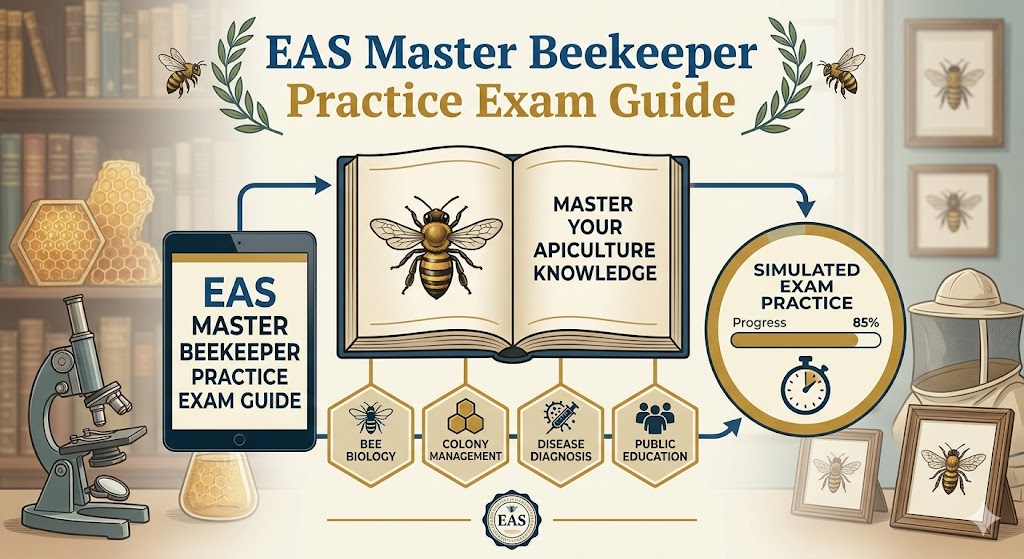
Additional Information
What the Course Entails and Exam Details
The broader Master Beekeeper program doesn't offer a traditional course but requires candidates to demonstrate mastery through four rigorous exams: Written, Laboratory, Oral, and Field. The program’s syllabus—which your Practice Exam will test the theoretical foundation of—covers deep knowledge in:
Honey Bee Biology: Anatomy, physiology, and behavioral ecology of all castes.
Colony Management: Advanced practices for every season, including swarming control and over-wintering strategies.
Disease & Pest Management: In-depth identification, diagnosis, and integrated treatment for Varroa mites, foulbrood, small hive beetles, and more.
Apicultural Operations: Commercial honey production, processing, food safety, pollination services, and equipment utilization.
Queen Rearing: Techniques for producing high-quality local queens and managing apiary genetics.
Education: Principles of teaching and public speaking to disseminate accurate beekeeping information.
What to Expect in the Final Exam
The final certification journey is composed of four distinct, demanding components, taken in-person over multiple days at the annual EAS conference. Your core written practice materials are designed to mirror the first of these steps:
Written Examination: Evaluates comprehensive knowledge through multiple-choice, true-false, matching, and short essay questions. (This is the primary focus of most self-guided practice exams).
Laboratory Examination: Tests practical identification skills using physical samples, photomicrographs, and equipment, requiring you to diagnose diseases, identify pests, and recognize hive components.
Oral Examination: Assesses your ability to clearly and confidently communicate accurate apicultural information in real-time, often simulating situations like an interview with the press or presenting to a local council.
Field Examination: A one-on-one practical test in an unfamiliar live apiary, where you must perform a thorough hive inspection, evaluate colony health, and propose appropriate management actions.
A exceptionally high passing score of 85% is typically required for each individual component to achieve certification. While a practice exam is usually a self-guided study tool, the final is a high-stakes, time-limited assessment (four hours for written) with no outside materials allowed.
How to Study and Exam Centers
Succeeding on a Master-level exam requires a multifaceted and dedicated study strategy. A single resource will not be enough. You should create a structured plan over months, not weeks. Key strategies include:
Utilize Official EAS Guides: Regularly work through all available study guides and example questions on the Eastern Apicultural Society’s official website. These indicate the depth of knowledge expected.
Read Core Apicultural Texts: Your foundation must rest on a deep understanding of standard, current academic texts. Master the materials from the official EAS recommended reading list, which includes works on bee biology, pathology, and advanced management.
Take Simulated, Timed Practice Exams: The most effective study method is to mimic the test environment. Create your own practice quizzes from your reading and EAS guides, setting strict time limits to practice information recall under pressure. Analyze your weak areas.
Form Study Groups: Collaborating with other experienced beekeepers prepares you for the standard of knowledge required. Quiz each other, practice oral presentations, and troubleshoot field scenarios.
Seek a Mentor: Connecting with a current, certified EAS Master Beekeeper can provide invaluable guidance, feedback, and realistic insights into the exam's difficulty.
Regarding exam centers, while your practice exam resources are generally available on the official EAS website for you to take anywhere, the actual certification exams are administered only once a year, in-person, at the location of the EAS Annual Conference and Short Course.
Job Opportunities from the Course
Becoming an EAS Master Beekeeper signals to the industry and the public that you possess a gold standard of knowledge. It opens advanced career paths where authoritative expertise and education are paramount. Career paths include:
Certified Apiary Inspector for state or regional agriculture departments.
Lead Apiculture Educator in collegiate, continuing education, or large-scale community programs.
Commercial Pollination Specialist managing and advising on complex pollination contracts.
Commercial Apiary Manager overseeing operations with hundreds or thousands of colonies.
Specialized Queen Rearing and Nuc Production business owner.
Technical Consultant for apicultural supply companies or commercial honey processors.
Frequently Asked Questions
Reviews
5.0
Based on 0 reviews
Leave a Review
No reviews yet. Be the first to review!