
ECCO Cardiovascular Disorders Practice Test
$69.00
- Buy to unlock unlimited access to all Quiz questions and Answers in this Quiz.
- After purchase you can print a PDF of the whole quiz at any point. The PDF will contain the questions and the correct answers.
About this Exam
The Essentials of Critical Care Orientation (ECCO) Cardiovascular Disorders program is a specialized educational track designed for registered nurses transitioning into critical care environments. This course, often administered through the American Association of Critical Care Nurses (AACN), provides foundational knowledge for treating acutely ill cardiac patients.
The ECCO Cardiovascular Disorders Practice Test is a crucial diagnostic tool for nurses preparing for the final module exam. This practice assessment identifies areas where further study is needed and simulates the actual exam experience. It helps nurses build the confidence necessary to demonstrate mastery in identifying, monitoring, and managing complex cardiovascular conditions.
Ready to test your knowledge?
Buy Now to Access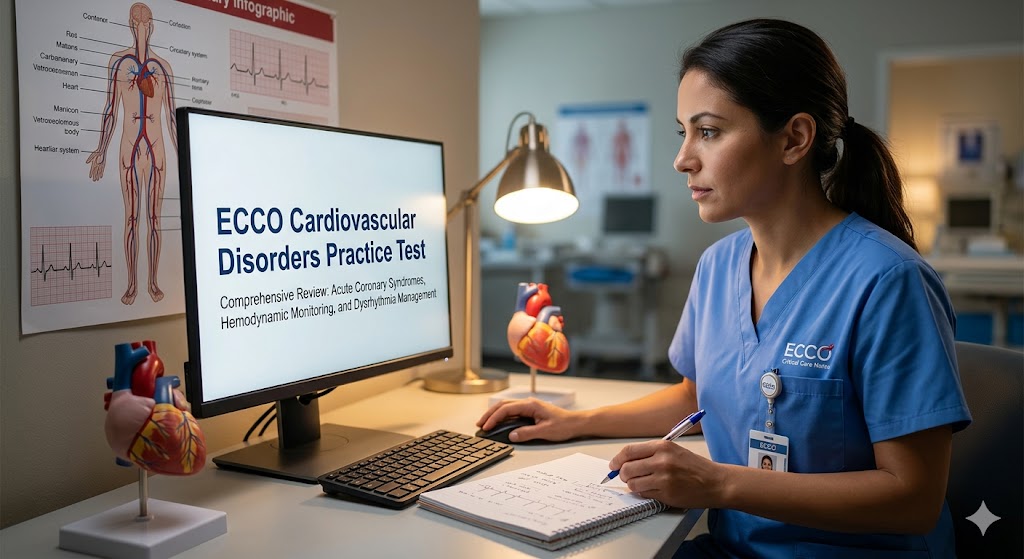
Additional Information
What the Course Entails and Exam Details
The ECCO Cardiovascular Disorders course covers comprehensive knowledge necessary for high-acuity cardiac patient management. The curriculum begins with a deep dive into advanced cardiovascular anatomy and physiology.
Students must understand the pathophysiology of various acute conditions, such as acute coronary syndromes, myocardial infarction, and heart failure. The course places significant emphasis on hemodynamic monitoring principles, including invasive monitoring techniques. Learners are trained to interpret complex ECG dysrhythmias and recognize emergency cardiac events.
Pharmacological management strategies for cardiac patients are heavily featured, focusing on vasopressors, inotropes, and antiarrhythmics. The syllabus also covers common cardiac interventions, surgical procedures, and standard nursing care for patients in cardiac shock.
What to Expect in the Final Exam
The final examination for the ECCO Cardiovascular Disorders module is typically conducted online through a designated learning management system. It is a standardized assessment designed to measure competency in critical thinking and knowledge application.
The exam consists primarily of multiple-choice questions that reflect real-world clinical scenarios. Nurses must achieve a passing score, which is commonly set at 80% or higher, depending on the specific hospital or institutional requirement.
The exam is usually time-limited, often allowing between 60 to 90 minutes to complete. Candidates may not have the option to return to previous questions once they have been submitted.
How to Study and Exam Centers
Effective preparation for this exam requires a proactive and diverse study strategy. First, thoroughly review all ECCO module content, including the assigned readings and interactive scenarios.
Utilization of the ECCO Cardiovascular Disorders Practice Test is one of the most effective methods of study. Take the practice test multiple times to gauge your readiness and familiarize yourself with the question formatting. Pay close attention to the rationales provided for incorrect answers to solidify your understanding. Use flashcards for key medications and ECG rhythms.
Regarding exam centers, the ECCO module exams are typically administered online via the learning platform provided by your healthcare employer. Ensure you have a quiet environment and a stable internet connection before beginning. You may need to complete the assessment under the supervision of a clinical educator or in an authorized education lab at your hospital facility.
Job Opportunities from the Course
Mastery of cardiovascular disorders through the ECCO program significantly enhances a nurse's professional portfolio and career opportunities in high-acuity care. Successful completion demonstrates a strong commitment to specialized knowledge.
This training unlocks numerous specialized job opportunities, including:
Cardiovascular ICU (CVICU) Nurse
Coronary Care Unit (CCU) Nurse
Medical/Surgical ICU Nurse
Post-Anesthesia Care Unit (PACU) Nurse focusing on cardiac patients
Cardiac Catheterization Lab Nurse
Cardiac Progressive Care/Stepdown Unit Nurse
Cardiac Nurse Educator
Frequently Asked Questions
Reviews
5.0
Based on 0 reviews
Leave a Review
No reviews yet. Be the first to review!