
ECG Lead System Practice Test
$69.00
- Buy to unlock unlimited access to all Quiz questions and Answers in this Quiz.
- After purchase you can print a PDF of the whole quiz at any point. The PDF will contain the questions and the correct answers.
About this Exam
The Electrocardiogram (ECG), or EKG, is one of the most vital diagnostic tools in modern medicine, providing a window into the heart's electrical activity. This specialized "ECG Lead System Practice Test" is a comprehensive, interactive educational tool designed specifically for students, nursing professionals, EMS providers, medical technicians, and anybody preparing for official ECG certifications. It is crafted to build a deep, practical understanding of ECG lead systems, electrode placement, waveform analysis, and troubleshooting techniques. This practice resource is not just about memorizing answers; it’s about mastering the principles that ensure accurate cardiac monitoring and diagnosis. Whether you are looking to secure your first healthcare role or aiming to enhance your current skills and prepare for high-stakes certification, this course material is your first step towards cardiac expertise.
Ready to test your knowledge?
Buy Now to Access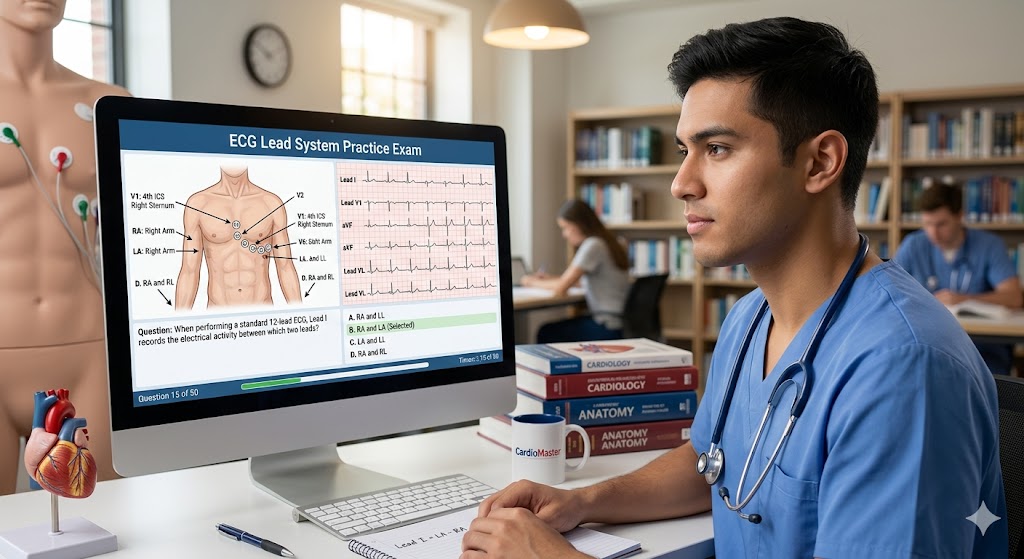
Additional Information
What the Course Entails and Exam Details
The subject matter covered in this comprehensive guide and practice material mirrors the rigorous standards of leading medical education and certification bodies. We’ve distilled this vital knowledge into key domains. Here is what you will master through this detailed study and practice experience:
Cardiac Anatomy & Physiology Foundations: A fundamental grasp of the heart's chambers, blood flow, and, most critically, the intrinsic electrical conduction system (SA node, AV node, Bundle of His, Purkinje fibers). You will learn how these structures translate to the classic P-QRS-T waveforms on an ECG tracing.
The 12-Lead ECG System in Detail: Master the placement and purpose of all 12 standard leads (6 precordial/chest leads and 4 limb leads). You will understand the unique "viewpoint" each lead provides of the heart's electrical vector and how they combine to create a three-dimensional picture.
Practical Lead Acquisition & Electrode Placement: This isn't just theory. Learn the step-by-step techniques for precise electrode application. Understand the crucial roles of proper skin preparation, patient positioning, and techniques for varied patient populations (e.g., pediatric, amputee cases, respiratory issues).
Waveform and Interval Analysis: Deep dive into identifying and measuring each component of the ECG complex: the P wave, PR interval, QRS complex, ST segment, and T wave. Learn normal values and what specific variations and abnormalities can signify within each lead.
Troubleshooting and Artifact Recognition: Learn to distinguish between true cardiac signals and common artifacts (wandering baseline, somatic tremor, AC interference, loose leads). Crucially, master how to identify the cause and quickly resolve these issues to obtain a clean, diagnostically accurate tracing.
Basic Rhythm Interpretation & Clinical Correlations: While focusing heavily on lead systems, the comprehensive material also covers recognizing normal sinus rhythm and simple common arrhythmias, always with a focus on how lead placement affects rhythm detection.
What to Expect in the Final Exam
While the "ECG Lead System Practice Test" allows for unlimited, supportive practice, the subsequent formal certifications or official course assessments you may take to validate your skills typically follow specific, rigorous guidelines. This practice material is meticulously designed to prepare you for these requirements. Final exams, depending on the specific certification body (e.g., NHA Certified EKG Technician, state-level nursing boards, hospital competencies), generally encompass the following:
Comprehensive Multiple-Choice Questions: A substantial portion of your exam will be composed of questions that test your conceptual knowledge, scenario analysis, and interpretation abilities. You'll encounter questions on anatomy, lead placement logic, troubleshooting, and clinical decision-making. These questions are designed not only for knowledge recall but to assess your ability to apply concepts in practical scenarios.
Visual Interpretation of ECG Tracings: A critical skill tested is the ability to read and analyze real or simulated ECG strips. Expect questions that present ECG images from various leads and ask for lead identification, waveform analysis, interval measurements, or basic rhythm interpretation.
Potential Practical or Simulated Skills Assessment: Some exams include a hands-on or detailed simulated component where you might be required to demonstrate proper lead placement, troubleshoot artifact generation in real time, or answer complex questions based on a mock patient case.
Structured Format, Time Limits & Proctored Settings: Official exams are typically administered within a strict time limit (e.g., 1-2 hours) and are proctored, either in a dedicated testing center (e.g., Pearson VUE) or remotely via secure online platforms. Valid identification is required, and strict rules against external aids apply.
Passing Score and Certification: A defined passing score (often ranging from 70% to 80% or equivalent point value) must be achieved to earn your certification. Successfully passing a formal exam will grant you a recognized credential that validates your expertise.
This practice test provides a risk-free environment where you can review your answers, receive immediate feedback with detailed explanations, and identify areas that need more focus, ultimately ensuring you are fully prepared for the structure and content of your final high-stakes assessment.
How to Study and Exam Centers
Effective preparation for your ECG proficiency assessment requires a dynamic blend of structured learning, deep study, and extensive practical application. Here’s a strategic roadmap to guide your efforts:
Create a Consistent Study Plan: Dedicate regular, focused study sessions each week. Consistency is key to long-term knowledge retention.
Engage Deeply with Study Materials: Thoroughly read and take notes from recommended textbooks, comprehensive study guides, and online resources focused on cardiac electrophysiology and ECG lead systems.
Utilize This Comprehensive Practice Test: Take the "ECG Lead System Practice Test" multiple times! Use its interactive features, practice electrode placement simulations, and most importantly, review the detailed explanations for every single correct and incorrect answer. Use these explanations to truly understand why a particular response is accurate. This will build deep conceptual knowledge, not just test-taking skills.
Incorporate Active Learning: Form study groups to discuss concepts, create flashcards for key terms and values, and teach material to others to solidify your understanding. Label diagrams of the heart's conduction system and proper lead locations from memory.
Practical Skill Application: Practice proper lead placement techniques on a volunteer, a CPR mannequin, or a model, explaining the rationale behind each step. Focus on achieving a clean signal and identifying potential artifacts.
Simulate Exam Conditions: As you build confidence, attempt to complete this practice test within the time limits of your final official exam to build speed and stamina. Identify and target your weakest areas for extra practice.
Exam Centers (for Formal Certifications):
Once you are confident in your knowledge and have fully utilized our comprehensive practice materials, you will need to register for your official certification or course assessment. While this specific practice resource is typically accessed and completed online via your provided educational platform, real-world exams are generally administered in several ways:
Authorized Physical Testing Centers: Many leading certifications utilize established, secure networks like Pearson VUE or Prometric. These centers offer a controlled, proctored environment for your test-taking.
Educational Institutions & Affiliated Hospitals: Your current school, college, or hospital employer may be an authorized testing site or have relationships with specific certification bodies to facilitate exams for their students and staff.
Secure Online Remote Proctoring: Increasingly, certification bodies offer the convenience of taking your exam from home using live or recorded remote proctoring software, allowing you to complete your assessment from almost anywhere with a stable internet connection.
Job Opportunities from the Course
Mastering the complexities of ECG lead systems and interpretation isn't just about passing a test; it's about unlocking a fundamental skill and paving the way for numerous fulfilling and high-demand healthcare careers. A deep understanding in this area is a core requirement and powerful asset for a wide range of rewarding paths. Successfully mastering this crucial knowledge, alongside pursuing any necessary subsequent certifications, will prepare you for specific roles and career advancement opportunities. A comprehensive list of potential career paths follows:
ECG / EKG Technician (often requiring or benefiting from specific certification)
Nurse (Registered Nurse, Licensed Practical/Vocational Nurse across various specialties such as cardiology, ICU, Emergency Room, etc.)
Emergency Medical Technician (EMT)
Paramedic
Cardiac Monitor Technician
Cardiac Rehabilitation Technician
Medical Assistant
Cardiovascular Technologist (with potential for advanced specialization)
Veterinary Technician (increasingly incorporating ECG analysis for animal patients)
Healthcare Education / Instructor (training future cardiac professionals)
Research Assistant (in cardiac studies and clinical trials)
Telehealth Provider (using remote cardiac monitoring technologies)
Frequently Asked Questions
Reviews
5.0
Based on 0 reviews
Leave a Review
No reviews yet. Be the first to review!