
Ecology Science Olympiad Practice Test
$69.00
- Buy to unlock unlimited access to all Quiz questions and Answers in this Quiz.
- After purchase you can print a PDF of the whole quiz at any point. The PDF will contain the questions and the correct answers.
About this Exam
The Ecology Science Olympiad event is a premier biology competition designed for middle school (Division B) and high school (Division C) students across the United States. This rigorous event challenges participants to apply their knowledge of ecological principles, ecosystem dynamics, and environmental science through critical thinking and problem-solving scenarios. It is not merely a memory test; it is an exploration of how living organisms interact with their physical environments. This event is designed for students who are passionate about the natural world, conservation, sustainability, and biological research. It provides an excellent platform for aspiring scientists to deepen their understanding of complex global ecosystems.
Ready to test your knowledge?
Buy Now to Access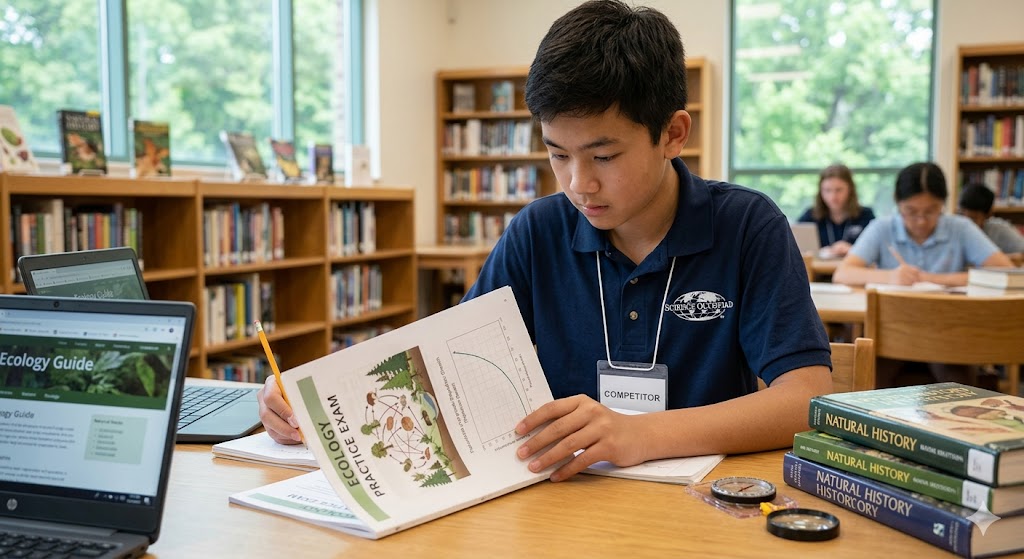
Additional Information
What the Course Entails and Exam Details
While not a "course" in the traditional academic sense, preparation for the Ecology event requires studying a comprehensive syllabus akin to an advanced biology or environmental science curriculum. The core focus areas generally include the fundamental principles of ecology, ecosystem structure, and energy flow. Students must master topics such as population dynamics, including growth curves and carrying capacity, and community interactions, like symbiosis, predation, and competition. The syllabus extends to biogeochemical cycles, including the water, carbon, nitrogen, and phosphorus cycles. Furthermore, participants must understand major biomes, biodiversity conservation strategies, and the impact of human activity on ecosystems, such as pollution, invasive species, and climate change. The event frequently includes a section on identifying organisms or interpreting field data.
What to Expect in the Final Exam
The Ecology "exam" is a competitive event held at Science Olympiad tournaments. It typically involves a team of two students working together. The format is versatile; it can be a written test composed of multiple-choice, matching, fill-in-the-blank, and short-answer questions, or it can be a "station" format where teams rotate through different lab setups or data analysis challenges. These stations may require analyzing graphs, identifying species from specimens or pictures, conducting water quality calculations, or interpreting ecological field data. The time limit is strict, usually around 50 minutes, demanding quick thinking and efficient collaboration. The passing score is relative, as teams are ranked against other competitors. Specific rules regarding allowed materials, such as a single binder of notes or specific calculator models, are outlined in the official Science Olympiad Rules Manual for the current year.
How to Study and Exam Centers
Effective study for the Ecology event requires a multi-faceted approach. Students should first master the official Science Olympiad rules manual and use it as their primary syllabus. Recommended study materials include standard biology textbooks (like Campbell Biology), environmental science texts, and official practice tests available through the Science Olympiad website and various invitationals. Creating a well-organized reference binder, which is often permitted in the competition, is crucial. This binder should contain condensed notes, diagrams, cycles, and identification guides. Field practice, such as visiting local ecosystems and practicing species identification, is highly valuable. Unlike professional certifications, these "exams" are not taken at testing centers like Pearson VUE; they are held at tournament locations. These locations are typically middle schools, high schools, or university campuses that host regional, state, and national Science Olympiad tournaments. Participation is managed through your school's Science Olympiad coach.
Job Opportunities from the Course
While the Ecology event itself is a competition and not a job certification, the deep knowledge, critical thinking, and teamwork skills developed are directly applicable to numerous prestigious career paths in the biological and environmental sciences. Excelling in this event can be a significant addition to a college application and provides a strong foundation for future study. The experience prepares students for academic and professional roles such as:
Ecologist
Conservation Biologist
Wildlife Biologist
Environmental Scientist
Zoologist
Forestry Technician
Marine Biologist
Restoration Ecologist
Environmental Consultant
Sustainability Specialist
Frequently Asked Questions
Reviews
5.0
Based on 0 reviews
Leave a Review
No reviews yet. Be the first to review!