
Economics and Personal Finance Practice Exam
$69.00
- Buy to unlock unlimited access to all Quiz questions and Answers in this Quiz.
- After purchase you can print a PDF of the whole quiz at any point. The PDF will contain the questions and the correct answers.
About this Exam
The [Economics and Personal Finance Practice Exam] is a essential preparatory tool designed for individuals, primarily high school students and adult learners, who are working towards a foundational understanding of both micro/macroeconomic principles and real-world financial management skills. This exam typically serves as the final assessment for a dedicated 'Economics and Personal Finance' course, which is a mandatory graduation requirement in many states. It is also utilized as a general financial literacy benchmark to measure a learner's readiness to make informed, lifelong financial decisions and understand the broader economic forces that shape their world.
Ready to test your knowledge?
Buy Now to Access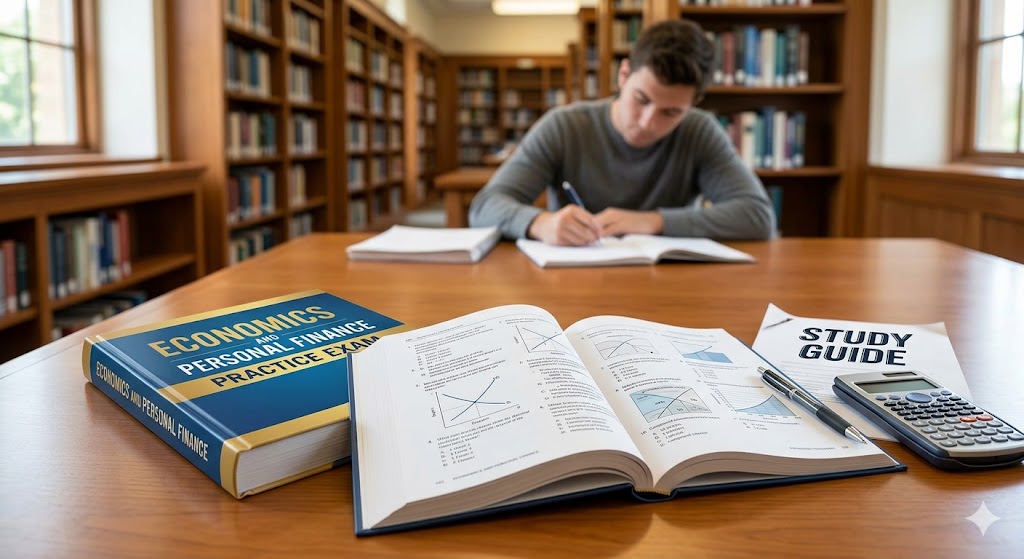
Additional Information
What the Course Entails and Exam Details
The underlying course for the [Economics and Personal Finance Practice Exam] covers a comprehensive curriculum structured to blend theoretical economic knowledge with practical financial application. Learners will delve into two primary domains:
Core Economics Topics:
Fundamental Concepts: Scarcity, opportunity cost, and the economic way of thinking.
Microeconomics: Supply and demand, market structures, price determination, and the role of competition.
Macroeconomics: Measuring the economy (GDP, inflation, unemployment), monetary and fiscal policy, and international trade.
Core Personal Finance Topics:
Earning and Reporting Income: Understanding paychecks, taxes (local, state, federal), and employee benefits.
Managing Money: Creating and maintaining budgets, using banking services, and cash management.
Spending and Credit: Wise consumerism, understanding credit scores, types of loans (e.g., mortgages, auto), and managing debt.
Saving and Investing: Strategies for building wealth, compound interest, investment vehicles (stocks, bonds, mutual funds), and retirement planning.
Protecting and Insuring: Assessing and managing risk, identity theft, and types of insurance (health, life, property, auto).
The [Economics and Personal Finance Practice Exam] itself is designed to mirror the structure and content of the final, official assessment.
What to Expect in the Final Exam
While the exact specifications of the final exam can vary by state, educational institution, or test provider, the [Economics and Personal Finance Practice Exam] prepares you for a standardized format with the following likely characteristics:
Format: Primarily consist of objective questions, most commonly multiple-choice, to assess a broad range of knowledge efficiently. Some advanced versions may include short-answer or scenario-based problem-solving questions.
Number of Questions: Often ranges from 50 to 100 questions.
Time Limit: Typically a timed exam, allowing approximately 60 to 120 minutes for completion.
Passing Score: The required passing score is generally determined by the specific school district or state board of education, commonly set around 60-70%.
Specific Rules: In many standardized settings, calculators might be permitted for the personal finance section, but not for the pure economic theory questions. No outside resources are allowed.
How to Study and Exam Centers
Preparation is key to succeeding on the [Economics and Personal Finance Practice Exam] and the official test.
Actionable Study Strategies:
Leverage Practice Exams Regularly: Take full-length, timed [Economics and Personal Finance Practice Exam] multiple times. This builds stamina, highlights weak areas, and familiarizes you with the question phrasing and pacing. Analyze your answers, especially the incorrect ones.
Deep-Dive into Key Concepts: Do not just memorize terms; understand the relationships. Be able to explain how an increase in supply affects price and quantity, or how a credit score influences a loan's interest rate.
Use Visual Aids and Real-World Application: Map out supply and demand curves. Create a personal budget on a spreadsheet. Use compound interest calculators to see how small investments can grow over time.
Form Study Groups: Collaborating with peers can provide different perspectives on complex economic theories and practical finance dilemmas.
Exam Centers: The [Economics and Personal Finance Practice Exam] is typically hosted on educational platforms, teacher-managed sites, or specialized test prep portals. The official final exam is most often administered by schools and educational institutions as part of their end-of-course assessments. If you are taking a standardized national version, such as the W!se Financial Literacy Certification or a CTECS exam, it might be administered in your classroom under teacher supervision or at designated computer labs within your school or local testing centers.
Job Opportunities from the Course
While the 'Economics and Personal Finance' certification itself is not a professional license, mastering this material unlocks career advantages. It demonstrates a level of financial capability that is highly valued across all industries. Individuals with a strong grasp of these concepts are better equipped to navigate the modern workplace and pursue careers in the following sectors:
Consumer Banker
Credit Counselor
Customer Service Representative (Financial Services)
Account Manager
Entry-level Financial Analyst
Loan Officer assistant
Taxes and Payroll Clerk
Budget Analyst (Entry-level, Government/Non-profit)
All business-related roles demanding financial literacy.
Positions that benefit from understanding consumer behavior.
Frequently Asked Questions
Reviews
5.0
Based on 0 reviews
Leave a Review
No reviews yet. Be the first to review!