
Economics for Hawaii Teachers Practice Test
$69.00
- Buy to unlock unlimited access to all Quiz questions and Answers in this Quiz.
- After purchase you can print a PDF of the whole quiz at any point. The PDF will contain the questions and the correct answers.
About this Exam
Welcome to your essential guide for mastering the economics and pedagogical requirements to become a qualified economics teacher in Hawaii. This comprehensive article is specifically designed for current educators seeking to add an endorsement or aspiring teachers navigating licensure in the Aloha State. The focus here is on the expectations, content, and preparation strategies (including essential practice tests) needed to successfully demonstrate your proficiency in economic principles and how to effectively teach them within a Hawaii context. Whether you're aiming for a state-required certification like the Praxis Economics (5911) test or completing a dedicated professional development program like those offered by the Hawaii Council on Economic Education (HCEE) in partnership with Hawaii Pacific University, this guide has you covered.
Ready to test your knowledge?
Buy Now to Access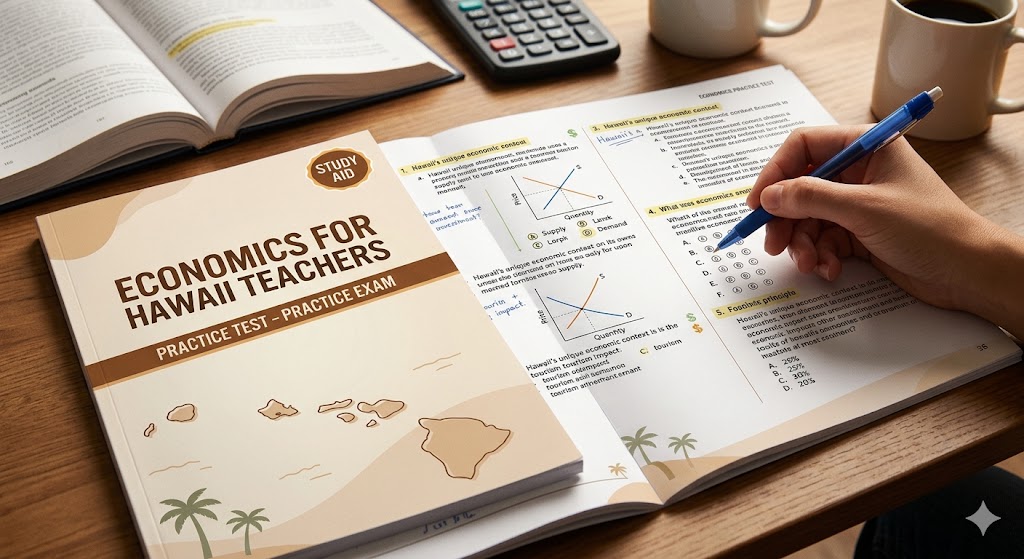
Additional Information
What the Course Entails and Exam Details
Preparing to teach economics to Hawaii students is a multi-faceted journey that blends rigorous understanding of general economic principles with essential pedagogical strategies and local context. While the specific pathway might vary—from general licensure exams to course-based assessments—the core content usually aligns with national standards and is tailored for Hawaii's unique setting.
Your journey will likely involve:
Core Economic Concepts: Mastering fundamental ideas like scarcity, choice, opportunity cost, supply and demand, and various market structures. You'll dive deep into both Microeconomics (individual/firm decision-making) and Macroeconomics (national/global economic performance, fiscal and monetary policies).
The Hawaiian Context: Understanding and integrating unique aspects of Hawaii's economy, history, and policies. This might include analyzing Hawaii's high housing costs, the impact of tourism, historical economic shifts, and contemporary local policies.
Curriculum & Instruction: Learning how to translate complex economic ideas into engaging lesson plans suitable for middle and high school students. You might even create and present original lesson plans as part of specific courses.
The final exam, in this context, refers to the high-stakes evaluation that concludes your study or program. For general licensure, this is typically a standardized exam like the Praxis Economics (5911). For specific PD programs, it could be a comprehensive final exam wrapping up several weeks of coursework, quizzes, and project-based assessments.
What to Expect in the Final Exam
Knowing what to expect is half the battle won. The final test you face will measure your understanding and ability to apply both economics and education concepts.
Exam Formats:
Praxis Economics (5911): If your requirement is the Praxis exam, expect a computer-delivered test with 110 selected-response (multiple-choice) questions. The questions are divided into key content categories: Fundamental Economic Concepts, Microeconomics, and Macroeconomics.
Course-Based Assessments: A final assessment for a dedicated PD program often includes multiple-choice questions but could also encompass short answers, an essay, or the final evaluation of key course projects like lesson plans and presentations.
Passing Score Requirements:
Praxis: The passing scaled score required is typically around 150 (out of 200), though this can vary slightly based on state requirements, so always check with the Hawaii Teacher Standards Board (HTSB).
PD Courses: Programs usually require a minimum overall grade, with the final exam counting for a significant portion, or the completion of all projects and assessments to a satisfactory standard.
Time Limits & Specific Rules:
Praxis: You will have two hours (120 minutes) to complete the full exam. Specific rules regarding arrive-early procedures, valid identification, electronic devices, and scratch paper are strict and clearly detailed in the Praxis Information Bulletin and testing center guidelines. Remote proctoring options have their own specific technology and environment requirements.
Course Assessments: Deadlines for quizzes, projects, and the final exam are set by the program instructors. If delivered online, there might be specific windows or time limits for the final test itself.
How to Study and Exam Centers
Preparation is the absolute cornerstone of success, and this includes a strong focus on practice tests. Here's a powerful combination of strategies:
Study Materials:
Leverage official study guides and resources provided by the exam/program administrator (ETS for Praxis, HCEE/University of Hawaii for specific courses).
Utilize established economics textbooks and online resources (e.g., resources from the Council for Economic Education, the Federal Reserve, and reputable educational platforms).
Incorporate Hawaii-specific context from reliable local government sites, historical documents, and economic analysis reports.
Take Multiple Practice Tests:
This is essential. Use provided sample questions, official Praxis practice tests, and any assessments from your PD course to simulate the real exam experience.
Timed practice helps with pacing; untimed practice allows you to dissect question structures and identify knowledge gaps without pressure.
Analyze every wrong answer to understand the concepts you need to review. The repetition of doing practice tests is a proven memory-aid.
Where and How to Take the Exam:
Praxis: Register online through Educational Testing Service (ETS). You can choose to take the test in person at authorized testing centers (which may include physical centers or approved schools/institutions) across Hawaii or even remotely through their At Home testing option, provided you meet the strict equipment and environment requirements.
Course-Based assessments: These are typically delivered through the online learning portal of the administering university or organization (e.g., Hawaii Pacific University's system, HCEE's platform), both for quizzes and final assessments.
Job Opportunities from the Course
Mastering the requirements to teach economics in Hawaii unlocks numerous rewarding and critical roles within the education sector:
Economics Teacher (Middle & High School): Confidently teach dedicated economics courses or integrated social studies units, fulfilling state standards and equipping students with crucial life skills.
Social Studies Teacher (with Economics specialization): Stand out as a valuable asset for schools needing teachers capable of delivering diverse social science curricula with a strong economic foundation.
Curriculum Developer: Design engaging and effective economics educational materials, particularly resources that blend core principles with essential Hawaii-specific examples and pedagogical approaches.
Professional Development Facilitator: Share your expertise by training other educators, either through programs like HCEE or state-wide initiatives.
Roles in State Education Departments & Advocacy: Contribute to education policy, standards, and advocacy related to economic literacy.
Frequently Asked Questions
Reviews
5.0
Based on 0 reviews
Leave a Review
No reviews yet. Be the first to review!