
EDAPT Altered Mobility Practice Test
$69.00
- Buy to unlock unlimited access to all Quiz questions and Answers in this Quiz.
- After purchase you can print a PDF of the whole quiz at any point. The PDF will contain the questions and the correct answers.
About this Exam
The EDAPT Altered Mobility course is a vital component of modern nursing education, particularly within programs emphasizing adaptive, scenario-based learning. It is designed for nursing students and current healthcare professionals seeking to deepen their expertise in managing patients with impaired movement. This module focuses on the pathophysiological effects of immobility and the critical nursing interventions needed to prevent common complications and promote safety. For students preparing for licensure or comprehensive assessments, a practice test on this topic is an indispensable tool for gauging readiness and strengthening clinical reasoning.
Ready to test your knowledge?
Buy Now to Access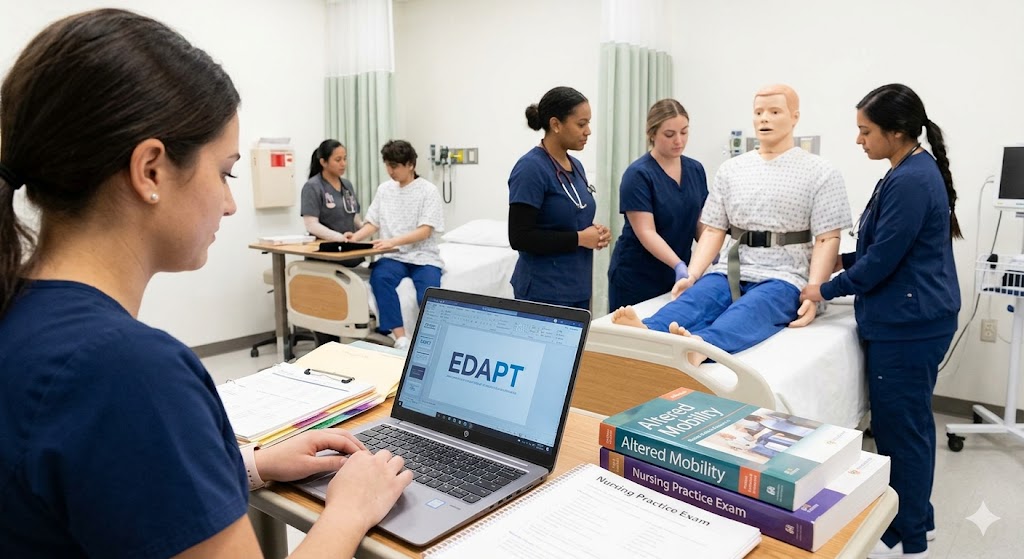
Additional Information
WHAT THE COURSE ENTAILS AND EXAM DETAILS
This course takes a holistic approach to patient mobility, covering the physical, psychological, and systemic consequences of reduced movement. It ensures that learners understand the evidence-based principles required to provide safe, high-quality care.
Key core topics covered within the course and practice exam usually include:
Pathophysiology of Immobility: Understanding how bedrest affects the cardiovascular, respiratory, musculoskeletal, metabolic, and integumentary systems.
Assessment of Mobility Status: Learning to evaluate range-of-motion (ROM), muscle strength, gait, balance, and activity tolerance.
Safe Patient Handling and Transfer Techniques: Proper body mechanics and the correct use of assistive devices such as gait belts, walkers, canes, and crutches.
Prevention of Complications: Essential nursing interventions to avoid deep vein thrombosis (DVT), pressure injuries (bedsores), atelectasis, pneumonia, contractures, and foot drop.
Therapeutic Positioning and ROM Exercises: Implementing passive and active range-of-motion, and utilizing therapeutic positions (e.g., Fowler’s, supine, lateral).
WHAT TO EXPECT IN THE FINAL EXAM
The EDAPT Altered Mobility Practice Test is structured to mimic the complexity and format of your graded adaptive learning unit assessments. It serves as a simulation, providing feedback on your command of the material before you encounter higher-stakes evaluations.
You should expect the following format details:
Exam Format: This is an online, computer-based test that is generally adaptive. This means the question difficulty may adjust based on your previous answers. The questions are almost exclusively multiple-choice, including single-best-answer and "Select All That Apply" (SATA) formats, which test your depth of comprehensive knowledge.
Passing Score: Because EDAPT is a mastery-based platform, the target score for "mastery" or a passing grade is typically very high, often set at 80% to 90%. In many settings, students must continue taking practice and final adaptive tests until this benchmark is achieved.
Time Limits: While some practice tests are untimed to allow for study, they are generally designed to be completed within a specific timeframe (e.g., 45 to 60 minutes) to prepare you for the time pressure of standardized licensing exams.
HOW TO STUDY AND EXAM CENTERS
Success on this practice test relies heavily on proactive engagement with the online module content and the application of theoretical knowledge to clinical scenarios.
Consider these actionable study strategies:
Master the "Why" Behind Interventions: Do not just memorize interventions; understand the rationale. For example, do not just know that a patient needs to be turned every two hours; know that this is to prevent tissue ischemia and pressure injuries by relieving prolonged pressure on bony prominences.
Focus on Systemic Complications: Create a study chart mapping each body system (Respiratory, Cardiovascular, Musculoskeletal) to the specific complications caused by immobility (e.g., Atelectasis, DVT, Muscle Atrophy) and the corresponding nursing assessment and intervention.
Utilize the Adaptive Feedback: When taking practice scenarios in the EDAPT platform, pay close attention to the explanations for both correct and incorrect answers. This feedback is tailored to address your specific knowledge gaps.
Regarding Exam Centers: The EDAPT Altered Mobility module is a learning tool integrated into specialized educational programs (such as Chamberlain University). Therefore, the practice test is administered online through your institution’s Learning Management System (LMS) or the dedicated EDAPT online portal. It is not generally taken at physical third-party centers like Pearson VUE.
JOB OPPORTUNITIES FROM THE COURSE
A robust understanding of altered mobility is a foundational competency expected in virtually all direct patient care roles. Successfully mastering this content enhances your employability across diverse healthcare settings.
The knowledge gained from this course unlocks several career paths, including:
Medical-Surgical Nurse: Managing complex care for patients requiring mobility assistance post-surgery or during acute illness.
Rehabilitation Nurse: Specialized care for patients recovering from strokes, spinal cord injuries, or orthopedic trauma.
Geriatric/Long-Term Care Nurse: Focus on preventing immobility complications in the elderly population.
Orthopedic Nurse: Providing care for patients with fractures or joint replacements, emphasizing safe mobilization.
Critical Care Nurse: Preventing systemic failure due to immobility in highly vulnerable patients.
Home Health Nurse: Assessment and education of patients and caregivers regarding safe transfers and mobility in the home environment.
Frequently Asked Questions
Reviews
5.0
Based on 0 reviews
Leave a Review
No reviews yet. Be the first to review!