
EDAPT Homeostasis and Elimination Practice Test
$69.00
- Buy to unlock unlimited access to all Quiz questions and Answers in this Quiz.
- After purchase you can print a PDF of the whole quiz at any point. The PDF will contain the questions and the correct answers.
About this Exam
The EDAPT Homeostasis and Elimination Practice Test is a vital educational resource specifically designed for students pursuing careers in nursing, healthcare, and the biological sciences. This comprehensive practice exam serves as a robust self-assessment tool to measure your understanding of two fundamental pillars of human physiology: homeostasis and elimination. It is an essential component for individuals preparing for high-stakes licensure exams such as the NCLEX-RN and NCLEX-PN, or for those enrolled in rigorous anatomy, physiology, and basic nursing concepts courses. By utilizing this practice test, you will identify knowledge gaps, build confidence, and solidify your grasp of the critical concepts required for safe and effective patient care.
Ready to test your knowledge?
Buy Now to Access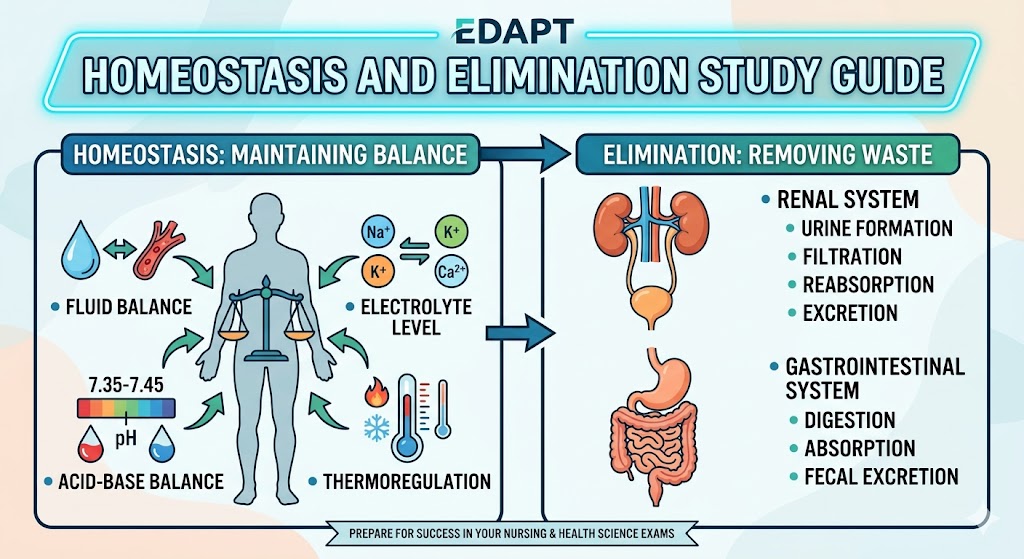
Additional Information
What the Course Entails and Exam Details
This study guide and the associated practice test focus on the complex, interconnected systems the human body uses to maintain a stable internal environment and efficiently remove waste products. The content is aligned with the core syllabus of modern nursing and health science programs. The key areas covered in the practice test include:
Principles of Homeostasis: Understanding the concept of dynamic equilibrium, negative and positive feedback loops, and the roles of the nervous and endocrine systems in regulation.
Fluid and Electrolyte Balance: The distribution of body fluids (ICF, ECF), the role of electrolytes (Sodium, Potassium, Calcium, Magnesium, Phosphate) and their regulation.
Acid-Base Balance: The physiological buffer systems (bicarbonate, phosphate, protein), the role of the lungs and kidneys in maintaining pH, and interpreting arterial blood gas (ABG) values.
Thermoregulation: Mechanisms of heat production, conservation, and loss, and the body's response to hypothermia and hyperthermia.
The Renal System and Urinary Elimination: Anatomy of the kidney and nephron, urine formation (filtration, reabsorption, secretion), regulation of urine volume and concentration, and common alterations in urinary elimination (e.g., incontinence, retention, infection).
The Gastrointestinal System and Bowel Elimination: Anatomy of the GI tract, mechanisms of digestion and absorption, and common alterations in bowel elimination (e.g., constipation, diarrhea, impaction).
What to Expect in the Final Exam
While the exact format of your specific final exam may vary depending on your institution or the specific program you are enrolled in, the EDAPT Homeostasis and Elimination Practice Test is designed to mirror the style and rigor of standard nursing licensure and comprehensive course exams. Here is what you should generally expect:
Exam Format: The practice test and many final exams consist primarily of multiple-choice questions. You may also encounter other item types, such as select-all-that-apply (SATA), fill-in-the-blank, and ordering questions.
Question Style: The questions are often application-based and use clinical scenarios. Instead of simply asking for definitions, they require you to synthesize your knowledge to prioritize patient care, interpret data, and make sound clinical judgments. For example, you might be given patient symptoms and laboratory values and asked to identify the most likely electrolyte imbalance and the appropriate nursing intervention.
Passing Score: The required passing score is determined by your individual program or the licensing body. It is crucial to check with your instructor for the exact score needed to pass. Use the practice test to aim for a score well above the minimum to ensure proficiency.
Time Limit: Expect a timed exam to simulate the pressure of a real testing environment. The practice test will help you build your pacing skills to ensure you can complete all questions within the allotted time.
How to Study and Exam Centers
Preparation is the key to success. Here is a multifaceted study strategy to help you master the material for the EDAPT Homeostasis and Elimination exam:
Utilize Active Learning: Do not just reread your textbook. Create concept maps to connect homeostasis to specific organ systems. Draw diagrams of the nephron and the digestive tract, labeling their functions in elimination.
Focus on "Why" and "How": For every physiological process, understand the mechanism. For example, instead of just memorizing that the body retains water when dehydrated, understand the role of Antidiuretic Hormone (ADH) and how it acts on the collecting ducts of the kidney.
Practice NCLEX-Style Questions: This is crucial. The EDAPT practice test is an excellent start, but also utilize additional question banks (e.g., UWorld, Kaplan, Saunders) that focus on application and analysis. Analyze the rationals for both correct and incorrect answers.
Form Study Groups: Explaining concepts to others is one of the best ways to solidify your own understanding. Quiz each other on critical values and patient scenarios.
Regarding Exam Centers and Taking the Test:
The "EDAPT" component indicates that this is a practice test, likely administered through your educational institution's online learning management system (e.g., Canvas, Blackboard, Moodle). You would take it online from your personal computer.
The final, high-stakes exams this practice test prepares you for (like the NCLEX) are proctored and taken at authorized testing centers. Major examples include Pearson VUE centers, which have locations worldwide, and specific physical testing centers located within authorized nursing schools or universal testing facilities. Always refer to your program's guidelines for exact instructions on where and how to register for your final proctored exam.
Job Opportunities from the Course
Mastering the concepts of homeostasis and elimination is not just a hurdle to pass an exam; it is a fundamental skill set required for safe and effective clinical practice. This knowledge is essential for numerous rewarding career paths in the healthcare field, including:
Registered Nurse (RN)
Licensed Practical Nurse (LPN) / Licensed Vocational Nurse (LVN)
Patient Care Technician (PCT)
Medical Assistant
Renal / Dialysis Technician
Surgical Technologist
Emergency Medical Technician (EMT) / Paramedic
Frequently Asked Questions
Reviews
5.0
Based on 0 reviews
Leave a Review
No reviews yet. Be the first to review!