
EDAPT Infection Practice Test
$69.00
- Buy to unlock unlimited access to all Quiz questions and Answers in this Quiz.
- After purchase you can print a PDF of the whole quiz at any point. The PDF will contain the questions and the correct answers.
About this Exam
The EDAPT NCLEX Readiness: Safety and Infection Control practice test is an essential diagnostic and preparatory tool designed for nursing students and graduates on their journey to becoming licensed nurses. Specifically tailored to the "Safety and Infection Control" client needs category of the National Council Licensure Examination (NCLEX), this exam simulates the rigor and style of the final licensure test. It is designed to evaluate a candidate’s understanding of critical principles required to prevent the spread of infection and maintain a safe environment for both patients and healthcare workers, which is a foundational aspect of all nursing practice.
Ready to test your knowledge?
Buy Now to Access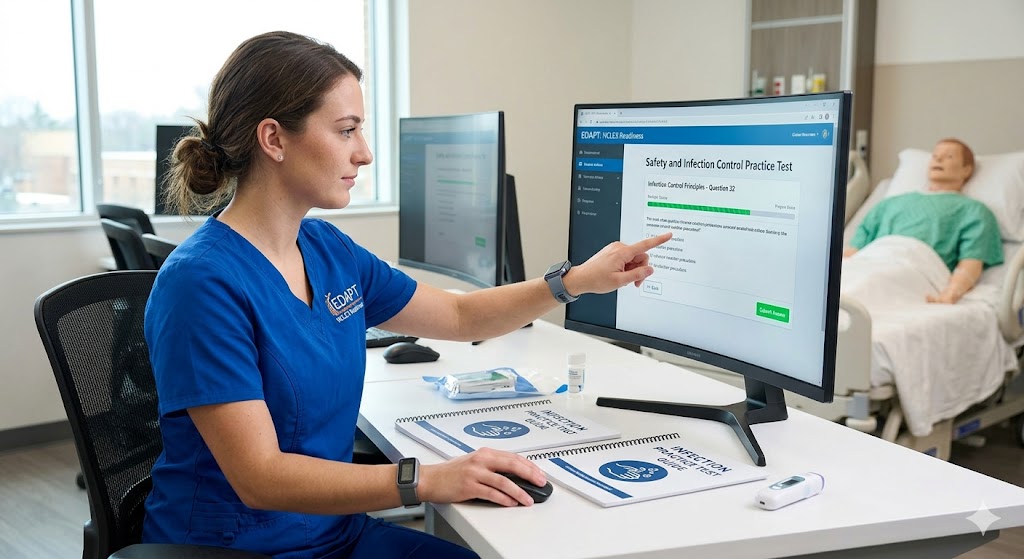
Additional Information
What the Course Entails and Exam Details
The preparatory content leading to the EDAPT Infection Practice Test is comprehensive and covers a wide array of topics critical to contemporary healthcare. The practice exam itself is designed to test knowledge across these key domains:
Hand Hygiene: Techniques, timing, and indications for both soap-and-water washing and alcohol-based hand sanitizer.
Standard and Transmission-Based Precautions: Detailed understanding of Contact, Droplet, and Airborne precautions, including specific personal protective equipment (PPE) requirements for each.
Sterile Technique (Surgical Asepsis): Creating and maintaining a sterile field, including procedures like catheterization and wound dressing changes.
Safe Handling of Hazardous Materials: Principles of managing medical waste, sharps disposal, and chemical safety.
Accident and Injury Prevention: Measures to ensure client safety, including fall prevention and correct use of restraints.
Disaster Planning and Emergency Response: The nurse’s role in facility-specific emergency protocols.
What to Expect in the Final Exam
As a specialized preparatory module, the EDAPT Infection Practice Test is created to mirror the final NCLEX experience, providing students with a realistic preview. While it is not the actual licensure exam, it incorporates several NCLEX characteristics:
Format: The exam predominantly features "best-of-five" multiple-choice questions, but it also includes computer-based alternate format questions such as "Select All That Apply" (SATA), "Drag and Drop" (for ordering procedures), and hot-spot items.
Adaptive Testing: The "EDAPT" component implies an element of computerized adaptive testing (CAT), where the difficulty of the questions adjusts based on the test-taker's performance to precisely measure their competence.
Passing Score: Scoring is typically designed to give students a high probability of passing the actual NCLEX if they score within a certain percentile, rather than just a simple percentage.
Time Limit: Similar to a section of the NCLEX, this practice test will likely have a set time limit to test speed and decision-making under pressure.
How to Study and Exam Centers
Preparation for this practice test requires dedication and a strategic approach. We recommend a multi-faceted study plan:
Utilization of the EDAPT Platform: Fully engage with all learning modules and diagnostic quizzes within the system to identify weak areas.
Review of Rationales: After completing practice questions, meticulously review both correct and incorrect answers to understand the clinical reasoning behind them. This is the most crucial part of studying.
Timed Practice Sessions: Simulate the testing environment by taking the practice exam under real time constraints without distractions.
Resource Integration: Supplemental study with standard nursing textbooks and NCLEX review guides focused on safety and infection control.
As the EDAPT product is an online preparatory tool, students take the practice test via the designated EDAPT web portal on a personal computer. The final licensure exam, the NCLEX-RN or NCLEX-PN, must be scheduled and taken in person at an authorized Pearson VUE testing center worldwide.
Job Opportunities from the Course
While the EDAPT Infection Practice Test is not a standalone qualification that directly leads to a job, it is a critical milestone in passing the NCLEX. Successfully clearing the NCLEX is the prerequisite for obtaining licensure and unlocking a vast landscape of career opportunities. Below are job titles and career paths available after becoming a licensed nurse:
Registered Nurse (RN)
Licensed Practical Nurse (LPN) / Licensed Vocational Nurse (LVN)
Medical-Surgical Nurse
Critical Care Nurse
Infection Control Nurse
Operating Room (OR) Nurse
Home Health Nurse
Pediatric Nurse
Public Health Nurse
Travel Nurse
Frequently Asked Questions
Reviews
5.0
Based on 0 reviews
Leave a Review
No reviews yet. Be the first to review!