
EDAPT The Urinary System Practice Test
$69.00
- Buy to unlock unlimited access to all Quiz questions and Answers in this Quiz.
- After purchase you can print a PDF of the whole quiz at any point. The PDF will contain the questions and the correct answers.
About this Exam
The [EDAPT The Urinary System Practice Test] is an essential preparatory tool designed for students, aspiring healthcare professionals, and anyone currently studying anatomy and physiology. This practice exam is specifically tailored for those aiming to solidify their understanding of renal function and structure before taking a final, graded assessment. It helps learners evaluate their readiness, identify knowledge gaps, and build confidence in mastering the complexities of the urinary system.
Ready to test your knowledge?
Buy Now to Access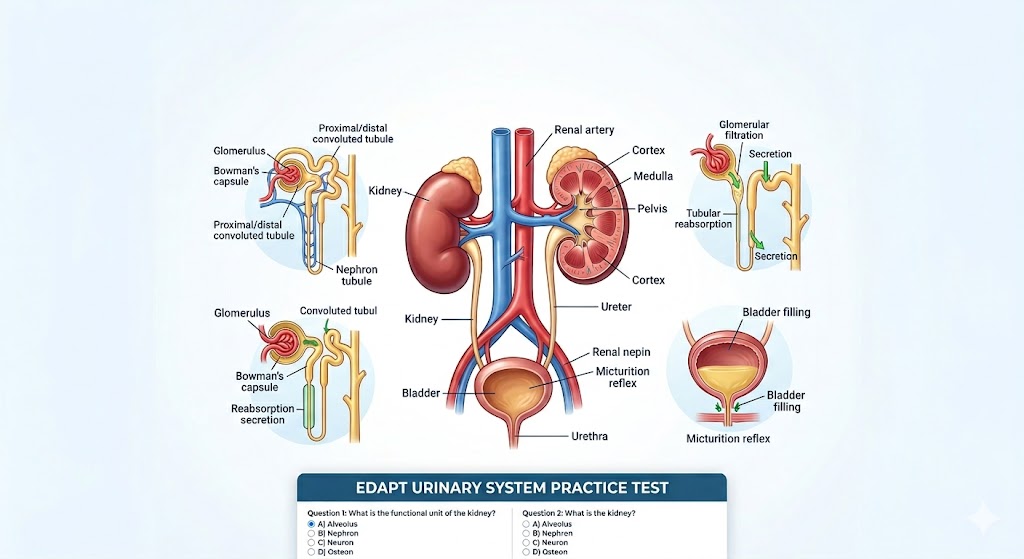
Additional Information
What the Course Entails and Exam Details
This study guide and practice test cover all the foundational aspects of the human urinary system. The core topics included in the curriculum and assessment generally focus on:
Gross Anatomy: Identifying the kidneys, ureters, urinary bladder, and urethra, including their locations and structure.
Microscopic Anatomy (Histology): Detailed understanding of the nephron (renal corpuscle, glomerulus, Bowman’s capsule, proximal and distal tubules, Loop of Henle, and collecting ducts).
Renal Physiology: The processes of glomerular filtration, tubular reabsorption, and tubular secretion.
Urine Formation and Composition: How urine is concentrated and the normal constituents of urine versus abnormal findings (urinalysis).
Fluid, Electrolyte, and Acid-Base Balance: The kidney's crucial role in maintaining homeostasis, including the renin-angiotensin-aldosterone system (RAAS) and the effect of antidiuretic hormone (ADH).
Micturition Reflex: The physiology of urination.
What to Expect in the Final Exam
While the format can vary depending on the specific institution or platform administering the final exam for which this EDAPT resource prepares you, most anatomy and physiology exams share common characteristics.
Format: The final exam typically consists of multiple-choice questions, which may include matching, true/false, and labeling diagrams of the urinary system. Some advanced exams might include short-answer questions.
Time Limit: Expect a timed environment, often ranging from 60 to 90 minutes.
Passing Score: A passing score generally falls between 70% and 80%, depending on your specific program's requirements.
Specific Rules: Final exams are usually proctored (either in person or remotely) and are closed-book, meaning no outside notes or resources are allowed.
How to Study and Exam Centers
Preparation is key to succeeding on the urinary system exam. Here are actionable strategies:
Utilize the EDAPT Practice Test: Take the practice test multiple times. Review the rationales for both correct and incorrect answers to understand the "why" behind each question.
Use Visual Aids: Study labeled diagrams of the nephron and the kidney’s cross-section extensively. Draw them yourself to reinforce memory.
Focus on Physiology: Don't just memorize structures; focus on the processes. Understand how blood pressure affects filtration and where specific electrolytes are reabsorbed.
Create Flashcards: Use flashcards for key terminology, hormones (like aldosterone and ADH), and normal laboratory values related to renal function.
Exam Centers: The practice test itself is typically accessed through the online EDAPT learning portal provided by your educational institution. For the actual final, credit-bearing exam, it is usually administered either through your school's secure online testing platform (which may use remote proctoring software) or on-site at your institution's testing center.
Job Opportunities from the Course
A strong understanding of the urinary system, validated by a course completion or certification, is a prerequisite for many career paths in healthcare and science, including:
Registered Nurse (RN) or Licensed Practical Nurse (LPN)
Medical Assistant
Surgical Technologist
Dialysis Technician
EMT/Paramedic
Pre-Med or Pre-Physician Assistant Student
Laboratory Technician
Frequently Asked Questions
Reviews
5.0
Based on 0 reviews
Leave a Review
No reviews yet. Be the first to review!