
Edexcel IGCSE: Changes in Medicine c1845-c1945 Practice Test
$69.00
- Buy to unlock unlimited access to all Quiz questions and Answers in this Quiz.
- After purchase you can print a PDF of the whole quiz at any point. The PDF will contain the questions and the correct answers.
About this Exam
This comprehensive practice test is designed specifically for students preparing for the Changes in Medicine c1845-c1945 breadth study within the Edexcel IGCSE History qualification.
It is an invaluable resource for anyone aiming to test their knowledge and understanding of this crucial historical period, helping you measure your readiness for the actual exam.
Using this tool helps you identify areas where you may need more focus, reinforcing essential concepts and preparing you for the specific demands of your final history papers.
This practice material is typically utilized by students in the secondary education phase (around 14-16 years old) who are studying the Edexcel IGCSE History curriculum, but it can also be a helpful tool for adult learners or anyone seeking to solidify their understanding of the rapid advancements and key figures in modern medical history leading up to 1945.
Ready to test your knowledge?
Buy Now to Access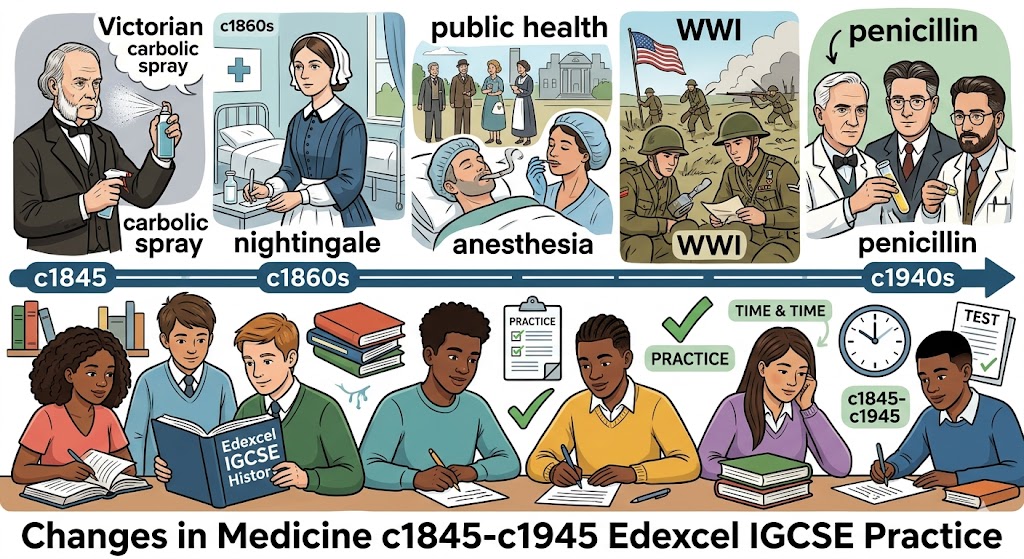
Additional Information
What the Course Entails and Exam Details
This breadth study covers a remarkable century, from the middle of the 19th century to the end of World War II, a time of profound and accelerated transformation in the world of medicine.
The course content, and subsequently this practice material, will typically explore key themes and developments including:
The landscape in the mid-19th century: Understand the challenges of pain, infection, and public health before major discoveries. This includes the roles of figures like Florence Nightingale in nursing and Edwin Chadwick in public health.
The breakthrough in understanding disease: Dive into the work of Louis Pasteur and germ theory, and Robert Koch in identifying specific bacteria, which revolutionized medicine and public health.
The battle against infection and pain: Explore the pioneering antiseptic techniques of Joseph Lister using carbolic spray, and the development of effective anesthetics like chloroform by James Simpson.
Government action and public health: Learn about the rise of public health measures, including the work of John Snow during the cholera outbreak and subsequent government legislation to improve conditions.
Accelerating change and new technologies: Discover developments in understanding blood, the discovery of X-rays, and the gradual shift towards more effective treatments and therapies.
Medicine in conflict: Examine the impact of World War I and World War II on accelerating advances in surgery, blood transfusion, and the treatment of infection and battle-related injuries, including the role of women in medical roles during wartime.
The dawn of a new era: Covers the discovery and development of penicillin by Alexander Fleming, Florey, and Chain, and conceptualizes the lead up to the post-war National Health Service (NHS) (up to 1945 conceptually).
The corresponding section in the official Edexcel IGCSE History exam is part of Paper 2 (Breadth Studies in Change), which is a written examination.
The actual exam typically lasts 1 hour and 30 minutes and is worth 50 marks in total, covering this and one historical investigation topic. You will usually answer one multi-part question on your Breadth Study (Medicine), which often includes a combination of descriptive, explanatory, and analysis-style questions, sometimes involving historical sources.
Specific details regarding total potential marks, the exact number of question options on the breadth study, and passing requirements are provided within the official and current Edexcel specifications for each exam cycle; grades are awarded on a scale (typically 9-1 for new specifications).
What to Expect in the Final Exam
While this practice material is self-administered, the official Edexcel IGCSE History final exam is a highly controlled assessment. You must understand how to apply your knowledge effectively within a limited timeframe to achieve your best possible score.
For the Changes in Medicine breadth study section, you should expect to:
Analyze and interpret historical sources: You may be presented with primary and secondary sources (cartoons, quotes, reports, images) and asked to explain how useful, reliable, or relevant they are for understanding specific developments in medical history.
Describe and explain key changes and events: You will need to be able to clearly describe specific medical discoveries, public health measures, or the impact of major figures, and explain why these were significant and what the causes or consequences were.
Synthesize and evaluate: Expect questions that require you to compare and contrast different developments, assess the importance of various factors (e.g., individuals vs. government action), and make historical judgments about the extent of change over time.
Demonstrate knowledge and understanding: Be prepared to accurately recall dates, names, key terms, and the detailed content of the curriculum. The practice test aims to reinforce this.
The final exam environment is typically quiet, invigilated, and has strict rules regarding permitted materials (usually only pens and relevant mathematical equipment - although not common in history).
The total duration, number of marks available for the entire Paper 2, and any optionality in question choices are specified on the front cover of each official exam paper and in current curriculum documents. Be sure to check the current specification details for passing score requirements and grading structures.
How to Study and Exam Centers
Preparation is key to succeeding in any history exam, and using a practice test is a fantastic starting point. Here are effective study strategies:
Practice with Purpose: Treat this practice material like a real exam. Set yourself a time limit similar to the time you would have in the actual exam section. This helps build time-management skills and stamina. Analyze your answers afterward to find areas for improvement.
Active Recall and Spaced Repetition: Instead of just reading, actively test yourself. Use flashcards (digital or physical) to memorize dates, key figures, and terms. Review topics multiple times over weeks and months, with increasing intervals, to embed information effectively.
Source Analysis Practice: Regularly work with historical sources similar to those used in the exam. Practice explaining who produced the source, when, why, and what it shows you. Assess its reliability for answering specific questions. Official past papers from Edexcel are crucial for this.
Essay Planning: Practice outlining structured answers to typical explanatory or evaluative essay questions. Understand how to introduce a topic, present well-developed paragraphs with supporting evidence, and conclude by directly answering the question.
Collaborate and Discuss: Talk about historical events and arguments with teachers, peers, or a study group. Explaining concepts to others is an excellent way to reinforce your own understanding.
Where to Take the Exam
You cannot register for or sit the official Edexcel IGCSE History exam directly through a practice test itself. This material is solely for preparation.
The official Edexcel IGCSE (and other qualifications) are externally assessed examinations. To take the real exam, you must register through an authorized exam center, which is most often:
Your School or Educational Institution: If you are a student at a school that offers the Edexcel IGCSE curriculum, registration will typically be handled internally.
Authorized British Council Centers: In many countries, the British Council operates as an official exam board partner and facilitates IGCSE registration and examination for private candidates (students not enrolled in a school offering the exam).
Private Schools and Other Authorized Centers: Some private schools or specific educational institutions are authorized exam centers for Edexcel qualifications and may accept external candidates. You would need to contact individual institutions directly to confirm.
How to Find and Use Practice Tests:
This Specific Practice Test: The availability and format of the particular practice material you have would depend on how it was obtained (e.g., part of a textbook, provided by a teacher, a digital tool, or specific online practice platform). It is likely accessible through your educational institution, official Pearson/Edexcel resources for students, or authorized providers. Ensure you understand any online or offline conditions for its use.
Online/Onscreen Options: For the final exam, Edexcel offers both traditional paper-based assessments and, increasingly, onscreen assessment options for some qualifications and subjects, including some IGCSE History modules/options. Check the British Council or Pearson's official Edexcel website in your region, or with your exam center, to determine if an onscreen version of the qualification/exam is available and suitable for you. Practice tests might also be available in digital or onscreen formats.
Job Opportunities from the Course
While this IGCSE course in Changes in Medicine does not directly qualify you for specific professional medical roles, it provides a crucial foundation and demonstrates key analytical and analytical skills valuable across numerous fields, especially after further specific education and training.
The course builds essential skills such as:
Critical thinking and source analysis
Historical context and research
Constructing clear, evidence-based arguments
Communicating complex information
After further study and qualification, potential career paths where this foundation is highly beneficial, and conceptually related fields, include:
Broad Careers in Medicine & Healthcare: While requiring comprehensive clinical training, a strong understanding of medical history can provide valuable context for professionals in nursing, healthcare administration, public health, medicine (various specializations), and medical research (after extensive scientific education).
History & Heritage Sector: Opportunities in museum work (curating, education), historical preservation, archiving, and research, particularly with a focus on medical or modern history (requires further history/heritage degrees).
Education: Teaching History in schools or higher education institutions (requires relevant teaching qualifications and advanced history studies).
Archiving & Records Management: Organizing and preserving historical medical records and documents for research and institutions (requires archival qualifications).
Law: The critical analysis and argumentative skills are highly relevant for legal professions (requires law degree and professional qualification).
Writing & Communications: Medical writing, science communication, historical writing, or journalism (requires relevant experience or qualifications).
Healthcare Administration & Management: Managing healthcare facilities, interpreting policy and information, and coordinating services (requires relevant management qualifications).
Public Health Conceptual Roles: Researching public health trends, advocating for policy change, and implementing health programs based on historical understanding and data (after advanced public health study).
Frequently Asked Questions
Reviews
5.0
Based on 0 reviews
Leave a Review
No reviews yet. Be the first to review!