
Educating All Students (EAS) Practice Exam
$69.00
- Buy to unlock unlimited access to all Quiz questions and Answers in this Quiz.
- After purchase you can print a PDF of the whole quiz at any point. The PDF will contain the questions and the correct answers.
About this Exam
The Educating All Students (EAS) exam is a mandatory and critical stepping stone for aspiring educators seeking certification in New York State.
This assessment is specifically designed to measure your professional readiness to teach highly diverse student populations in today's dynamic classroom environments.
It is tailored for prospective teachers, school leaders, and educational specialists who want to demonstrate their ability to foster an inclusive, equitable, and effective learning space.
Whether you are finishing your education degree or transitioning from another career, passing the EAS proves you have the empathy and foundational knowledge to support every learner.
Ready to test your knowledge?
Buy Now to Access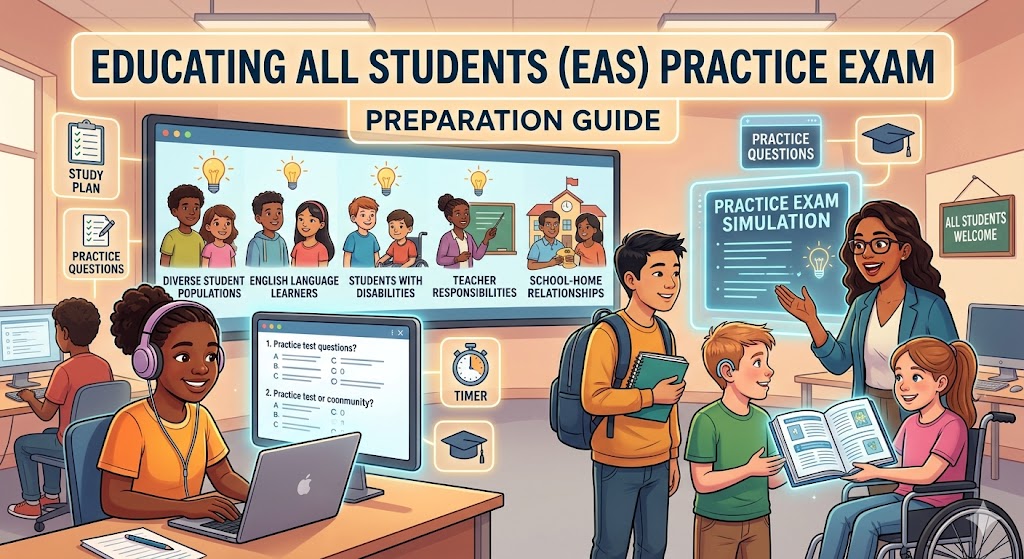
Additional Information
What the Course Entails and Exam Details
Preparing for the EAS exam means immersing yourself in the core competencies required to support varied learning needs.
The syllabus is built around five major educational frameworks that are essential for modern teaching.
First, you will cover strategies for engaging Diverse Student Populations, ensuring that cultural and socioeconomic differences are respected and celebrated.
Second, the curriculum places a heavy emphasis on English Language Learners (ELLs), equipping you with the pedagogical tools to help non-native speakers thrive.
Third, you will dive deeply into supporting Students with Disabilities and Other Special Learning Needs, focusing on individualized education programs (IEPs) and classroom accommodations.
Fourth, the material covers fundamental Teacher Responsibilities, including legal and ethical mandates, advocacy, and professional conduct.
Finally, you will learn how to build strong, collaborative School-Home Relationships that empower parents and guardians in the educational process.
What to Expect in the Final Exam
The EAS is a computer-based test (CBT) that requires both critical thinking and precise knowledge application.
You will face a total of 40 selected-response items, which are essentially multiple-choice questions designed around realistic classroom scenarios and case studies.
In addition to these, you must complete 3 constructed-response assignments that require you to write short, analytical essays based on provided student data and teaching scenarios.
To achieve certification, candidates must secure a passing score of at least 520.
You will be granted a strict time limit of 2 hours and 15 minutes to complete the entire exam.
Standard testing rules apply, meaning no outside electronics, personal notes, or unapproved materials are allowed inside the testing room.
How to Study and Exam Centers
Effective preparation requires a mix of theoretical study and practical, timed application.
Begin by thoroughly reviewing the official New York State Teacher Certification Examinations (NYSTCE) preparation framework to understand the exact rubric for the written assignments.
Taking a full-length, timed Educating All Students practice exam is crucial to building your pacing skills for the 135-minute test window.
When you practice, spend extra time analyzing the detailed case studies—known as "exhibits"—since multiple questions will be linked to a single reading passage.
When you are ready to test, you will register through the official NYSTCE website and schedule your session via Pearson VUE.
Pearson VUE operates secure, physical testing centers across New York State and nationwide, providing flexible scheduling options for all candidates.
Job Opportunities from the Course
Passing the EAS exam and earning your certification unlocks a wealth of rewarding career paths in the education sector.
NYS Certified Public School Teacher: This is the primary role for most candidates, allowing you to teach your subject specialty in elementary, middle, or high schools across New York.
Special Education Teacher: With the test's strong focus on disabilities, you are well-positioned to step into roles focused entirely on special needs advocacy and instruction.
English as a Second Language (ESL) Instructor: The heavy ELL component of the EAS prepares you to work specialized roles helping newly arrived students master the English language.
School Counselor: Educational counseling professionals use the equity and diversity frameworks tested on the EAS to guide students academically and emotionally.
Educational Administrator: Future principals and school district leaders rely on the foundations of the EAS exam to shape inclusive, district-wide policies and foster school-home relationships.
Frequently Asked Questions
Reviews
5.0
Based on 0 reviews
Leave a Review
No reviews yet. Be the first to review!