
EESTX 33302 Fiber Optics (25 Hours) Practice Exam
$69.00
- Buy to unlock unlimited access to all Quiz questions and Answers in this Quiz.
- After purchase you can print a PDF of the whole quiz at any point. The PDF will contain the questions and the correct answers.
About this Exam
Welcome to your comprehensive study guide for the EESTX 33302 Fiber Optics (25 Hours) Practice Exam.
This practice exam is a crucial step for professionals seeking to validate their foundational knowledge in fiber optic systems, focusing on the concepts often covered in a standard 25-contact-hour introductory course.
It is designed primarily for aspiring fiber optic technicians, network installers, telecommunications workers, and data center personnel who need to demonstrate competence in handling, installing, and testing fiber optic cabling.
Passing this exam proves your readiness to enter the field with a strong understanding of industry standards and safety protocols.
Ready to test your knowledge?
Buy Now to Access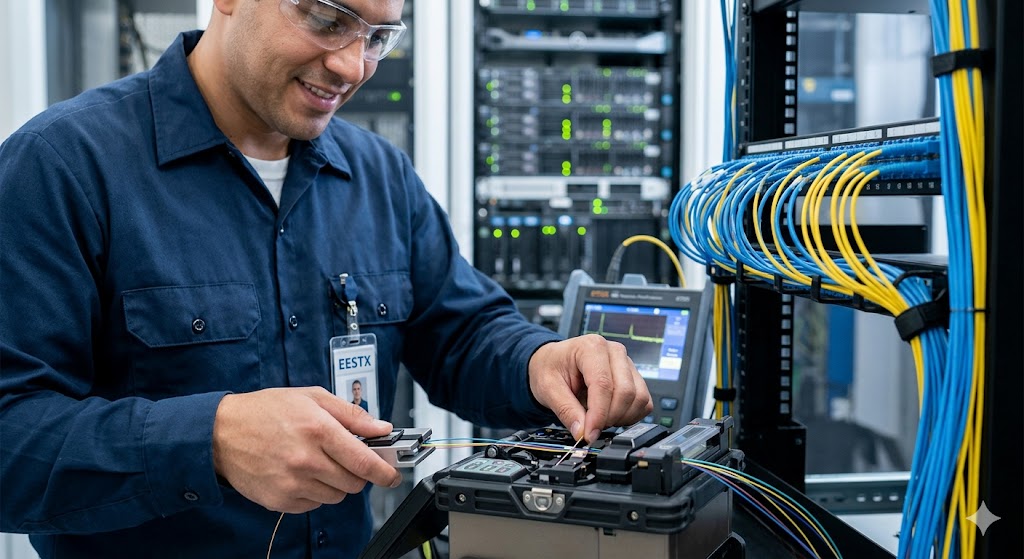
Additional Information
What the Course Entails and Exam Details
The core knowledge base covered by this exam centers on the essential skills required for entry-level fiber optics work.
Candidates are expected to have a firm grasp of the following domains:
Basic Fiber Optic Theory: Understanding how light propagates through glass and plastic fibers, including refraction, reflection, and attenuation.
Fiber Types and Specifications: Differentiating between Single-mode (OS1/OS2) and Multimode (OM1-OM5) fibers, and understanding their applications.
Cable Construction: Knowledge of loose-tube, tight-buffered, ribbon, and armored cable designs for various environments.
Safety Protocols: Mastery of laser safety, proper fiber shard disposal, and handling chemical strippers/cleaners.
Termination and Splicing Techniques: Understanding the concepts of fusion splicing, mechanical splicing, and installing various connector types (LC, SC, ST).
Testing and Troubleshooting: Knowing how to use key diagnostic tools, including visual fault locators (VFL), optical power meters (OPM), and Optical Time-Domain Reflectometers (OTDR).
Industry Standards: Familiarity with organizations like the TIA/EIA and their relevance to installation practices.
What to Expect in the Final Exam
While exact specifications can vary depending on the testing authority, the EESTX 33302 is typically a knowledge-based exam rather than a hands-on practical test.
It is designed to assess your understanding of the principles before you apply them in the field.
You can generally expect the following format:
Exam Type: Multiple-choice, matching, and true/false questions.
Number of Questions: Usually ranging between 50 and 75 questions.
Time Limit: Approximately 90 to 120 minutes is standard.
Passing Score: Most industry standard exams of this nature require a score of 70% or higher to pass.
Rules: The exam is typically closed-book, and no outside reference materials are allowed.
How to Study and Exam Centers
Preparation is the key to confidence on exam day.
Because this exam validates a 25-hour course, your study path should involve both theoretical review and practical conceptualization.
Use these actionable strategies:
Review Your Core Manual: Go back to the specific textbook or training manual provided during your 25-hour course.
Use Practice Exams Repeatedly: This practice exam is your best tool for identifying weak points in your knowledge retention.
Create Visual Aids: Draw diagrams of how an OTDR works, trace the light path in a splice, and memorize color codes for fibers.
Focus on Safety: Do not skim the safety section; questions on laser safety and hazardous materials are almost guaranteed.
Authorized Exam Centers
This exam is not generally offered at generic testing centers.
Because it validates specific course material, you must take the final exam through an authorized school, technical college, or approved training organization (ATO).
These centers are equipped to verify your attendance in the prerequisite 25-hour course before administering the test. Contact your course provider directly to schedule your final examination session.
Job Opportunities from the Course
Earning a certification that validates this course material opens the door to numerous high-demand roles in the telecommunications and data infrastructure sectors.
This certification proves to employers that you have the foundational knowledge to begin working immediately under supervision.
Career paths unlocked by this knowledge include:
Fiber Optic Technician: The primary role involving installation, splicing, testing, and troubleshooting.
Telecommunications Installer: Working on broader network installations that involve fiber backbones.
Broadband Technician: Servicing residential and commercial customers with high-speed fiber internet.
Data Center Technician: Maintaining the critical fiber optic links that connect servers and storage.
Network Field Operative: Providing on-site support and maintenance for established fiber networks.
Outside Plant (OSP) Technician: Specializing in the installation and repair of fiber cables in outdoor and underground environments.
Frequently Asked Questions
Reviews
5.0
Based on 0 reviews
Leave a Review
No reviews yet. Be the first to review!