
EETC Four Stroke Engine Certification Practice Exam
$69.00
- Buy to unlock unlimited access to all Quiz questions and Answers in this Quiz.
- After purchase you can print a PDF of the whole quiz at any point. The PDF will contain the questions and the correct answers.
About this Exam
The EETC Four Stroke Engine Certification is the industry standard for technicians specializing in small engine maintenance and repair within the Outdoor Power Equipment (OPE) sector. This prestigious certification, administered by the Equipment & Engine Training Council, validates a professional’s comprehension of four-stroke cycle theory, maintenance protocols, and advanced diagnostic procedures.
It is designed for entry-level technicians, vocational students, and seasoned professionals who wish to formally document their expertise and enhance their marketability. Whether you are aiming to work on lawnmowers, generators, or commercial landscaping equipment, this certification proves you possess the rigorous knowledge required by leading manufacturers and dealerships. Passing this exam is a critical step toward achieving Master Technician status.
Ready to test your knowledge?
Buy Now to Access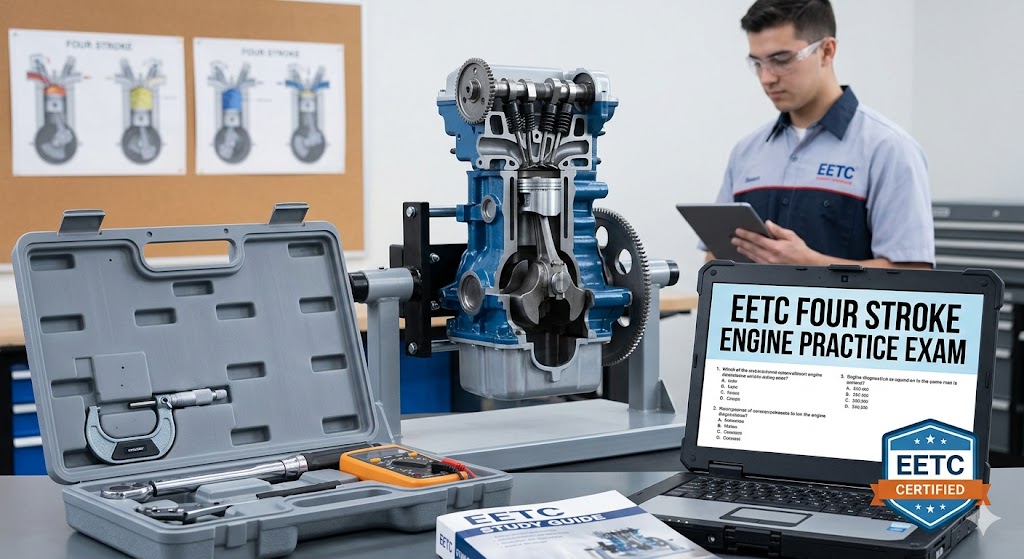
Additional Information
What the Course Entails and Exam Details
This certification program does not usually require a mandatory course, but it is supported by a comprehensive syllabus outlined in the official EETC study materials. The exam measures your proficiency across a broad spectrum of technical competencies. Key core topics and skills covered include:
Four-Stroke Fundamentals: Detailed understanding of the intake, compression, power, and exhaust strokes, including valve timing and compression ratios.
Engine Components: Identification and function of all major internal and external parts, from crankshafts and camshafts to pistons and rings.
Fuel Systems and Carburetion: Operation, adjustment, and troubleshooting of gravity-feed and pump-feed fuel systems, including modern electronic fuel injection (EFI) concepts.
Governor Systems: Mechanics and air-vane governor operations used for speed regulation.
Ignition and Electrical Systems: Theory of magneto ignition, spark plug failure analysis, and basic DC electrical circuits used in starting and charging.
Lubrication and Cooling: Understanding oil classifications, lubrication methods, and air-cooling system maintenance.
Engine Failure Analysis: The ability to accurately diagnose the root cause of engine failures based on component wear and damage patterns.
Shop Safety and Precision Tools: Proper use of micrometers, dial indicators, torque wrenches, and distance-measuring tools.
The official EETC Four Stroke Engine Study Guide is a crucial 167-page resource that maps directly to these exam domains.
What to Expect in the Final Exam
While a practice exam is an essential preparation tool, understanding the final certification exam format is vital for success. The actual EETC Four Stroke Engine Certification exam is a robust, computer-based test designed to be challenging but fair.
Here are the specific rules and details you must know:
Exam Format: The test consists of 150 multiple-choice questions.
Content: Questions are randomized from a large test bank and cover all topics mentioned in the "Course Entails" section above.
Passing Score: You must achieve a minimum score of 70% to pass.
Time Limit: The exam is usually timed, often allowing approximately 120 to 180 minutes to complete all 150 questions. You should verify the exact time limit at the time of registration.
Testing Environment: The exam is proctored, meaning it must be taken in a controlled environment to ensure integrity.
If you do not pass on your first attempt, EETC allows for retesting after a waiting period and upon payment of a retesting fee.
How to Study and Exam Centers
Preparation is the absolute key to success on the EETC Four Stroke Engine exam. Because it is a knowledge-based exam focused on diagnosing real-world scenarios, your study must go beyond rote memorization.
Actionable Study Strategies:
Obtain the Official Study Guide: Your first step should be purchasing the official EETC Four Stroke Engine Study Guide. Read it cover-to-cover multiple times. It includes self-test questions that directly mirror the style of the final exam.
Utilize Practice Exams: Seek out reputable EETC Four Stroke Engine Certification Practice Exams. These practice tools help you get accustomed to the multiple-choice format, the complexity of diagnostic questions, and the time constraints. Analyze your mistakes on practice tests to identify weak points.
Apply Hands-on Learning: If possible, reinforce your reading by disassembling and reassembling a four-stroke engine. Trace the path of fuel, electricity, and air. Practice using precision measuring tools on actual components.
Review Failure Analysis: Pay special attention to the Engine Failure Analysis section. Study images of damaged components to learn the distinct visual cues of overheating, lubrication failure, or over-speeding.
Where and How to Take the Exam:
EETC exams are accessible primarily through educational and professional institutions. You have two main avenues for taking the test:
Authorized Testing Centers (Schools): Many vocational schools, community colleges, and trade academies that offer OPE technician training are authorized EETC testing centers. Instructors at these institutions can administer the exam to students or local professionals. Use the "Member/Testing Center Search" tool on the EETC website to find a physical location near you.
Online Portals via Proctored Environments: While you can access the testing portal online, it must be accessed from an authorized location under the supervision of an approved proctor. It is not an "at-home" unproctored exam. You will register, pay the fee, and take the computerized test at the center.
Job Opportunities from the Course
Earning your EETC Four Stroke Engine Certification is a powerful signal to employers that you are a motivated, knowledgeable, and competent technician. This credential unlocks a variety of career paths within the outdoor power, rental, and agricultural industries.
Below is a clear list of specific job titles and career paths this certification unlocks:
Outdoor Power Equipment (OPE) Technician
Small Engine Technician
Lawn and Garden Equipment Mechanic
Generator Service Technician
Rental Equipment Maintenance Technician
Dealership Service Technician (specifically for brands like Briggs & Stratton, Honda, or Stihl)
Field Service Technician
Marine Engine Assistant Technician
Industrial Technician (utilizing small internal combustion engines)
Technical Trainer (for OPE manufacturers or dealerships)
Service Manager
Frequently Asked Questions
Reviews
5.0
Based on 0 reviews
Leave a Review
No reviews yet. Be the first to review!