
EICA Crane Certification Practice Test
$69.00
- Buy to unlock unlimited access to all Quiz questions and Answers in this Quiz.
- After purchase you can print a PDF of the whole quiz at any point. The PDF will contain the questions and the correct answers.
About this Exam
The Electrical Industry Certifications Association (EICA) provides a specialized certification designed explicitly for crane and digger-derrick operators within the electrical construction and utility industry. Because this field often requires operating heavy machinery in close proximity to energized power lines and unique terrains, a standard construction crane license is frequently insufficient. The EICA program ensures that operators possess the niche knowledge and practical skills required to handle these high-risk environments safely. This certification is essential for journey workers, apprentices, and anyone aiming to build a career in electrical transmission, distribution, or substation construction.
Ready to test your knowledge?
Buy Now to Access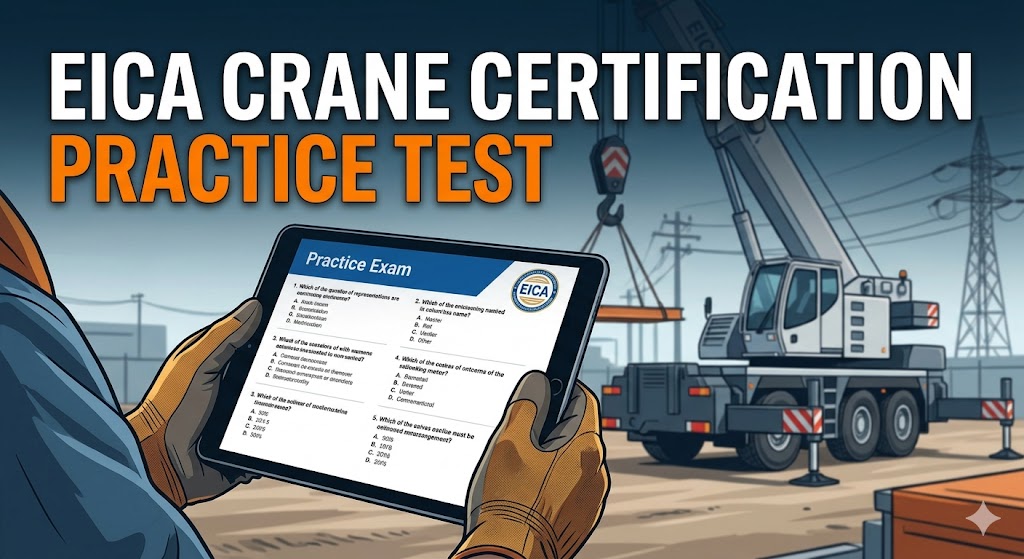
Additional Information
What the Course Entails and Exam Details
This certification path focuses rigorously on safety standards and technical proficiency within the utility sector. Candidates are expected to master a range of topics that are critical for day-to-day operations. The core curriculum covers extensive power line safety protocols, including understanding minimum approach distances (MAD) and proper voltage identification. Additionally, the course entails deep dives into federal regulations, specifically OSHA 1926 subpart CC (Cranes and Derricks in Construction) and ASME B30 standards for mobile cranes, slings, rigging hardware, and personnel lifting systems. Key technical skills include performing precise net capacity calculations, interpreting complex load charts, mastering standard hand signals, and conducting rigorous pre-operation equipment inspections.
What to Expect in the Final Exam
The final EICA assessment is a multi-part examination process, adhering to ANSI accreditation standards to ensure a rigorous evaluation. You must pass both a written and a practical exam. The written portion is typically divided into separate modules, often requiring candidates to pass multiple distinct test papers covering general knowledge, specific crane types, and load chart math. These questions are in a multiple-choice format, designed to test your understanding of safety protocols and operational theories under strict time limits. The practical exam is a hands-on demonstration of skill, where you will operate a crane (either stationary or rotating control) through a series of timed maneuvers to prove precision, control, and absolute adherence to safety procedures, particularly regarding equipment setup and shutdown.
How to Study and Exam Centers
Preparation is the cornerstone of success for this difficult assessment. Begin your journey by utilizing a reliable EICA Crane Certification Practice Test to familiarize yourself with the structure and tone of the written questions. Devote significant time to memorizing the power line clearance tables and practicing complex load chart scenarios. EICA operates as a testing agency rather than a training provider; therefore, candidates often receive their training through authorized channels. Testing frequently occurs at Joint Apprenticeship Training Committee (JATC) locations throughout the United States, as well as authorized private vocational schools and large employer facilities. You should coordinate with your local JATC or employer to schedule your specific written and practical testing dates at these authorized centers.
Job Opportunities from the Course
Earning your EICA certification demonstrates a high level of specialized competence that is highly valued by employers in the utility and electrical sectors. This qualification unlocks various profitable and stable career paths. Below is a list of job opportunities this certification can unlock.
Certified Electrical Industry Crane Operator
Digger Derrick Operator
Journeyman Lineman with Crane Endorsement
Transmission and Distribution Equipment Operator
Substation Construction Specialist
Utility Foundation Driller
Site Safety Coordinator (with further experience)
Utility Fleet Manager (career advancement path)
Frequently Asked Questions
Reviews
5.0
Based on 0 reviews
Leave a Review
No reviews yet. Be the first to review!