
EICA Mobile Crane & Digger Practice Test
$69.00
- Buy to unlock unlimited access to all Quiz questions and Answers in this Quiz.
- After purchase you can print a PDF of the whole quiz at any point. The PDF will contain the questions and the correct answers.
About this Exam
The Electrical Industry Certifications Association (EICA) Mobile Crane and Digger Derrick certification is a specialized credential tailored for professionals in the electrical, telecommunications, and utility industries.
It is designed to ensure that operators possess the essential knowledge and practical skills required to safely operate heavy machinery around high-voltage power lines and complex job sites.
This certification is ideal for linemen, groundmen, heavy equipment operators, and utility contractors who need to comply with OSHA standards (specifically OSHA 1926 Subpart CC) and demonstrate unmatched safety and competence in the field.
Taking an EICA Mobile Crane & Digger Practice Test is the absolute best way to prepare, allowing you to identify your weak points and build the confidence necessary to ace the official evaluation.
Ready to test your knowledge?
Buy Now to Access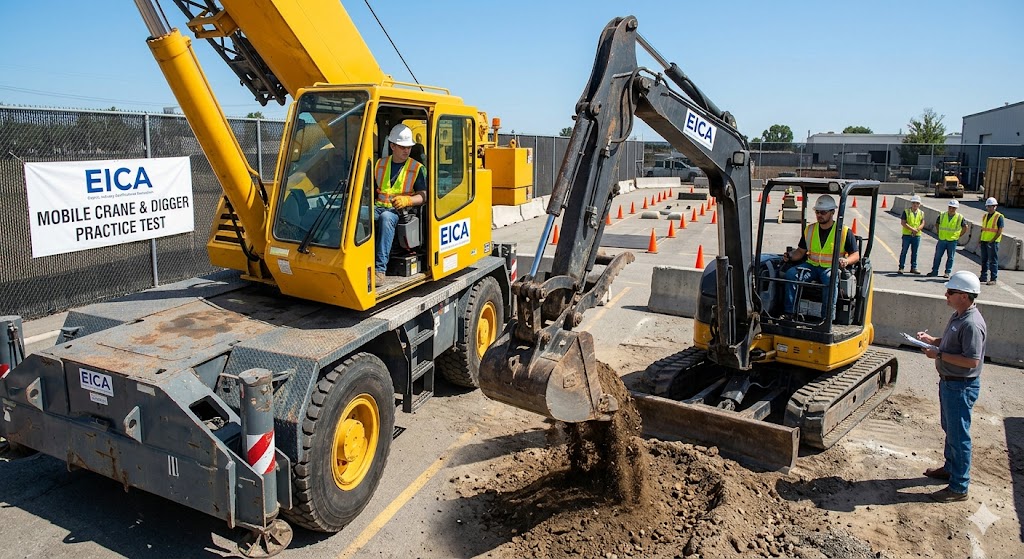
Additional Information
What the Course Entails and Exam Details
Preparing for the EICA certification means mastering both the theoretical principles and the mechanical realities of crane and digger derrick operations.
The syllabus is deeply focused on real-world utility construction scenarios, electrical hazard awareness, and machine-specific capacities.
Core topics covered in the training and practice exams include advanced load chart reading, which is arguably the most critical skill for any operator.
You will also be tested on proper machine setup, site evaluation, and understanding ground bearing pressure to prevent accidental tip-overs.
Rigging procedures, hand signals, wire rope inspection, and preventative machine maintenance are also heavily featured.
Furthermore, the course emphasizes electrical safety, including minimum approach distances (MAD) and proper grounding techniques when operating near energized power lines.
What to Expect in the Final Exam
The final EICA certification exam is a comprehensive two-part assessment designed to test both your mind and your muscle memory.
The first part is a Written Examination, which consists of multiple-choice questions focusing on safety regulations, load chart calculations, and operational theory.
You are typically given a strict time limit—often around 90 minutes—to complete the written portion, and you must achieve a passing score of at least 70% to move forward.
The second part is the Practical Examination, where you will step into the cab of a mobile crane or digger derrick to perform a series of timed, hands-on tasks.
During the practical test, an evaluator will score you on your ability to navigate an obstacle course, perform precision lifts, and interpret hand signals without compromising safety.
Points are deducted for knocking over cones, failing to control the load swing, or violating safety protocols, so remaining calm and steady under pressure is key.
How to Study and Exam Centers
Success on the EICA exam requires a mix of textbook study and simulated practice, and utilizing a high-quality practice test is your best starting point.
Begin by memorizing the load charts specific to the equipment you will be testing on, as these mathematical calculations often trip up examinees.
Use flashcards for standard hand signals and OSHA regulations, and take multiple timed practice exams to get comfortable with the pacing of the real test.
For the practical portion, log as much "seat time" in the machinery as possible under the supervision of a certified operator.
When you are ready to take the test, you will need to register through authorized EICA testing centers.
These exams are frequently hosted at local union halls (such as IBEW training centers), specialized utility training schools, or directly on-site at major utility companies that have partnered with EICA-certified proctors.
Check the official EICA website to find a registered testing portal or physical location near you.
Job Opportunities from the Course
Earning your EICA certification opens the door to a highly lucrative and stable career within the utility and construction sectors.
By proving your competence with both mobile cranes and digger derricks, you instantly become a highly valuable asset to employers.
Here are some of the primary career paths and job titles this certification unlocks:
Journeyman Lineman: Use digger derricks to set utility poles and mobile cranes to hoist heavy transformers, working directly on high-voltage infrastructure.
Dedicated Crane Operator: Work for utility contractors or large construction firms focusing strictly on lifting operations, material handling, and site setup.
Digger Derrick Operator: Specialize in drilling holes, setting poles, and maintaining telecommunications and electrical grids in both urban and remote locations.
Heavy Equipment Instructor: With enough field experience, certified operators can transition into teaching roles, helping the next generation of apprentices earn their credentials.
Utility Groundman / Rigger: Start by expertly rigging loads and signaling operators, using your deep understanding of EICA standards to ensure site-wide safety before moving into the operator's seat.
Frequently Asked Questions
Reviews
5.0
Based on 0 reviews
Leave a Review
No reviews yet. Be the first to review!