
EJPME-US002-16 Design and Planning Practice Test
$69.00
- Buy to unlock unlimited access to all Quiz questions and Answers in this Quiz.
- After purchase you can print a PDF of the whole quiz at any point. The PDF will contain the questions and the correct answers.
About this Exam
Welcome to your essential resource for mastering the Joint professional landscape. The Enlisted Joint Professional Military Education (EJPME) program is a vital educational pillar designed for enlisted service members (typically E-5 through E-9) who are preparing for, or are currently assigned to, joint duty assignments. It equips leaders with the knowledge required to operate effectively in a multi-service, interagency, and multinational environment. The specific module, EJPME-US002-16 Design and Planning, focuses on the fundamental concepts of operational design and the Joint Planning Process. Mastering this practice test ensures you have the critical thinking skills necessary to synthesize strategic guidance into actionable military operations, making you an indispensable asset to your commander in any joint environment.
Ready to test your knowledge?
Buy Now to Access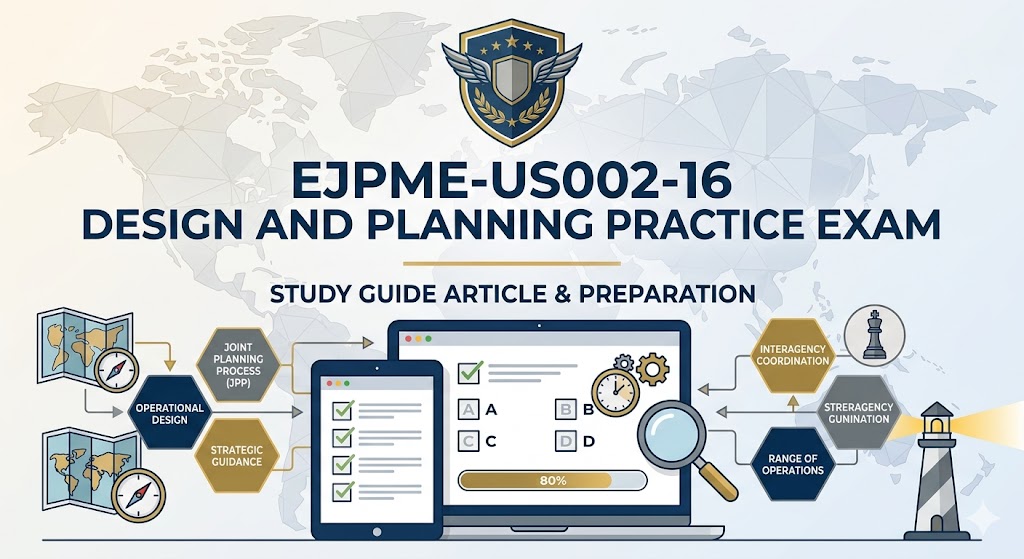
Additional Information
What the Course Entails and Exam Details
The EJPME-US002-16 Design and Planning module zeros in on the "how" of military operations. It moves beyond standard Service-specific doctrines and focuses entirely on the joint perspective. The curriculum is designed to help you synthesize strategic guidance from the highest levels of government and translate that into effective operational plans. You will explore how senior leaders use operational design to understand the complex environments they face before any forces are moved.
The core syllabus and skills covered in this domain include:
Operational Design: Understanding how to visualize the operational environment, define the problem, and develop an operational approach.
Joint Planning Process (JPP): Master the seven steps of JPP, from Mission Analysis to Plan or Order Development.
Operational Art: Learning how to apply creative thinking to organize and employ military forces effectively.
Strategic Guidance: Analyzing directives from the President, Secretary of Defense, and Chairman of the Joint Chiefs of Staff.
Interagency and Multinational Coordination: Learning how to integrate non-military partners and allied nations into the joint planning cycle to achieve unity of effort.
What to Expect in the Final Exam
While you are using this study guide for the specific Design and Planning Practice Test, the ultimate goal is success on the comprehensive EJPME final exam administered on Joint Knowledge Online (JKO). The final examination validates your mastery of all learning modules, including the critical planning concepts covered here. You must be prepared for a rigorous academic assessment.
Here are the typical final exam details:
Format: The final exam, like this practice test, is administered online via computer-based training.
Question Type: The questions are standard multiple-choice. They are designed to test not only your recall of definitions but also your ability to apply joint planning concepts to hypothetical scenarios.
Passing Score: You must achieve a minimum score of 80 percent (80%) on the final exam. This benchmark applies to this individual module quiz as well.
Time Limit: While the individual learning modules and quizzes are generally self-paced, you must manage your time efficiently. The entire EJPME course must be completed within 180 days of enrollment.
Specific Rules: You cannot "click through" the material. The JKO system tracks your engagement. If you fail an assessment multiple times, you may be locked out of the course for a specified period (e.g., 48 hours to 14 days) before you can attempt the retest.
How to Study and Exam Centers
Effective preparation for EJPME requirements goes beyond simple memorization; it requires active engagement with the courseware. The Joint context can be dense, and success requires dedicated study habits.
How to Study Effectively
The most important strategy is this: Do not rush. The material is complex, and the system requires genuine interaction.
Apply these active learning strategies:
Treat the Practice Test as a Diagnostic Tool: Take the EJPME-US002-16 Design and Planning Practice Test early in your study process. Identify your weak areas and immediately go back to the specific learning modules that cover those topics. Do not move on until you understand the underlying concepts of every question you missed.
Develop a Joint Terminology Glossary: The Joint environment has its own unique vocabulary and acronyms (e.g., JPP, COA, OPORD, JIIM). Keep a running log of these terms as you encounter them.
Relate Concepts to Your Service Experience: When studying Operational Design or JPP, think about how your specific military branch planning process relates to the Joint process. Understanding the similarities and differences will deepen your comprehension.
Take Detailed Notes on the JPP Steps: The Joint Planning Process is sequential and logical. Summarize each step, its inputs, and its crucial outputs.
Exam Centers
You will not need to travel to a physical Pearson VUE testing center or specialized authorized school for this certification. The entire EJPME curriculum, including the instructions, intermediate knowledge checks, and the final comprehensive exam, is administered completely online. You take the exam where you are—typically on a government computer using a Common Access Card (CAC) reader, accessing the Joint Knowledge Online (JKO) portal. Ensure you have a reliable internet connection and a conducive environment before starting the final assessment.
Job Opportunities from the Course
Graduating from the EJPME program is a substantial professional development achievement for any enlisted service member. While it may not automatically trigger a change in your primary Military Occupational Specialty (MOS) or rating, it unlocks significant opportunities within the military structure and greatly enhances your competitive profile for advancement. It signals to senior leaders that you are prepared for the complexities of a joint environment.
Completion of this program is often a prerequisite or highly viewed qualification for the following career paths:
Job Opportunities in Uniform:
Enlisted staff roles within Combatant Commands (CCMDs) (e.g., USCENTCOM, USINDOPACOM).
Enlisted leadership positions in Joint Task Forces (JTFs).
Senior Enlisted Advisors in multi-service units.
Joint Operations Center (JOC) staff.
Instructors at Senior Enlisted Academies or Professional Military Education (PME) institutions.
Job Opportunities after Military Transition:
The strategic thinking, planning proficiency, and interagency collaboration skills honed in the Design and Planning module are extremely valuable in the civilian sector, particularly in these roles:
Operations Manager (Defense/Aerospace Sector).
Project Manager (Strategic Planning focus).
Emergency Management Coordinator (Federal/State Government).
Logistics Analyst (Federal Agencies).
Program Manager for defense contracting firms.
Frequently Asked Questions
Reviews
5.0
Based on 0 reviews
Leave a Review
No reviews yet. Be the first to review!