
ELDT Class A CDL Practice Exam
$69.00
- Buy to unlock unlimited access to all Quiz questions and Answers in this Quiz.
- After purchase you can print a PDF of the whole quiz at any point. The PDF will contain the questions and the correct answers.
About this Exam
The ELDT Class A CDL program represents the mandatory foundational training for anyone aiming to launch a career as a professional commercial truck driver. This certification, mandated by the Federal Motor Carrier Safety Administration (FMCSA), is required for individuals seeking to obtain their Class A commercial driver’s license for the first time. The ELDT Class A designation is specifically designed for those planning to operate the largest combinations of vehicles, most commonly tractor-trailers (semi-trucks). Utilizing a robust ELDT Class A CDL practice exam is a critical step in verifying your knowledge base and ensuring you are ready to master the official theory curriculum and subsequent road skills required for a successful and safe career in trucking.
Ready to test your knowledge?
Buy Now to Access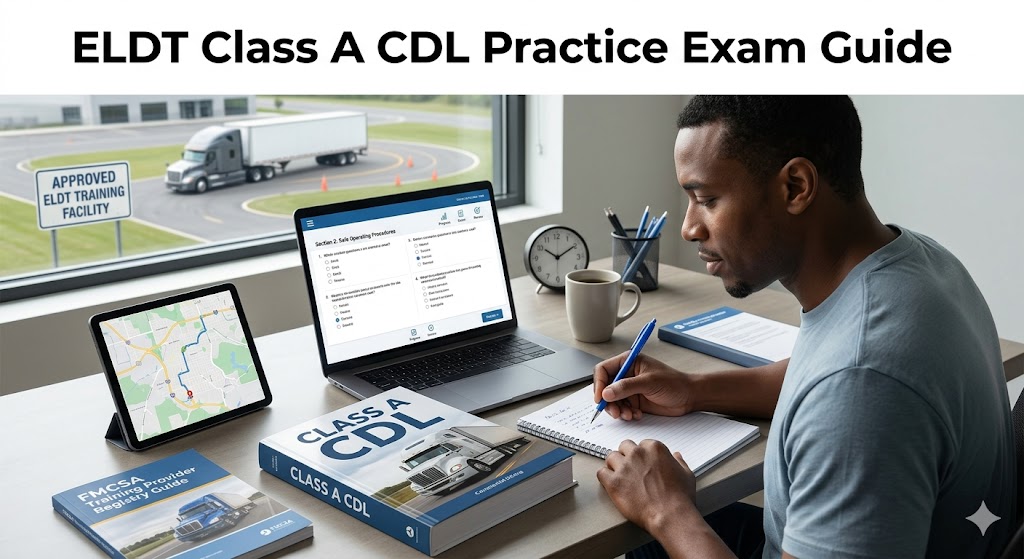
Additional Information
What the Course Entails and Exam Details
Your official FMCSA-approved ELDT Class A training will be divided into specific, mandatory theory areas that must be thoroughly learned before you can proceed to the behind-the-wheel phase. The content within these areas is what you must study for both your school's assessments and your state’s final written exams. Key topics include:
Basic Operation: Learn vehicle systems control, orientation, pre-trip and post-trip vehicle inspections, basic vehicle control, and essential backing and docking maneuvers.
Safe Operating Procedures: Study critical defensive driving techniques, speed and space management, and visual search strategies to navigate the roads safely.
Advanced Operating Practices: Gain knowledge in hazard perception, emergency maneuvers, skid control and recovery, and driving in extreme weather conditions.
Vehicle Systems and Reporting Malfunctions: Understand the primary mechanics of commercial vehicles, identify defects, and learn proper reporting procedures for maintenance issues.
Non-Driving Activities: Master the regulations regarding Hours of Service (HOS), cargo securement requirements, and necessary documentation and communication procedures.
While "exam details" refer to the official DMV/DPS written knowledge tests for your Commercial Learner’s Permit (CLP), your ELDT school will also administer knowledge checks or a final theory exam. An official ELDT Class A CDL practice exam will specifically simulate the types of questions and formatting you can expect to encounter during your school’s comprehensive theory assessment.
What to Expect in the Final Exam
It is important to understand the difference between your ELDT school's assessment and the state’s CDL knowledge test.
The State CDL General Knowledge Test: This is the ultimate "final exam" written test required to get your Commercial Learner’s Permit (CLP) and eventually your license. This exam is:
Administered by your state’s licensing agency (e.g., DMV, DPS).
Format is strictly multiple-choice questions.
Questions cover comprehensive general commercial driving knowledge, air brakes, and combination vehicle regulations.
Passing this exam allows you to receive your CLP and begin the behind-the-wheel portion of your ELDT.
The ELDT School Assessment: Your FMCSA-approved training provider must also assess your proficiency. Your training provider's comprehensive final theory exam often features the following:
Format: Typically all multiple-choice questions focusing on the FMCSA curriculum.
Passing Score: Students must achieve a minimum score of 80% on this assessment to successfully complete the ELDT theory training requirement.
Time Limits and Content: The time allowed is usually set by the specific training institution, but the content must encompass all key ELDT domain areas mentioned above.
How to Study and Exam Centers
Preparation is the single most important element to your success. Follow these actionable strategies and understand the logistical process:
Effective Study Strategies:
Take Repeated Practice Exams: Utilize high-quality ELDT Class A CDL practice exams. They are invaluable for identifying your knowledge gaps and familiarizing yourself with the multiple-choice format.
Review Official Resources: Read the FMCSA regulations directly. Use your training provider's curriculum materials extensively and complement them with official guides like the Commercial Driver’s License Manual available from your state.
Focus on Key Regulations: Deepen your understanding of hours-of-service (HOS) rules, load securement, vehicle inspection checklists, and the critical rules specific to air brakes and combination vehicles.
Join Study Groups: Discussing tricky scenarios, inspection requirements, and regulations with classmates can solidify your understanding.
Where to Take the Exam (Exam Centers):
Your official ELDT theory training (and the associated school assessments) must be completed with an FMCSA-approved Entry-Level Driver Training provider. These include:
Public or private truck driving schools.
Community colleges or technical/vocational schools.
Carrier-based training programs (for company drivers).
These approved providers are listed on the official FMCSA Training Provider Registry (TPR). You must confirm that your chosen provider is on this registry. Once you have successfully completed both the theory and behind-the-wheel portions of your ELDT, your provider will update the registry, and you will then be eligible to schedule your final state CDL skills and written tests at your state's dedicated licensing facility.
Job Opportunities from the Course
Successfully navigating the ELDT training and obtaining your Class A CDL is the key that unlocks a vast range of high-demand, stable job opportunities. A Class A license permits you to operate vehicles with a Gross Combination Weight Rating (GCWR) of 26,001 pounds or more. Possible career paths unlocked by this qualification include:
Over-the-Road (OTR) Truck Driver: Cross-country long-haul freight delivery.
Regional or Local Delivery Driver: Making deliveries within a specific geographic area (often allowing for more home time).
Flatbed Driver: Specializing in securing and transporting oversized, heavy, or irregularly shaped loads.
Tanker Driver (requires endorsement): Hauling liquid or gaseous bulk cargo.
Hazmat Driver (requires endorsement): Safely transporting regulated hazardous materials.
Specialty Hauler: Transportation of unique cargo like automobiles, livestock, or heavy machinery.
CDL Instructor: Sharing your experience to train the next generation of professional drivers.
Dispatcher: Managing logistics and communicating with drivers from a central office (often with driver experience).
Frequently Asked Questions
Reviews
5.0
Based on 0 reviews
Leave a Review
No reviews yet. Be the first to review!