
Electrical 3rd Year Practice Test
$69.00
- Buy to unlock unlimited access to all Quiz questions and Answers in this Quiz.
- After purchase you can print a PDF of the whole quiz at any point. The PDF will contain the questions and the correct answers.
About this Exam
The Electrical 3rd Year Practice Test is a crucial tool designed to assist electrical apprentices and students in preparing for the challenging third-year licensing or qualification examinations. It serves as a comprehensive self-assessment, helping candidates evaluate their understanding of advanced electrical principles, codes, and practical applications that are typically covered in depth by the third year of a structured electrical curriculum. The primary audience for this test includes individuals nearing completion of their intermediate training phase and aiming for journeyman status or similar advanced certifications.
Ready to test your knowledge?
Buy Now to Access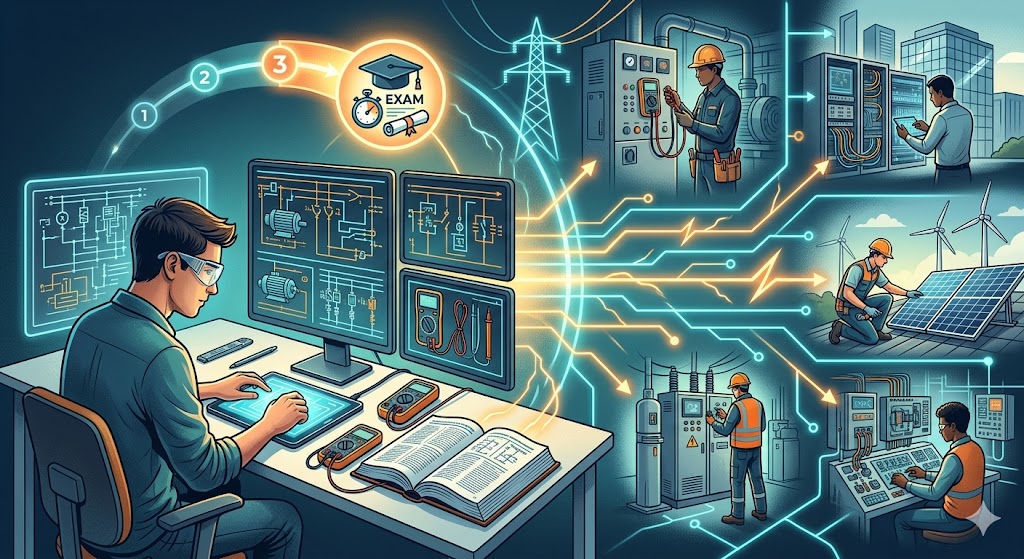
Additional Information
What the Course Entails and Exam Details
The content of an electrical 3rd-year course typically builds upon foundational knowledge, diving deeper into complex systems. Expect the practice test to mirror this complexity with a curriculum often covering:
Advanced Electrical Theory: Comprehensive principles of alternating current (AC) circuits, power factor, transformer connections, and intricate motor calculations.
Detailed Electrical Code Application: Significant emphasis on correctly navigating and interpreting the National Electrical Code (NEC) or equivalent local electrical codes, with specific focus on grounding, bonding, hazardous locations, and load calculations.
Complex Wiring Methods: Advanced practices in industrial and commercial wiring, including different types of raceways, cable assemblies, and specialized equipment installations.
Control Systems and Automation: Introduction to motor control circuits, programmable logic controllers (PLCs), basic electronics applicable to control systems, and troubleshooting methodologies.
Power Distribution: Indepth study of transformers, voltage drop, panelboard wiring, service entrance requirements, and power quality issues.
What to Expect in the Final Exam
The final exam for 3rd-year electrical proficiency often represents a significant hurdle. While specific details vary by jurisdiction and training program, common characteristics include:
Multiple-Choice Format: The test is frequently composed entirely of multiple-choice questions, which may include theoretical scenarios and code-based lookups.
Timed Test: There will be a strict time limit (e.g., several hours), making efficiency in both calculation and codebook reference critical.
Open or Closed Book: Programs often specify if reference materials like the NEC can be used during the test, adding complexity to preparation strategies.
Passing Score Requirement: Students typically need a minimum score (often around 70% or above) to pass and demonstrate competency.
Range of Difficulty: Expect questions ranging from basic principles to highly complex scenario-based problem solving, designed to test both knowledge breadth and depth.
How to Study and Exam Centers
To maximize preparation and performance for this practice test and the subsequent official exam, candidates are encouraged to:
Practice Regularly: Utilize practice tests extensively to identify knowledge gaps, practice time management, and become familiar with the question format.
Focus on the Code: Dedicate substantial study time to mastering the structure and application of the relevant electrical code. Practice looking up rules and exceptions efficiently.
Review Course Materials and Textbook: Systematically revisit lecture notes, textbook chapters, and practical exercise documentation from your 3rd-year course.
Utilize Study Groups: Collaborate with peers to discuss challenging concepts, share problem-solving strategies, and reinforce learning through mutual explanation.
Seek Clarification from Instructors: Do not hesitate to ask qualified instructors for explanation on complex topics or code interpretations.
Understand Exam Center Procedures: Official licensing exams are generally conducted at specific physical testing locations or authorized institutions (e.g., Pearson VUE, Prometric, or local government offices). Candidates should register well in advance, arrive prepared with required identification and allowed tools, and familiarize themselves with all examination rules and procedures. Online proctoring options may also be available in some regions. Practice tests themselves may be administered through authorized training providers or available online.
Job Opportunities from the Course
Successfully completing 3rd-year training and passing relevant examinations significantly impacts an electrical career, making individuals competitive for more advanced positions:
Qualified Electrician (Journeyman or equivalent): With experience and licensure, this is the main goal.
Commercial/Industrial Electrician: Specializing in complex installations in business and industrial environments.
Electrical Technician: Role focusing on installation, maintenance, and repair of electrical equipment and systems.
Controls Technician/PLC Programmer: Entry-level or specialized role in industrial automation and control systems.
Renewable Energy Installer: Opportunities in solar, wind, and energy storage system installation.
Electrical Inspector/Consultant: Potential future path involving safety and code compliance.
Maintenance Electrician: Role focused on keeping existing electrical systems running efficiently.
Electrical Project Lead/Supervision: Path towards supervising smaller teams or aspects of projects.
Frequently Asked Questions
Reviews
5.0
Based on 0 reviews
Leave a Review
No reviews yet. Be the first to review!