
Electrical Code Calculations, Level I (1-4) Practice Test
$69.00
- Buy to unlock unlimited access to all Quiz questions and Answers in this Quiz.
- After purchase you can print a PDF of the whole quiz at any point. The PDF will contain the questions and the correct answers.
About this Exam
The [Electrical Code Calculations, Level I (1-4) Practice Test] is a vital educational resource designed to measure and advance a student's proficiency in applying the complex regulations of the National Electrical Code (NEC) to practical scenarios. This comprehensive assessment tool is crafted for aspiring electricians, existing electrical apprentices seeking advancement, electrical inspectors, or individuals involved in the design and planning of electrical systems. Achieving success in electrical code calculations means demonstrating mastery in determining correct conductor sizes, load requirements, circuit parameters, and protective device ratings, ensuring both safety and legal compliance for varied installations across distinct complexity levels.
As students progress through the different tiers, the challenges and complexity of the calculations increase. This specific practice test serves as an indispensable stepping stone and a rigorous simulation for actual certification or state licensing examinations, providing invaluable insights into areas that require further study and building the confidence essential for success.
Ready to test your knowledge?
Buy Now to Access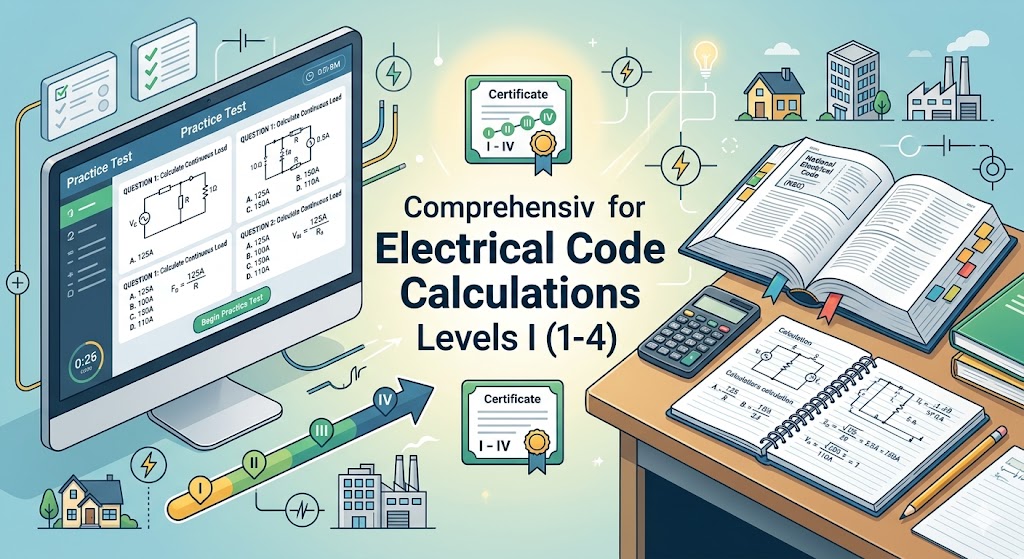
Additional Information
What the Course Entails and Exam Details
This rigorous practice test series meticulously mirrors the learning journey through four progressive levels of electrical code application. Each level builds upon the foundational knowledge and calculations from the previous one. The exam and the course it supports encompass a broad spectrum of critical topics essential for navigating the complexities of electrical system calculation and design. Key components usually covered across these levels include:
ExpertCE
Foundational Mathematics and Theory: An understanding of essential electrical theory (Ohm’s Law, power formulas) and the practical mathematics required for code calculations.
ExpertCEBranch Circuits & Feeders (Levels I-II): Calculations for diverse load types (dwelling units, general lighting, special appliances) and sizing of branch circuit and feeder conductors and protective devices. Progressive complexity often moves from single-family residential to multi-family or small commercial applications.
Services & Systems (Levels III-IV): More complex calculations for entire service entrances, multiple-occupancy buildings, industrial load calculations, parallel conductors, and grounding electrode systems.
Motor Circuits & Special Occupancies (Levels III-IV): In-depth knowledge of sizing conductors and protection for motor loads, and navigating the specific requirement of specialized areas like health care facilities or hazardous locations.
Voltage Drop & Other Specific Calculations: Understanding how to account for voltage drop across long conductor runs and performing other specific code-mandated calculations.
Code Book Mastery: A primary goal is to ensure candidates can quickly and accurately locate relevant sections, articles, and tables in the applicable version of the National Electrical Code to apply correctly to calculation problems.
The structure of the practice tests themselves is often multiple-choice with numerical answers or lookup questions. Some advanced versions might include simulated scenarios. Students are expected to complete specific tiers in a defined sequence, corresponding to their learning and experience progression, often leading up to comprehensive tests. The overall exam system ensures a progressive deepening of skill, building a complete portfolio of code calculation knowledge from fundamental applications to advanced commercial and industrial requirements.
What to Expect in the Final Exam
When you are ready to take the actual certifying exam after rigorous preparation with these practice tests, you should anticipate a structured and challenging environment designed to assess both speed and accuracy. The actual final exam is typically:
Multiple-Choice Format: The vast majority of questions are objective, multiple-choice or calculation-based questions requiring you to select or input numerical values and relevant code references.
MometrixOpen-Book Examination (Specifically for NEC): The final certification/licensing exam for electrical code calculations is typically open-book, allowing candidates to bring an authorized copy of the current National Electrical Code. However, this is not a luxury of time but a test of your ability to navigate the book with incredible speed and complete calculation accuracy.
MometrixStrict Time Limits: Each level or section of the exam is subject to a fixed, often challenging, time limit, simulating real-world pressure and requiring speedy code lookup and efficient calculations. The comprehensive practice tests are excellent for building this necessary timing skill.
High Passing Scores: The required score to pass is often high, emphasizing the critical nature of precise calculations and code adherence for safety. While practice tests provide immediate feedback, the actual exam must be passed with a high degree of confidence and accuracy.
Strict Conduct Rules: Exams are typically strictly proctored, either in physical testing centers or through secure online proctoring services. Only authorized materials, like the NEC book and potentially a basic calculator, are permitted. Electronic devices are strictly forbidden.
How to Study and Exam Centers
Effective preparation for this type of demanding exam requires a blend of rigorous self-discipline, comprehensive resource utilization, and specific strategic techniques. Here are actionable study strategies and information on where to find authorized testing.
ExpertCE
Actionable Study Strategies:
ExpertCE
Master the NEC Book: Become intimately familiar with the layout, indexing, and specific articles and tables of your designated NEC edition. Learn where key information for calculations resides. Implement a diligent tabbing system with clear and easily accessible markers for common reference points to speed up lookup times.
ExpertCEIntensive Calculation Practice: The key to success is practice, practice, practice. Utilize this comprehensive set of [Electrical Code Calculations, Level I (1-4) Practice Tests] repeatedly. Tackle various calculation scenarios (branch circuits, motors, services, residential vs. commercial) to reinforce problem-solving skills across all difficulty tiers.
ExpertCETime Management: In both study sessions and practice exams, adhere to realistic time limits. Train your speed in finding code sections and performing complex multi-step calculations under pressure. Time yourself on specific calculation types.
Code Lookup and Interpretation: Don't just memorize formulas. Understand why certain codes exist and how different sections relate. Focus on interpreting tricky language in the NEC correctly for varied scenarios.
Refresher on Electrical Theory: Regularly review basic electrical theory and mathematics to ensure calculations are mathematically sound.
Centura CollegeJoin Study Groups: Discussing difficult calculation problems with peers or experienced professionals can offer new insights and improve understanding.
Centura College
Where to Take the Exam / Exam Centers:
The administration of the actual certification or licensing exam varies widely depending on the country, state, or specific certifying body. Common locations and methods include:
Online Proctored Exam Portals: Many certifications offer secure, online-proctored exams taken from the comfort of your home or office, administered through dedicated testing platforms with strict verification procedures.
Physical Testing Centers (e.g., Pearson VUE): Major international testing networks like Pearson VUE often host specialized licensing and professional certification exams at numerous authorized physical locations.
Authorized Community Colleges or Technical Schools: Local community colleges and specialized trade schools frequently serve as approved centers for administered vocational and professional exams related to the electrical trades.
Internal Company Testing: Large electrical contracting companies or utilities might have internally authorized proctors and testing procedures for their employees.
State or Municipal Electrical Boards: The actual licensing entity itself might administer the exam at specific municipal buildings or state offices on designated dates. Always verify with your specific administrative body for the approved examination method and locations relevant to your area and desired level of certification.
Job Opportunities from the Course
A certification or proven expertise in advanced Electrical Code Calculations (Levels I-IV) is a highly desirable asset, unlocking numerous rewarding career paths in the electrical and construction industries. While licensing requirements often entail additional experience and broader practical exams, mastering these complex calculations is a crucial skill for roles demanding a high level of technical proficiency and safety compliance. Key job opportunities where this skill is paramount include:
Electrical Inspector: A quintessential role that mandates deep knowledge of all code regulations and calculations to verify code compliance for new construction and renovations in residential, commercial, and industrial settings.
Journeyman Electrician (Advanced Roles): Advanced-level electricians often assume leadership or specific project responsibilities requiring accurate calculations on site and complex installations.
Master Electrician & Electrical Contractor: Progressing to a Master level often begins with an unparalleled command of advanced code. This position enables leading large projects, starting your own business, and ensuring all company work adheres to strict regulatory standards. Note that full licensure as a Master or Contractor involves extensive additional experience and broader exams, but advanced calculations are a cornerstone skill.
Electrical Designer/Estimator: For those moving toward the engineering side, designing electrical systems or creating accurate cost estimates heavily depends on a profound ability to perform detailed code calculations from blueprints and requirements.
Facility Manager/Maintenance Supervisor: Managers in complex buildings, including hospitals and industrial plants, require strong code knowledge to maintain and upgrade systems safely.
Safety Consultant/Trainer: Experienced professionals can provide specialized training on electrical code applications and safety to various organizations.
Specific Industry Specialist Roles: Various high-tech industries, data centers, manufacturing plants, and utilities employ electrical specialists whose roles involve complex system design and calculations across diverse voltage and power levels.
Frequently Asked Questions
Reviews
5.0
Based on 0 reviews
Leave a Review
No reviews yet. Be the first to review!