
Electrical Craft Helper (ECH) Practice Exam
$69.00
- Buy to unlock unlimited access to all Quiz questions and Answers in this Quiz.
- After purchase you can print a PDF of the whole quiz at any point. The PDF will contain the questions and the correct answers.
About this Exam
The Electrical Craft Helper (ECH) certification is a vital gateway for individuals aiming to launch a career in the dynamic world of electrical work. This entry-level certification is designed to validate the foundational knowledge and practical understanding required to effectively support journey-level electricians in various settings, including construction, maintenance, and industrial operations. It is a fantastic first step for aspiring electricians, existing helpers looking to formalize their skills, or anyone interested in a strong start in the electrical trade. Our ECH Practice Exam is specifically crafted to mirror the structure and content of the real examination, providing you with a safe and effective way to build your confidence, identify your strengths, and highlight areas needing more study.
Ready to test your knowledge?
Buy Now to Access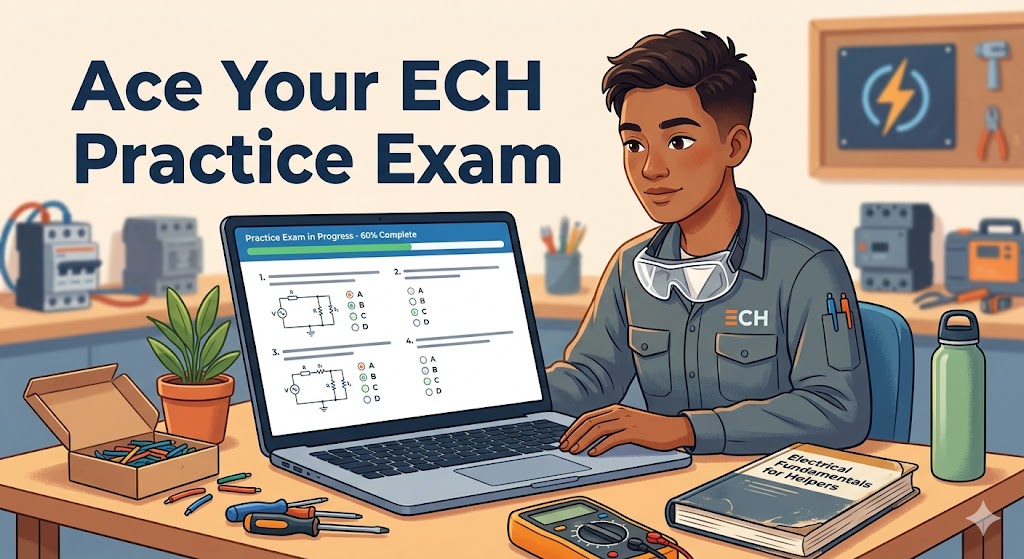
Additional Information
What the Course Entails and Exam Details
This comprehensive practice resource and the general ECH pathway focus on the core competencies essential for an electrical helper. The curriculum, reflected in the exam content, covers key areas such as:
Electrical Safety & PPE: A robust understanding of safety protocols, the National Electrical Code (NEC) relevance to safe work, and proper use of Personal Protective Equipment (PPE) is paramount.
Basic Electrical Theory: Grasping concepts like voltage, current, resistance, Ohm’s Law, and basic AC/DC principles is fundamental.
Common Tools & Materials: Identification, safe use, and maintenance of hand tools, power tools, and various electrical materials like conduit, wire types, and connectors.
Blueprint & Wiring Diagram Basics: The ability to read simple schematics and understand wiring diagrams at a helper level.
Measuring Instruments: Introduction to using key tools like multimeters, voltage testers, and clamp meters.
Basic Wiring & Installation: Fundamentals of running wires, installing basic fixtures, and assisting with conduit installation.
The real exam is a comprehensive assessment that benchmarks your readiness for the helper role. It typically combines theoretical questions with assessments of your understanding of practical tasks. Successfully completing this practice and the subsequent final exam signals to potential employers that you possess the crucial knowledge and commitment needed to succeed in the trade.
What to Expect in the Final Exam
Preparing for the final ECH exam can be intimidating, but understanding its format can ease your anxiety. Here is what you can generally expect:
Format: The final exam is most often presented in a multiple-choice format, designed to efficiently test a wide range of topics. Some advanced formats might include interactive, simulation-based questions that mimic practical scenarios, which this practice exam prepares you for. A specific practical, hands-on demonstration might also be part of the final, depending on the certifying body or employer.
Number of Questions: The real test typically consists of 50 to 100 questions, depending on the specific program. Our practice exam is designed with a similar range to ensure comprehensive coverage.
Passing Score: While the exact required score can vary by program, a passing grade is typically in the range of 70% to 80%. Aiming high during practice will better prepare you for the final challenge.
Time Limit: Expect a strict time limit, which often ranges from 90 minutes to 2 hours for the written portion. This is designed to test your efficiency and confidence.
Rules: Be prepared for strict testing protocols. You will likely not be allowed outside notes, textbooks (unless explicitly permitted for specific sections), or mobile devices. Authorized materials like the National Electrical Code might be allowed in some open-book sections, but this depends entirely on the specific exam rules.
How to Study and Exam Centers
Preparation is the key to success. Here’s a proven strategy to master the ECH and ace your practice:
Structure Your Study: Dedicate specific times each day to study, focusing on one key area at a time (e.g., Safety, Tools, Theory).
Use the Practice Exam Strategically: Take the practice exam early to benchmark your initial knowledge. Analyze your results, focus on the questions you got wrong, and use those insights to guide your deeper study. Retake the practice test multiple times as you progress.
Leverage Study Resources: Use authorized textbooks, online forums, and reputable educational websites that cover basic electricity, safety standards (NEC), and tool usage.
Focus on the Core Topics: Don't get overwhelmed; prioritize the major domains: safety, fundamental theory, and practical applications at the helper level.
Practical Familiarity: If possible, gain some familiarity with basic tools and materials by observing tradespeople or looking at diagrams. While this is a theoretical practice, understanding the real-world application of concepts can dramatically help.
Time Management: As you practice, simulate the real exam conditions. Time yourself to build speed and learn to manage your pacing efficiently.
Exam Centers for the REAL EXAM: Once you are ready, the real ECH exam can typically be scheduled and taken at:
Authorized trade schools and vocational colleges.
Union training centers (especially for apprenticeship programs).
Specific testing facilities and some government centers (for municipal roles).
In some cases, specific online platforms authorized by the certifying body might be an option.
For this specific practice exam, you can access it directly through the designated online portal, which provides immediate feedback and detailed analysis to help you prepare.
Job Opportunities from the Course
Successfully completing the ECH pathway and certification unlocks a rewarding career trajectory. Passing this exam is a strong indicator of your readiness for several essential entry-level and advancing roles:
Electrical Craft Helper: The direct entry-level position where you will support experienced electricians and gain valuable on-the-job experience.
Electrical Apprentice: A pivotal step for progression, combining formal training and structured practical work to advance toward becoming a skilled electrician.
Construction Electrician Helper: Working primarily on new construction projects, assisting in the installation of wiring, conduit, and other electrical components.
Maintenance Electrician Helper: Supporting the upkeep and repair of electrical systems in residential, commercial, or industrial buildings.
Industrial Electrical Helper: Assisting in the specialized context of factories and production plants, working with larger machinery and industrial systems.
Helper for Specialized Electrical Trades: Providing support in roles like telecommunications, solar installation, and security systems.
Career Progression: This foundational role is the first step towards a journeyman license and, with experience and further training, a future as a Master Electrician, Project Manager, or Electrical Inspector.
Frequently Asked Questions
Reviews
5.0
Based on 0 reviews
Leave a Review
No reviews yet. Be the first to review!