
Electrical Installation and Maintenance (EIM) Practice Test
$69.00
- Buy to unlock unlimited access to all Quiz questions and Answers in this Quiz.
- After purchase you can print a PDF of the whole quiz at any point. The PDF will contain the questions and the correct answers.
About this Exam
The Electrical Installation and Maintenance (EIM) Practice Test is your essential stepping stone towards a successful career in the electrical industry.
This practice tool is expertly designed for individuals preparing for official EIM certification exams, assessing their knowledge of standard procedures, safety protocols, electrical theories, and practical application.
Whether you're an apprentice seeking initial qualification or a maintenance professional looking to formalize your skills, this practice exam provides a valuable benchmark.
Successful certification typically confirms your ability to safely install, maintain, and repair electrical wiring and equipment in various settings, which is a highly valued skill set globally.
Our comprehensive practice materials aim to build your confidence and ensure you are thoroughly prepared for the real test's challenges.
Ready to test your knowledge?
Buy Now to Access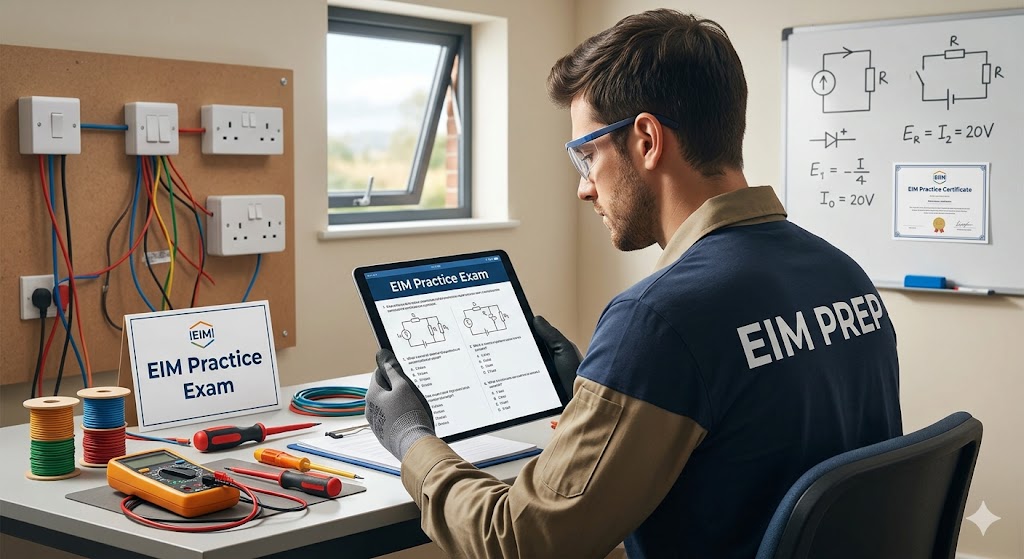
Additional Information
What the Course Entails and Exam Details
This course and practice test provide a thorough review of the core competencies required for Electrical Installation and Maintenance professionals.
The core modules of study include, but are not limited to:
Safety and Regulations: Rigorous focus on occupational health, safe work practices, and adherence to relevant electrical codes (e.g., the National Electrical Code or localized standards).
Electrical Principles: Fundamental knowledge of circuit behavior, calculation methods, and the function of various electrical components.
Tools and Equipment: Proper identification, selection, and use of essential electrical hand and power tools, and testing instruments.
Wiring Systems: Installation methods for different types of conduits, cables, wiring devices, and lighting fixtures in residential, commercial, and industrial contexts.
Installation of Panels and Controls: Connecting and installing distribution boards, circuit breakers, and control mechanisms.
Grounding and Bonding: Essential understanding and application of safety grounding principles.
Maintenance and Troubleshooting: Diagnostics, repair, and preventative maintenance procedures for electrical systems.
Our detailed syllabus and practice questions mirror the knowledge areas typically encountered in formal certification training.
What to Expect in the Final Exam
It's crucial to understand the format of the actual final certification exam you are preparing for.
While the exact structure can vary depending on the certifying body or region, you should be prepared for:
A Detailed Written Component: This is often a significant multiple-choice or short-answer exam. It will test your knowledge of safety protocols, code interpretation, electrical calculations, and theoretical concepts across all subject areas.
A Rigorous Practical Assessment: Many respected EIM certifications require hands-on demonstrations. You may need to perform tasks such as bending conduit, wiring specific circuits, installing electrical devices, or demonstrating correct troubleshooting techniques under a specified time limit and under inspection.
Strict Time Limits: Each portion of the final exam will be timed. Effective time management is essential, a skill you can hone through practice.
A Minimum Passing Score: You must achieve a certain percentage or score, which can typically range from 70% to 80% or more, depending on the standard.
Formal Exam Rules: Standard proctoring rules, identification requirements, and prohibitions on external aids (other than authorized code books, in some cases) will be strictly enforced at the testing center.
Always consult the specific guidelines of your target certification authority for precise details on their exam structure and requirements.
How to Study and Exam Centers
Preparation is the absolute key to success in any certification process.
Effective Study Strategies:
Consistent Practice: Utilize comprehensive practice tests, like this one, multiple times. Treat them like real exam conditions with set time limits.
Review the Code Book: Dedicate significant study time to your region's relevant electrical code. Practice navigating it efficiently, as some questions may require code-specific lookups.
Practical Practice: If your exam includes a practical component, get as much supervised, hands-on practice as possible. Set up practice wiring boards and rehearse core skills.
Join a Study Group: Collaborative learning and peer review can enhance understanding and retention.
Use Official Study Guides: Prioritize materials provided or recommended by the official certifying body.
Simulate Real Conditions: Create a quiet, timed environment for your practice sessions.
Locating Exam Centers:
The final certification exam for Electrical Installation and Maintenance is typically administered at authorized, proctored locations, including:
Technical or Trade Schools: Many accredited training facilities double as testing centers for their programs.
Authorized Testing Partners: Look for centers affiliated with recognized providers (e.g., specific national authorities, Pearson VUE, or other localized assessment bodies). Check their websites for locations near you.
Government-Designated Hubs: In some regions, specific government offices or trade licensing bodies manage and host the examinations.
When you are ready, you will usually need to register for the exam, select an available center, and pay the required fee through the official channels.
Job Opportunities from the Course
A formal EIM certification serves as a powerful credential, opening doors to a wide array of career opportunities in a high-demand field.
Successful completion of this qualification can lead to roles such as:
Residential Electrician: Installing and maintaining electrical systems in homes.
Commercial Electrician: Handling wiring and maintenance for businesses and larger buildings.
Industrial Electrician: Working on complex electrical systems in factories, plants, and manufacturing facilities.
Electrical Maintenance Technician: Performing preventative and restorative maintenance on electrical equipment.
Apprentice Electrician: Gaining further hands-on experience under master electricians (certification often makes you a more competitive candidate).
Maintenance Specialist: Broader maintenance roles within facilities with a significant electrical focus.
Control Panel Wirer: Specific work on constructing and installing electrical control panels.
Frequently Asked Questions
Reviews
5.0
Based on 0 reviews
Leave a Review
No reviews yet. Be the first to review!