
Electrical Measurement Safety Practice Test
$69.00
- Buy to unlock unlimited access to all Quiz questions and Answers in this Quiz.
- After purchase you can print a PDF of the whole quiz at any point. The PDF will contain the questions and the correct answers.
About this Exam
The Electrical Measurement Safety Practice Exam is a crucial study tool designed for students, apprentices, and experienced professionals working in or entering the electrical and electronics fields. This comprehensive prep resource aims to validate and enhance a candidate's knowledge and understanding of essential electrical safety practices, particularly focusing on the safe use and application of electrical measurement tools. Whether you are an electrician looking to stay current with safety standards, a technician performing complex installations, or a student beginning your training, this practice exam is a foundational step. By preparing for this assessment, individuals demonstrate a commitment to safety, the proper use of test equipment, and a thorough understanding of the protocols that prevent accidents, shocks, and hazardous arc flash incidents in the workplace. This course and practice test provide the crucial connection between understanding electrical principles and implementing them safely with measurement technology. The knowledge gained here is the bedrock of safe work, protecting lives and ensuring operational integrity.
Ready to test your knowledge?
Buy Now to Access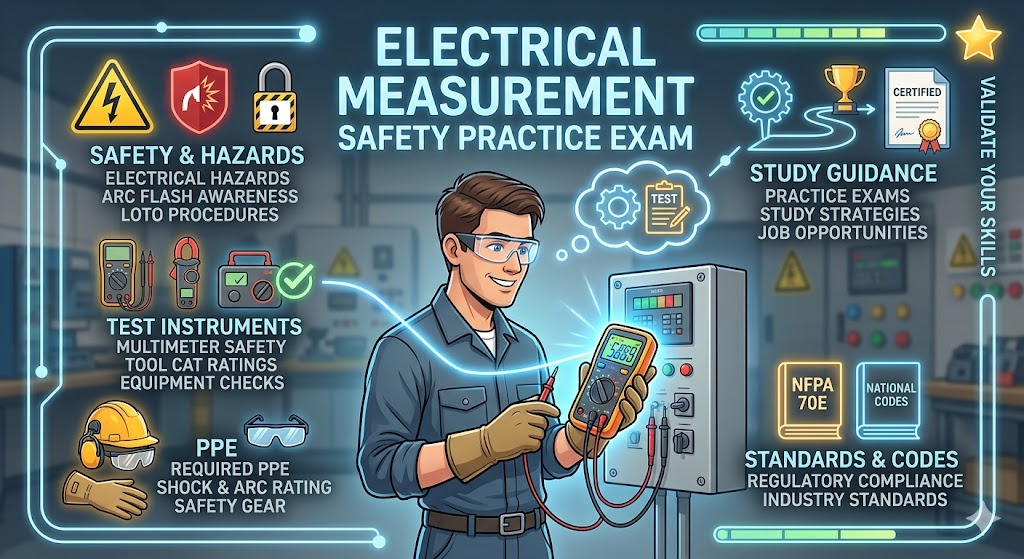
Additional Information
What the Course Entails and Exam Details
This course and its accompanying practice exam are structured to reflect the core competencies required for electrical safety in measurement. You will gain a profound understanding of industry-standard safety protocols and their practical application.
Core Standards & Regulations: Deep dive into key industry standards, including but not limited to the latest editions of national electrical codes and crucial safety guidelines like NFPA 70E (Standard for Electrical Safety in the Workplace) and relevant OSHA regulations. Understanding compliance is a major component and involves knowing when, where, and how these standards apply to your everyday tasks.
Understanding Electrical Hazards: Comprehensive knowledge of typical workplace hazards, identifying shock conditions, calculating hazard risks, and understanding the devastating potential of arc flash and arc blast events. You will learn to assess a scenario and recognize not just voltage and current, but the potential for sudden and severe energy release.
Test Instruments & Equipment: Proper identification, selection, inspection, and safe operation of common test instruments. This includes digital and analog multimeters, clamp meters, voltage testers, megohmmeters (insulation testers), and oscilloscopes. Candidates must know the correct test categories (CAT rating) for specific work environments, ensuring your tools are suitable for the energy levels they will encounter.
Safe Measurement Procedures: Step-by-step methodology for performing measurements correctly. Key topics include understanding circuit categories, ensuring tools are functioning, correct probe placement, and the absolute significance of 'test before touch' procedures on de-energized circuits, following established safety checklists.
Personal Protective Equipment (PPE): Detailed analysis of PPE selection, use, maintenance, and relevant rating systems for different voltage levels and shock/arc flash hazard scenarios. You will understand how PPE layers and categories provide critical levels of protection for your face, body, and hands.
Energy Control Procedures (Lockout/Tagout): A profound understanding of the procedures for isolating energy sources, applying locks and tags (LOTO), and verifying the complete absence of voltage. This procedure is fundamental to ensuring your own safety and that of your colleagues while work is performed on a de-energized system.
Pre-Measurement Checklist & Risk Assessment: Creating and adhering to checklists for equipment condition, workspace safety, and performing necessary hazard analysis before initiating any measurements. A solid understanding of these pre-task steps can prevent most electrical accidents.
Interpreting Readings & Response: Understanding the meaning of measurement results and how to react safely to unusual or dangerous readings, recognizing potential equipment or system faults that could themselves pose a hazard. The course and exam prepare you to be an analytical, not just procedural, operator.
What to Expect in the Final Exam
The actual certification exam following a comprehensive electrical measurement safety course is a serious assessment of your safety knowledge and judgment.
Format: Final exams for this level of safety certification are typically comprehensive knowledge-based assessments, most commonly presented in a proctored, computer-based testing format. They ensure the integrity of the certification process by validating that the knowledge belongs solely to the candidate.
Question Types: The bulk of the exam is usually composed of multiple-choice and true/false questions. These questions are carefully crafted to test both theoretical understanding and the critical application of safety standards and procedures to specific, realistic electrical measurement scenarios. Many questions will feature real-world diagrams, equipment photos, and situational descriptions. You may be shown a CAT-III working environment and a choice of four meters, requiring you to select the correct one based on its specifications.
Time Limit: There is almost always a fixed time limit, which can range from one to two hours, depending on the specific certification body and the depth of the exam (e.g., 60-120 minutes). Managing your time across all questions is essential. Don’t get stuck; if you’re unsure, flag the question and return to it later.
Passing Score: A passing score is required to obtain the certification, commonly set in the range of 70-80% or higher, reflecting the critical nature of safety competence in high-risk environments. This is a measure of competency, not just effort.
Scenario-Based Questions: Expect complex scenario-based questions that ask you to identify hazards, select the correct CAT-rated tool, determine appropriate PPE, or outline the correct safe work procedure for a specified measurement task. The exam tests not just what you know, but how you apply that knowledge safely and instinctively. Your answer is a direct reflection of how you would act in the workplace.
How to Study and Exam Centers
Preparation for the Electrical Measurement Safety certification requires a structured and dedicated approach. Your commitment to preparation is your first, and perhaps most important, safety action.
Actionable Study Strategies:
Understand the Standards: Deeply study the official standards and regulations (e.g., NFPA 70E and your national/regional electrical codes). Become very familiar with the structure, key articles, tables (especially those for PPE and boundary distances), and definitions. Know how to navigate these documents efficiently; the exam may test your ability to quickly find specific compliance details.
Use Official Resources: Maximize the use of materials provided with your chosen study program or course. Pay attention to all sections, review quizzes, and interactive components. These materials are tailored directly to the final exam's objectives.
Practice Tests are Vital: The most crucial tool in your arsenal is the practice exam itself. Take it multiple times, treat it as the real exam, and analyze your performance. Don't just look at the score; understand why you got each question right or wrong. This highlights your weak areas, which is where you must focus your subsequent review. Identify the specific standard, procedure, or equipment category referenced in each incorrect question.
Visualize and Simulate: Connect theoretical concepts with practical actions. Mentally walk through the safety procedures (LOTO, testing) as you read them. Visualize using test instruments safely in a workplace environment, checking their condition, and wearing the correct PPE for each scenario you encounter in your studies or the practice exam. This active learning approach builds strong neural connections.
Focus on "Why": For safety standards and procedures, always seek to understand the underlying reasons. Why are CAT ratings important? Why do we test before we touch? Why are certain PPE materials required for arc flash protection? Understanding the "why" solidifies your knowledge and makes it far easier to recall under pressure.
Create Custom Study Aids: Summarize key points, create flashcards for definitions, standards, equipment category requirements, and specific safety procedures. Develop mnemonic devices to help you memorize checklists.
Manage Test Anxiety: Familiarize yourself with the exam structure, practice timed tests, get adequate rest before the exam, and ensure your testing space (physical or online) is set up and stress-free well in advance. Employ relaxation techniques if needed during the exam to maintain focus.
Where and How to Take the Exam:
Online Portals: Many certifications, including introductory safety modules and practice exams, can be taken via secure, proctored online testing platforms directly through the authorized training provider or school. These offer the ultimate flexibility and often immediate results.
Vocational Schools & Community Colleges: Educational institutions with established electrical and technical programs often act as testing centers for their own students and sometimes for the public. Check local colleges with relevant departments.
Industry Training Centers: Major electrical contracting firms, utilities, manufacturing facilities, and relevant industry associations maintain dedicated training facilities that provide both training and proctored examinations.
Authorized Testing Centers: Standardized testing providers with extensive networks of physical testing centers (e.g., companies similar to Pearson VUE, though specific providers vary widely) are frequently used for diverse certification exams. When registering for the exam, you will be able to search for authorized centers near your location, ensuring you have a secure and professional environment to complete your assessment. Always follow the official registration procedures and information from the specific certifying body for the exam you are attempting.
Job Opportunities from the Course
A certification in electrical measurement safety, reinforced by a strong performance on a practice exam, significantly enhances employability and opens diverse career pathways in a multitude of industries. This credential demonstrates a validated understanding of safety standards and the safe execution of electrical measurement tasks, which is an invaluable asset to employers focused on workplace safety and operational efficiency. The knowledge you build here is not just for the exam; it makes you a preferred candidate for critical roles where precision and safety are paramount.
Specific Job Titles and Career Paths Unlocked:
Electrician: In construction, senior roles, or specific artisanal work, safety knowledge is primary, especially when conducting measurements on live systems.
Electrical Technician / Industrial Maintenance Technician: Perform installations, troubleshooting, and repairs on complex systems. Safety proficiency is mandatory.
Electrical Services Specialist / Senior Electrical Services Specialist: Advanced roles that often involve critical system diagnosis, requiring impeccable safety knowledge.
Maintenance Technician: Broader roles that include electrical components, where safety and correct measurement procedures are vital.
Control Systems Technician: Work on automated systems and PLC, where precise, safe measurements are key to operational success.
Safety Officer / Health & Safety Specialist: With experience, your deep knowledge can lead to a career focused on developing, training, and auditing electrical safety programs.
Instrumentation & Control Technician: Focus on sensors and control devices, requiring specific expertise in safe, low-voltage and analog measurements.
Electrical Inspector / Plan Reviewer: Validate installations and plans against electrical codes, requiring thorough, practical safety understanding.
Aviation Crew Chief / Aviation Electrical Technician: Specialized fields where electrical systems are critical and safety protocols are exceptionally stringent.
Field Service Technician: Traveling roles to install, maintain, or repair diverse industrial or commercial equipment.
Electronics Technician: Focused on circuits and devices, requiring specific measurement safe-practices.
Energy Efficiency Auditor / Consultant: Measure power consumption and identify savings opportunities, always adhering to safe measurement protocols.
Manufacturing Technician: Oversee production machinery and quality control equipment.
Facility Manager: Oversee overall building operations, with the technical understanding needed for safety decisions.
Technical Trainer / Electrical Safety Instructor: With significant experience, you can educate the next generation, making this knowledge both your practice and your profession.
Frequently Asked Questions
Reviews
5.0
Based on 0 reviews
Leave a Review
No reviews yet. Be the first to review!