
Electrical Printreading Practice Test
$69.00
- Buy to unlock unlimited access to all Quiz questions and Answers in this Quiz.
- After purchase you can print a PDF of the whole quiz at any point. The PDF will contain the questions and the correct answers.
About this Exam
The Electrical Printreading certification/exam is a specialized assessment designed to verify a candidate's ability to interpret and extract crucial information from electrical blue prints, schematics, and diagrams. Being able to 'read' a print is a fundamental skill for any electrical professional, as it translates a design into a physical installation. It requires understanding of the conventions, symbols, and layouts used in the electrical industry.
This exam is designed for a broad audience:
Aspiring Electricians/Apprentices: Who must master this skill early in their training.
Trade School Students: As a key component of their electrical curriculum.
Experienced Electricians: Who want to formally validate their competence for a promotion or new role.
Electrical Contractors/Estimators: Who must accurately interpret plans to bid on projects.
Plant/Maintenance Electricians: Who use prints for troubleshooting and maintaining complex systems.
Ready to test your knowledge?
Buy Now to Access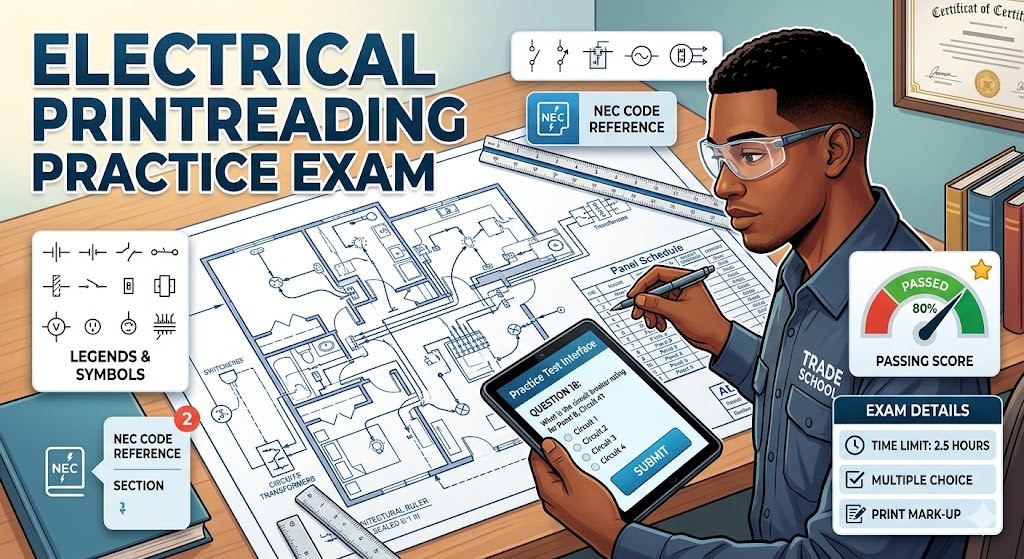
Additional Information
What the Course Entails and Exam Details
This examination covers a wide range of core topics, all focused on the accurate interpretation of electrical prints. While exact syllabi vary by institution, you can expect the following foundational areas:
Core Topics Covered:
Drawing Identification: Differentiating between standard electrical prints: site plans, floor plans (residential, commercial, industrial), elevation views, detail views, single-line diagrams, and schematic wiring diagrams.
Interpreting Legends and Symbology: Recognizing and identifying standard graphical symbols for all key components, including switches, receptacles, lights, motors, transformers, circuit breakers, fuses, and conduits. Knowledge of the National Electrical Code (NEC) as the standard for basic symbology is often a prerequisite.
Using Scales: Mastering the use of architectural and engineering scales to determine physical dimensions and distances from a blueprint.
Understanding Schematics and Wiring Diagrams: Tracing circuit paths, understanding component relationships, and identifying logic flow within complicated control systems and residential circuits.
Extracting Schedule Data: Interpreting information found on panel schedules, load schedules, and material lists, including voltage, current, wire size, and device ratings.
Identifying Code Requirements on Prints: Spotting where the print must adhere to specific electrical code sections, such as grounding/bonding and conduit fill requirements.
What to Expect in the Final Exam
While the exact structure might differ depending on whether the test is delivered by a trade school or a national testing body, most Electrical Printreading exams follow a similar pattern. They are almost always delivered via an online portal.
Typical Exam Format:
Format: The exam is predominantly multiple-choice, though some sections may ask you to 'mark up' an image of a blueprint digitally, or fill in a schedule based on information found on a schematic.
Structure: Questions will present a specific electrical print (e.g., a "Commercial Lighting Floor Plan" or a "Motor Control Schematic") and then ask a series of questions about it.
Total Questions: Generally ranges from 50 to 100 questions.
Passing Score: Most certification bodies require a score between 70% and 80% to pass.
Time Limit: Expect a strict time limit, typically 1.5 to 3 hours. It is designed to test both accuracy and efficiency.
Specific Rules: You may be allowed to use a copy of the National Electrical Code (NEC) and a basic calculator, but you should verify this with your testing provider. You are expected to interpret the print without outside assistance.
How to Study and Exam Centers
Passing this exam requires a combination of study and, most importantly, practical application.
Actionable Study Strategies:
Obtain Practical Practice: This is crucial. Get your hands on real blueprints or high-quality educational prints. Practice identifying components and symbols. A trade school, employer, or online resource can often provide these.
Use a Dedicated Study Guide: Invest in or use the study guide provided by your training provider. It will focus on the exact symbol set and print types covered in the exam.
Create Custom Flashcards: Create physical or digital flashcards for the most common electrical symbols. Test yourself until you can identify them instantly.
Take Practice Tests: This is where the Electrical Printreading Practice Test is your best tool. Taking simulated tests under timed conditions is the best way to understand the question style, manage your time, and identify your weaknesses.
Review Incorrect Answers: Don't just check your score. Spend time understanding exactly why you got a question wrong. Was it a misunderstood symbol? Did you use the scale incorrectly? Did you misread the panel schedule?
Practice Speed and Accuracy: Start by focusing on accuracy, then once you are confident, increase your speed. You need both to succeed.
Where and How to Take the Exam:
The exam is usually delivered by your specific educational or trade institution, an authorized training provider, or a state licensing board.
Online Portals: The test is most commonly proctored through the online assessment system of the training school or the certification body itself. You may take it from a computer in a controlled environment.
Authorized Schools/Institutions: Vocational schools, trade schools, and union training centers are primary locations for administering this exam.
Pearson VUE / Authorized Testing Centers: In some regions, formal electrical certifications may be administered via a national network of independent testing centers like Pearson VUE. Check with your specific regulatory or certification board.
Job Opportunities from the Course
Validating your skill in Electrical Printreading significantly boosts your career prospects in the electrical trade. It is a critical skill for advancement.
Here is a clear list of specific job titles and career paths this skill unlocks:
Electrician Apprentice
Journeyman Electrician
Master Electrician
Maintenance Electrician
Industrial Electrician
Electrical Contractor
Electrical Inspector
Electrical Systems Designer
Electrical Draftsman
Electrical Estimator
Project Manager (Electrical)
Field Service Technician
Field Engineer
Plant Electrician
Frequently Asked Questions
Reviews
5.0
Based on 0 reviews
Leave a Review
No reviews yet. Be the first to review!