
Electrical Safety-Related Work Practices Test Practice
$69.00
- Buy to unlock unlimited access to all Quiz questions and Answers in this Quiz.
- After purchase you can print a PDF of the whole quiz at any point. The PDF will contain the questions and the correct answers.
About this Exam
The Electrical Safety Practices Practice Exam is designed for professionals and individuals seeking to demonstrate a solid understanding and mastery of safe work practices within the electrical industry. This is not just about theory; it’s about applying crucial safety standards—often aligning with key regulations and best practices like those from OSHA or based on standards such as NFPA 70E—to prevent accidents and ensure a secure working environment. The exam is typically intended for electricians, electrical engineers, maintenance technicians, safety supervisors, and anyone who might encounter or supervise work involving electrical systems and hazards. For individuals already working or seeking to work in these fields, demonstrating competence through this practice can be an excellent stepping stone to achieving official certification or ensuring they meet regulatory requirements. It is a vital check on practical safety knowledge and application in real-world scenarios.
Ready to test your knowledge?
Buy Now to Access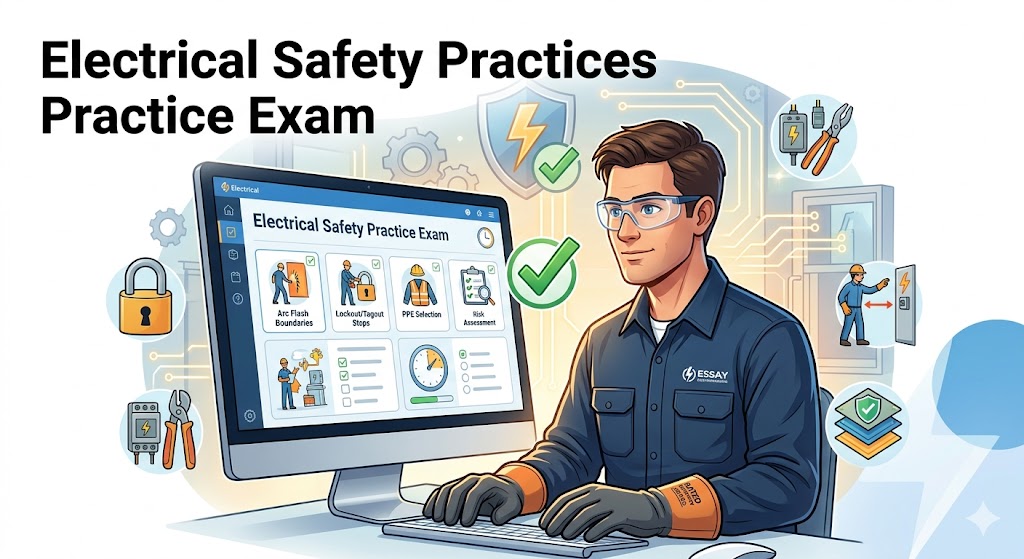
Additional Information
What the Course Entails and Exam Details
The content that this practice exam covers reflects the core topics often found in comprehensive electrical safety training courses. Candidates should expect to be tested on a wide range of essential subjects, including:
Understanding Electrical Hazards: Recognition of shock, arc flash, and arc blast hazards.
Standards and Regulations: Deep knowledge of relevant safety standards, such as those from OSHA (e.g., CFR 1910 Subpart S) and often specifically NFPA 70E (Standard for Electrical Safety in the Workplace).
Safe Work Procedures: Proper procedures for working around energized electrical equipment, including the concepts of establishing a legally safe work condition (LOTO - Lockout/Tagout).
Boundaries: Correct application of approach boundaries and the required boundary for arc flash.
Personal Protective Equipment (PPE): Selection, inspection, and maintenance of appropriate PPE for various electrical tasks.
Testing and Tools: Techniques for safely verifying absence of voltage and proper use of test equipment.
Documentation and Training: Requirements for employer and employee training and safety programs.
The practice exam details vary depending on the specific practice resource or the official certification it simulates, but typical structures often include a series of multiple-choice questions, which may include scenario-based questions that require practical application of safety rules to specific situations. Some online practice tools also offer timed sessions to simulate the real exam pressure.
What to Expect in the Final Exam
While the exact final exam will depend on the certifying body or employer requirement, here is a general overview of what you can usually expect:
Format: The most common format is a set number of multiple-choice questions. It might also include true/false, fill-in-the-blank, or short scenario-based responses in some advanced tests. A final certification might also incorporate a practical component, though this practice exam typically focuses on the knowledge-based assessment.
Question Types: Expect questions designed to test not just factual recall but your ability to interpret scenarios and apply safety principles. For example, you might be given an equipment description and task and then asked to identify the correct PPE, appropriate boundaries, or the steps for establishing a safe working condition.
Time Limit: A realistic final exam often has a set time limit, encouraging efficiency and clear understanding.
Passing Score: Most recognized safety certifications require a notable passing score (often 70-80% or higher). This reflects the critical importance of mastering the safety concepts to prevent real-world harm.
Specific Rules: Depending on the administrator, specific rules might apply, such as the allowed use of reference materials (like standard codes), requirements for quiet testing environments (for online/proctored exams), and identification protocols.
How to Study and Exam Centers
Preparation is absolutely key for success in both the practice and the actual exam. Here are effective study strategies:
Utilize Study Guides: Look for comprehensive study guides specifically developed for electrical safety practices exams. These guides consolidate relevant standards, key concepts, and common question types.
Take Practice Tests: Actively engage with multiple practice tests. This not only reinforces your knowledge but also familiarizes you with the question formats and identifies areas where you need more review.
Review Relevant Standards: Become deeply familiar with relevant standards. If the practice or final test is based on OSHA or NFPA 70E, dedicating time to read and understand these documents is crucial. Many exam resources refer directly to these standards.
Practical Application: Connect theoretical concepts to real-world applications. If possible, discuss scenarios with experienced professionals and understand how the safety practices are implemented on the job.
Identify Weaknesses: Use practice test results to pin-point specific topics where you consistently struggle and dedicate extra study time to those areas.
Authorized School/Online Platforms: For officially recognized certifications, you will usually take the final exam either through a proctored online platform (available via the certifying organization's portal), within a testing center network like Pearson VUE or Prometric, or sometimes through physical testing centers run by the authorized training provider or a specific authorized school. Practice exams, conversely, are frequently accessible online through various educational platforms, training companies, or certifying bodies directly to help you prepare. Be sure to use credible resources for both practice and the actual test.
Job Opportunities from the Course
A demonstrated mastery of electrical safety practices is highly valued by employers and is essential across various job roles in the electrical and related industries. Successfully passing a certification or demonstrating knowledge through this practice can significantly enhance career prospects. Job titles that often require or are enhanced by this type of knowledge and certification include:
Electrician (Apprentice, Journeyman, Master)
Maintenance Electrician / Technician
Industrial Electrician
Electrical Engineer / Power Systems Engineer
Safety Officer / Inspector (Electrical Specialization)
Construction Supervisor / Manager
Utility Worker (Lineman, Substation Technician)
Facilities Manager
Health and Safety Manager
Training Specialist in Electrical Safety
HVAC Technician
Appliance Repair Technician
Frequently Asked Questions
Reviews
5.0
Based on 0 reviews
Leave a Review
No reviews yet. Be the first to review!