
Electricity for HVACR Practice Test
$69.00
- Buy to unlock unlimited access to all Quiz questions and Answers in this Quiz.
- After purchase you can print a PDF of the whole quiz at any point. The PDF will contain the questions and the correct answers.
About this Exam
The Electricity for HVACR Practice Test is a comprehensive study tool designed for students and aspiring technicians preparing for standard HVACR (Heating, Ventilation, Air Conditioning, and Refrigeration) certification exams, specifically those focusing on electrical systems.
This practice test is ideal for individuals currently enrolled in HVACR training programs at trade schools or community colleges, as well as technicians looking to validate their knowledge or prepare for industry-recognized certifications like NATE (North American Technician Excellence) or ESCO Institute exams. Strong electrical troubleshooting skills are the backbone of a successful HVACR career, and this practice test helps ensure you are exam-ready.
Ready to test your knowledge?
Buy Now to Access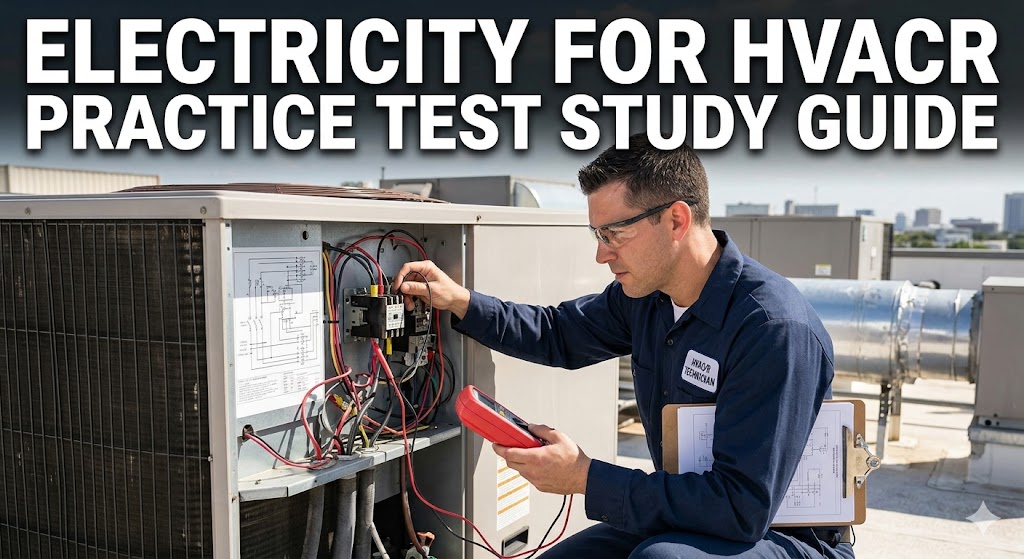
Additional Information
What the Course Entails and Exam Details
This practice test focuses exclusively on the critical electrical concepts and components relevant to HVACR systems. It is designed to reinforce material covered in foundational HVACR electrical courses. Key topics covered include:
Fundamentals of Electricity: Understanding voltage, current (amperage), resistance (Ohm’s law), and power.
Circuit Types: Knowledge of series and parallel circuits and how loads, switches, and safety controls are wired within them.
Electrical Safety: Lockout/tagout procedures, understanding shock hazards, and proper use of personal protective equipment (PPE).
Reading Schematics: Interpreting wiring diagrams, ladder diagrams, and understanding electrical symbols commonly used in HVACR.
HVACR Electrical Components: Identifying and understanding the function of motors (PSC, ECM), compressors, contactors, relays, transformers, capacitors, and thermostats.
Troubleshooting: Diagnostic techniques for identifying open circuits, short circuits, and ground faults in HVACR systems.
Testing Instruments: Proper application and interpretation of readings from digital multimeters (voltmeters, ammeters, ohmmeters).
What to Expect in the Final Exam
While this is a study guide and practice test, the actual HVACR certification exams it prepares you for typically follow a standardized format.
Format: The actual certification exams are almost always multiple-choice. This practice test mirrors that format to help you become accustomed to analyzing options and choosing the best answer under pressure.
Time Limits: Standard certification exams are timed, often giving you between 60 to 90 minutes to complete sections focused on electricity.
Passing Score: Requirements vary by the certifying body (e.g., NATE, ESCO), but a passing score is generally in the range of 70% to 75%.
Rules: Official exams are proctored and are usually closed-book, meaning you must rely solely on your knowledge.
How to Study and Exam Centers
Preparation is the key to success. Here are actionable strategies to get the most out of your study time:
Master the Multimeter: Practice using your multimeter on trainer boards or real (disconnected) equipment until you can confidently take accurate readings of voltage, resistance, and amperage.
Practice Schematic Reading: Get your hands on various HVAC unit wiring diagrams (for both furnaces and AC units) and trace the circuits repeatedly until you understand the sequence of operations.
Use the Practice Test Strategically: Don't just answer the questions. For every question you answer incorrectly, go back to your reference materials (textbooks, notes) to understand why the correct answer is right.
Form Study Groups: Explaining concepts to others is an excellent way to reinforce your own understanding.
Exam Centers: When you are ready to take the actual certification exam, you will not use this practice test portal. Instead, you must register through an authorized testing entity like NATE or the ESCO Institute. These exams are typically administered at Pearson VUE testing centers, local trade schools, union training facilities, or specialized testing centers designated by the certification body.
Job Opportunities from the Course
A strong understanding of HVACR electrical systems is the most critical technical skill needed in the field. Mastering this material opens up diverse career opportunities:
HVACR Service Technician: Diagnosing and repairing electrical malfunctions in residential and commercial HVAC units.
Commercial Refrigeration Technician: Installing and maintaining complex electrical systems for supermarket refrigeration, walk-in coolers, and ice machines.
HVAC Installer: Properly wiring new HVAC systems and ensuring control circuits are functioning correctly.
Facilities Maintenance Technician: Maintaining the HVACR electrical systems in large buildings like hospitals, schools, or office complexes.
Building Automation Systems (BAS) Technician: Specializing in the low-voltage electrical controls and networking that manage modern HVAC systems.
Frequently Asked Questions
Reviews
5.0
Based on 0 reviews
Leave a Review
No reviews yet. Be the first to review!