
Electromagnetic Spectrum and Light Practice Test
$69.00
- Buy to unlock unlimited access to all Quiz questions and Answers in this Quiz.
- After purchase you can print a PDF of the whole quiz at any point. The PDF will contain the questions and the correct answers.
About this Exam
The [Electromagnetic Spectrum and Light Practice Test] is a vital educational resource designed to help students master the fundamental principles of light and wave physics. This comprehensive assessment is primarily crafted for middle school and high school students enrolled in physical science or introductory physics courses. Teachers also find this practice test to be an essential tool for gauging class understanding and identifying learning gaps. The exam is designed for individuals seeking to solidify their knowledge of electromagnetic radiation, its properties, and its ubiquitous applications. It provides an encouraging and detailed self-assessment environment that mirrors the content and complexity of a final module test. By engaging with this practice exam, students can build confidence and ensure they are fully prepared for their actual coursework evaluations.
Ready to test your knowledge?
Buy Now to Access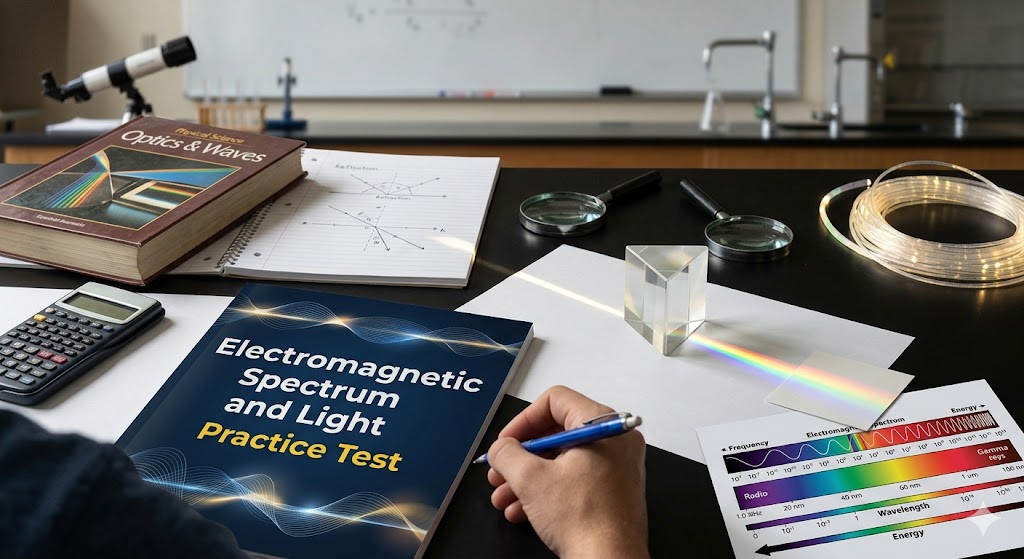
Additional Information
What the Course Entails and Exam Details
The course of study covered by this practice exam delves into the fascinating world of the electromagnetic (EM) spectrum and geometric optics. This is not just a vocabulary check; it tests a conceptual and practical understanding of how our universe is illuminated and connected.
Core topics include:
The Nature of Waves: Understanding wave characteristics, including wavelength, frequency, amplitude, and the relationship between them ($v=f\lambda$).
The Complete Electromagnetic Spectrum: Categorizing EM waves by frequency, wavelength, and energy: radio, microwave, infrared, visible, ultraviolet, X-ray, and gamma.
The Visible Light Spectrum: Detailed knowledge of the color spectrum (ROYGBIV) and the relative energies of each color.
Light Interactions: Explaining how light interacts with matter, including reflection, refraction, diffraction, and absorption.
Mirrors and Lenses: Practical applications of light behavior in forming images.
Practical Applications: Connecting theoretical concepts to everyday technology, such as communication systems, medical imaging, and solar energy.
What to Expect in the Final Exam
This [Electromagnetic Spectrum and Light Practice Test] mirrors the structure and challenge of a typical summative assessment. While specific formats can vary by curriculum, this practice exam prepares you for the most common methods.
Format: You should expect a mix of multiple-choice questions, short-answer questions, and problem-solving scenarios. Multiple-choice questions will test recall of facts, while short answers will require you to explain phenomena (e.g., "Why is the sky blue?"). Problem-solving will involve calculations using the wave equation.
Passing Score and Time Limits: As a course-based exam, there is no single universal "passing score." It is typically part of a weighted grade for a class, but a target of 80% or higher is a strong indicator of readiness. Time limits are typically between 45 to 90 minutes, designed to assess both your accuracy and efficient understanding of the material.
Specific Rules: Standard academic rules apply. You will usually be allowed a scientific calculator for calculations but cannot use external notes, textbooks, or personal devices during the actual test.
How to Study and Exam Centers
Preparation for this exam requires a strategic, active approach.
Actionable Study Strategies:
Create a Visual Map: Draw and color-code the entire electromagnetic spectrum. Annotate each section with its defining property (e.g., "highest frequency," "longest wavelength") and at least two practical applications.
Practice Calculations: Actively solve problems using the wave speed formula ($v=f\lambda$). Work with different units to ensure mathematical fluency.
Active Recall: Use flashcards (digital or physical) to master vocabulary and key concepts. Instead of just reading notes, quiz yourself on the difference between reflection and refraction.
Use the Practice Test: Take the [Electromagnetic Spectrum and Light Practice Test] under timed, closed-book conditions to simulate the real environment.
Exam Centers:
This exam is not administered by a single global professional body like Pearson VUE. It is a classroom-based or course-integrated assessment. You will take the final test either:
In-Class: At your school or educational institution, administered by your science teacher.
Online Portal: If enrolled in an online course, it will be taken via their learning management system (like Canvas or Blackboard), sometimes using proctoring software.
Job Opportunities from the Course
Mastery of the concepts tested in this exam is a prerequisite for a vast array of high-demand and high-impact careers. The foundational knowledge of how light and radiation work is essential in modern technology and medicine.
While this specific test does not grant a professional license, success in this subject area is your first step towards careers including:
Optical Engineer
Photonics Technician
Radiologic Technologist
Telecommunications Engineer
Meteorologist
Astronomer
Medical Physicist
Laser Safety Officer
Remote Sensing Specialist
Fiber Optic Technician
Frequently Asked Questions
Reviews
5.0
Based on 0 reviews
Leave a Review
No reviews yet. Be the first to review!