
Electronic Chart Display and Information System (ECDIS) Practice Exam
$69.00
- Buy to unlock unlimited access to all Quiz questions and Answers in this Quiz.
- After purchase you can print a PDF of the whole quiz at any point. The PDF will contain the questions and the correct answers.
About this Exam
The Electronic Chart Display and Information System (ECDIS) Practice Exam is a crucial stepping stone for mariners and nautical professionals. It is designed for deck officers, captains, and anyone aspiring to work on modern vessels where ECDIS has replaced paper charts. This exam validates a user's proficiency in operating a specific or generic ECDIS, ensuring they understand the complexities, potential pitfalls, and legal requirements of electronic navigation. It serves as both an assessment tool and a preparatory guide, helping candidates build the confidence and knowledge needed to transition effectively into a digital bridge environment.
Ready to test your knowledge?
Buy Now to Access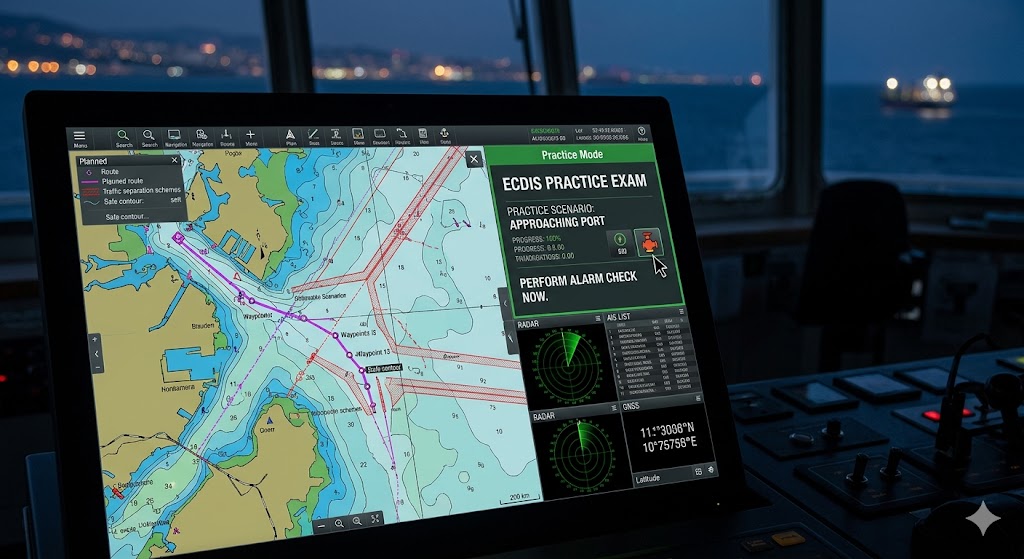
Additional Information
What the Course Entails and Exam Details
A comprehensive ECDIS course, and the associated exam, covers a wide spectrum of technical and practical knowledge. The curriculum is typically derived from international standards, such as IMO Model Course 1.27. It includes:
Understanding the functional requirements and regulatory framework governing ECDIS use, including safety-critical alerts.
Mastering user interface, display controls, and basic chart handling, such as updating, loading, and scale control.
Effective route planning, monitoring, and voyaging management using both manual and automated functions.
Integration and interpretation of data from other sensors, including GNSS (GPS), Radar, and AIS, on the chart display.
Safe handling of alarms and indications, and the limitations of ECDIS and associated sensors.
Chart data management, including the types, sources, and reliability of Electronic Navigational Charts (ENCs).
Correct application of safety settings, such as contour lines and depth alerts, tailored to the specific vessel.
What to Expect in the Final Exam
The final assessment for ECDIS certification, which this practice exam prepares you for, typically involves two main components: a theoretical test and a practical assessment.
The theoretical part is often a multiple-choice exam, focusing on regulatory knowledge, technical specifications, chart types, and operational principles. It tests understanding of critical functions and limitations. The number of questions and time limit can vary by training center but generally allows for approximately one minute per question. A passing score, often around 70-80%, is required.
The practical assessment is the most critical part. It takes place on an ECDIS simulator. Candidates are required to demonstrate proficiency in real-world scenarios. This includes setting up the display, creating and validating a route, managing alarms during a simulated voyage, performing data input from sensors, and navigating safely. The assessor observes the candidate's actions, responses, and efficiency, judging their ability to manage the system under pressure.
How to Study and Exam Centers
Effective preparation for the ECDIS practice and final exams combines both theoretical study and practical experience.
Actionable Study Strategies:
Utilize Practice Exams: Take multiple practice exams like this one to identify weak points in your understanding. Focus on why specific answers are correct, not just memorizing.
Read the ECDIS Manuals: While dense, the official manufacturer manuals for specific systems (e.g., Furuno, Transas, JRC) are invaluable for understanding precise features and procedures.
IMO Model Course 1.27: Reviewing the curriculum outline of IMO Model Course 1.27 provides a comprehensive checklist of all topics that can be tested.
Simulator Practice: This is non-negotiable. If you cannot access a full maritime simulator, seek out simulator software that runs on a personal computer. Spend as much time as possible performing route planning, handling alarms, and switching between chart sources. Focus on speed and efficiency.
Focus on Safety Criticals: Pay extreme attention to safety contours, alarm handling, and system degradation. These are often the primary cause of failures in both exams and real-world incidents.
Where and How to Take the Exam: Official ECDIS certification exams, including the practical simulator component, are only administered by authorized maritime training centers and nautical colleges. These institutions have the required certified ECDIS simulators and accredited instructors. The theoretical multiple-choice part might sometimes be offered online through a secure proctoring system connected to the accredited center, but the practical assessment must be done in person. To take the exam, candidates must first enroll in and successfully complete a formal ECDIS training course, either generic or type-specific, from one of these authorized providers. You cannot just register to "take the exam" without completion of the certified course. Candidates must check for centers approved by their national maritime authority or flag state.
Job Opportunities from the Course
Successful completion of the ECDIS course and exam is not just an added skill; it is a mandatory qualification for modern mariners. It significantly broadens career opportunities and is essential for progression in the maritime industry. Specific job titles and career paths this unlocks include:
Officer of the Watch (Deck) - Mandatory requirement.
Chief Officer / Chief Mate.
Master Mariner / Captain.
Pilot (Marine / Harbor).
Vessel Traffic Service (VTS) Operator (helpful, though not always mandatory, for systems integration).
Superintendent (Marine / Nautical) with oversight of modern fleets.
ECDIS Instructor or Trainer (requires additional experience and teaching qualifications).
Frequently Asked Questions
Reviews
5.0
Based on 0 reviews
Leave a Review
No reviews yet. Be the first to review!