
Electronic Navigation (E-NAV) Test 1 Practice
$69.00
- Buy to unlock unlimited access to all Quiz questions and Answers in this Quiz.
- After purchase you can print a PDF of the whole quiz at any point. The PDF will contain the questions and the correct answers.
About this Exam
The Electronic Navigation (E-NAV) certification is a fundamental milestone for maritime professionals seeking to master modern digital seafaring technologies.
This critical examination is specifically designed for deck cadets, maritime academy students, and junior navigating officers who need to prove their proficiency in digital bridge systems.
Mastering this content ensures that you have the essential knowledge to safely and effectively operate navigational equipment on modern commercial vessels.
It beautifully bridges the gap between traditional seafaring concepts and the advanced computer-based systems utilized on today's global fleets.
Ready to test your knowledge?
Buy Now to Access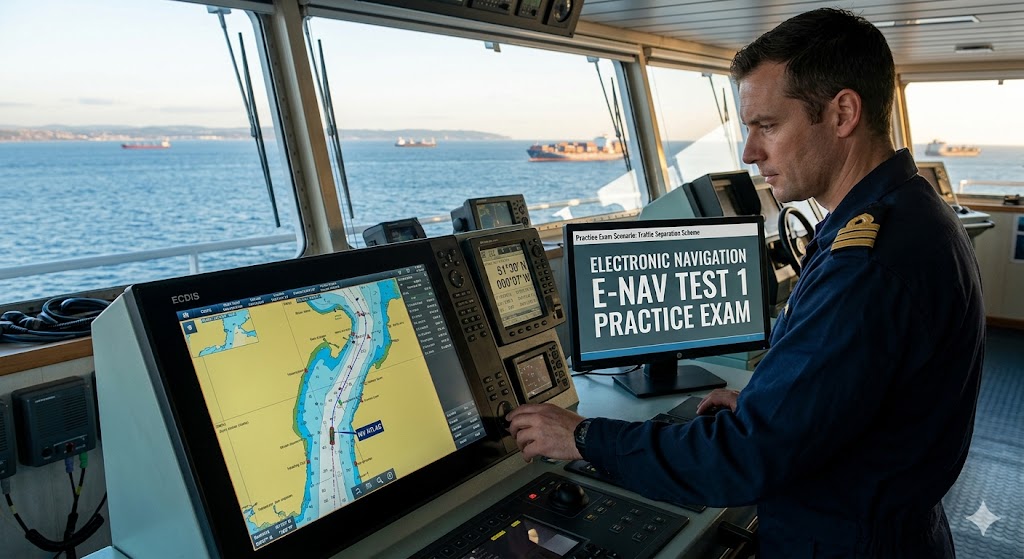
Additional Information
What the Course Entails and Exam Details
The E-NAV course syllabus immerses students in the core technologies that make up a modern ship's integrated bridge system.
You will thoroughly explore the principles and operations of the Electronic Chart Display and Information System (ECDIS), which has steadily replaced traditional paper charts.
The curriculum covers essential modules on Radar and Automatic Radar Plotting Aids (ARPA), teaching you how to track targets and avoid maritime collisions.
Additionally, students learn the intricacies of the Global Positioning System (GPS), Automatic Identification Systems (AIS), and digital Echo Sounders.
The course also emphasizes understanding system limitations, executing electronic chart corrections, and recognizing the critical dangers of over-relying on digital instrumentation.
What to Expect in the Final Exam
The final E-NAV Test 1 is a rigorous assessment designed to simulate the high-stakes environment of maritime navigation.
You can typically expect a computer-based format consisting of 40 to 60 multiple-choice questions, occasionally paired with practical scenario-based questions.
Because navigational errors can have severe safety and environmental consequences, the passing score is traditionally high, often strictly set at 70% or 80?pending on your specific maritime authority.
You will usually be given a strict time limit of 60 to 90 minutes to complete the assessment.
Be prepared for a strictly monitored, closed-book environment where the use of personal mobile devices or unauthorized reference materials is entirely prohibited.
How to Study and Exam Centers
Success in the E-NAV exam requires a strategic blend of theoretical memorization and hands-on practical familiarization.
Begin by thoroughly reviewing your course manuals and the official International Maritime Organization (IMO) model course materials.
Create flashcards for common electronic navigation abbreviations, chart symbols, and alarm codes to build lightning-fast recall skills.
Whenever possible, spend extra hours in your academy's ship simulator to build muscle memory for navigating complex ECDIS menus and operating ARPA controls.
When it comes to taking the actual exam, testing is highly regulated to meet international seafaring standards.
You will generally sit for the exam at approved maritime academies, official Coast Guard testing facilities, or authorized maritime training centers rather than standard third-party testing portals.
Job Opportunities from the Course
Earning your Electronic Navigation certification successfully unlocks a wealth of dynamic, globally recognized career paths in the maritime industry.
Here are the primary roles this qualification helps you secure:
Navigating Officer / Deck Officer: You will serve as the primary officer on watch, exclusively using E-NAV systems to ensure the ship's safe passage across the oceans.
Marine Pilot: You will board incoming vessels and use advanced navigation skills to guide them safely through congested local waterways, rivers, and into commercial ports.
Vessel Traffic Service (VTS) Operator: Working from a shore-based control center, you will use radar and AIS to monitor, advise, and direct ship traffic within busy harbors and coastal regions.
Maritime Instructor: Once highly experienced at sea, you can return to maritime academies to train the next generation of cadets on digital navigation software and bridge simulators.
Marine Superintendent: In this shore-based management role, you will oversee fleet safety, ensure compliance with international electronic navigation regulations, and manage onboard equipment upgrades.
Frequently Asked Questions
Reviews
5.0
Based on 0 reviews
Leave a Review
No reviews yet. Be the first to review!