
Electronics Engineering (ELEX) Board Practice Exam
$69.00
- Buy to unlock unlimited access to all Quiz questions and Answers in this Quiz.
- After purchase you can print a PDF of the whole quiz at any point. The PDF will contain the questions and the correct answers.
About this Exam
The Electronics Engineering (ELEX) Board Practice Exam is an essential preparatory tool designed for aspiring electronics engineering professionals who are aiming to achieve official licensure. This comprehensive practice examination serves as a simulated version of the actual board licensure test, which is a key requirement to legally practice as a registered Electronics Engineer (ECE) in many jurisdictions, particularly in the Philippines.
It is specifically tailored for graduates with a bachelor's degree in electronics engineering or related fields, offering them a chance to evaluate their readiness and identify key areas for improvement. The course aims to validate the extensive technical knowledge and problem-solving skills necessary for a successful and legally recognized career in the fast-evolving world of electronics and communication technologies.
Ready to test your knowledge?
Buy Now to Access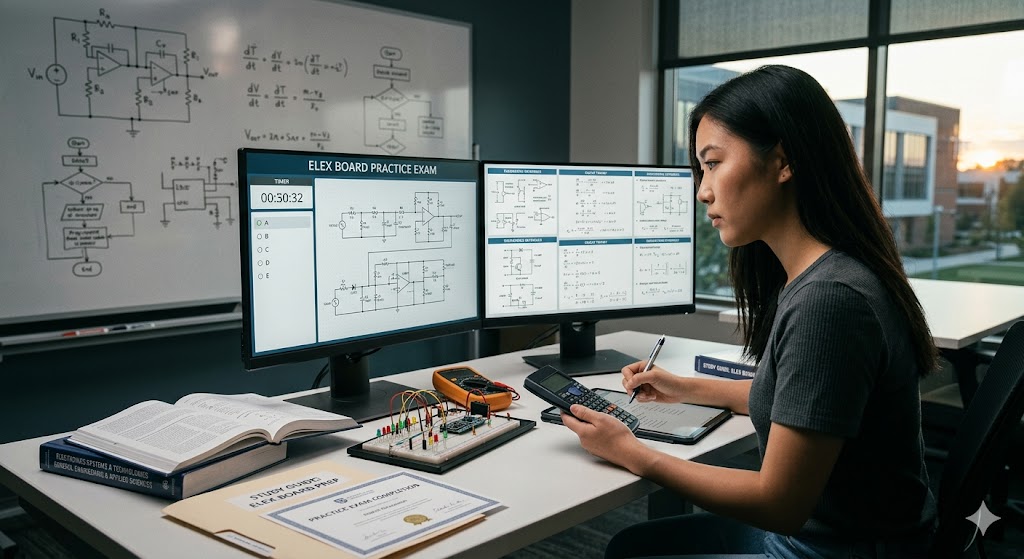
Additional Information
What the Course Entails and Exam Details
This practice exam covers the multi-disciplinary syllabus required for the full licensure examination. It does not teach the content from scratch but provides a structured review and extensive test-question bank. The core components include:
I. Mathematics (typically 20%): Advanced Algebra, Trigonometry, Plane and Solid Geometry, Analytical Geometry, Differential and Integral Calculus, Differential Equations, Probability and Statistics, and Engineering Laws.
II. General Engineering and Applied Sciences (typically 20%): Physics, Chemistry, Engineering Mechanics, Strength of Materials, Thermodynamics, Engineering Economics, Engineering Management, and a crucial section on the Electronics Engineering Law and Ethics.
III. Electronics Engineering (typically 30%): Electricity and Magnetism Fundamentals, Electric Circuits, Solid State Devices, Power Sources, Audio and RF Circuits, Tests and Measurements, Microelectronics, Industrial Electronics, and Computer Principles.
IV. Electronics Systems and Technologies (typically 30%): Radio Communication Systems, Acoustics, Modulation and Noise, Wave Propagation and Antennas, Fiber Optics, Satellite Systems, Data and Digital Communication Systems, Broadcast Engineering, and New Technologies like Wireless and Cellular.
What to Expect in the Final Exam
Students taking this practice exam will be exposed to conditions that closely mimic the final licensure examination, preparing them for the intense multi-day experience.
Exam Format: The actual final licensure exam is typically composed of two consecutive days of multiple-choice questions. It is a proctored, comprehensive test. The practice exam will feature a vast pool of multiple-choice questions (MCQs) of varying difficulty levels, all adhering strictly to the current syllabus.
Passing Score: To pass the licensure examination, candidates must obtain an overall general average of at least seventy percent (70%) in the two-day exam, with no grade lower than sixty percent (60%) in any of the four subject areas. The practice exam platform often provides detailed analytics, scoring your attempts according to these criteria.
Time Limits: The final exam subjects are typically allotted several hours each (e.g., three to four hours for each morning and afternoon session). The practice exam platform allows you to take sections in a timed environment to build speed and stamina.
Specific Rules: On the day of the licensure exam, strict rules are in place, including restrictions on bringing certain items, specific calculator models that are allowed, and precise check-in procedures. The practice guide will outline these official protocols for your review.
How to Study and Exam Centers
Effective preparation is key to success on the ELEX board exam, and this practice guide provides a comprehensive framework.
Actionable Study Strategies:
Consistent Schedule: Create a realistic and structured study plan, breaking down the massive syllabus into manageable daily and weekly goals.
Active Recall and Spaced Repetition: Do not just read. Use flashcards and summary notes. Review key concepts at regular, increasing intervals to encode them into long-term memory.
Master the Formulae: Compile and memorize all key formulae and mathematical derivations across all subjects.
Practice, Practice, Practice: Work through as many mock exams and previous years' question papers as possible. This is the core of the practice exam course, allowing you to get used to the wording and logic of the questions.
Focused Review: Use the results from your practice exams to identify weak points and focus your study on those topics.
Prioritize Engineering Laws and Ethics: This section is relatively easy to study but carries significant weight, ensuring you cannot fail based on technical knowledge alone.
How to Take the Exam and Testing Centers:
The actual final licensing exam is not taken online but in standardized, physical testing centers. In the Philippines, these are often organized in cities such as Manila, Baguio, Cagayan de Oro, Cebu, Davao, Iloilo, Legazpi, Lucena, Rosales, and Tuguegarao, following an official schedule announced by the Professional Regulation Commission (PRC).
This specific Practice Exam is often a digital course, accessed via secure online portals or authorized school review center platforms. Review centers offer structured, scheduled mock board exams that precisely mimic the two-day structure of the actual licensure test, providing invaluable real-world practice before test day.
Job Opportunities from the Course
Successfully passing the Electronics Engineering licensure exam opens a wide spectrum of career opportunities across various sectors of the global economy. This license is the foundation for numerous job titles and career paths, including but not limited to:
Electronics Design Engineer
Systems Engineer
Embedded Systems Developer
Hardware Engineer
Network and Telecommunications Engineer
Broadcast Engineer
Control and Automation Engineer
Avionics/Aerospace Electronics Engineer
Medical Electronics/Biomedical Engineer
Project Manager (Engineering)
Robotics and AI Specialist
Instrumentation Engineer
Regulatory and Compliance Officer
Frequently Asked Questions
Reviews
5.0
Based on 0 reviews
Leave a Review
No reviews yet. Be the first to review!