
Electronics Practice Test
$69.00
- Buy to unlock unlimited access to all Quiz questions and Answers in this Quiz.
- After purchase you can print a PDF of the whole quiz at any point. The PDF will contain the questions and the correct answers.
About this Exam
This comprehensive guide helps you prepare for crucial foundational electronics exams.A practice test acts as your key to success, assessing your understanding before the big day.It assesses your understanding of fundamental electronics principles and components. Successfully navigating this assessment demonstrates your readiness for common entry-level technician certifications. The material and the practice test are suitable for students, aspiring technicians, and hobbyists alike. This resource is designed to boost your confidence and knowledge before your final certification.
Ready to test your knowledge?
Buy Now to Access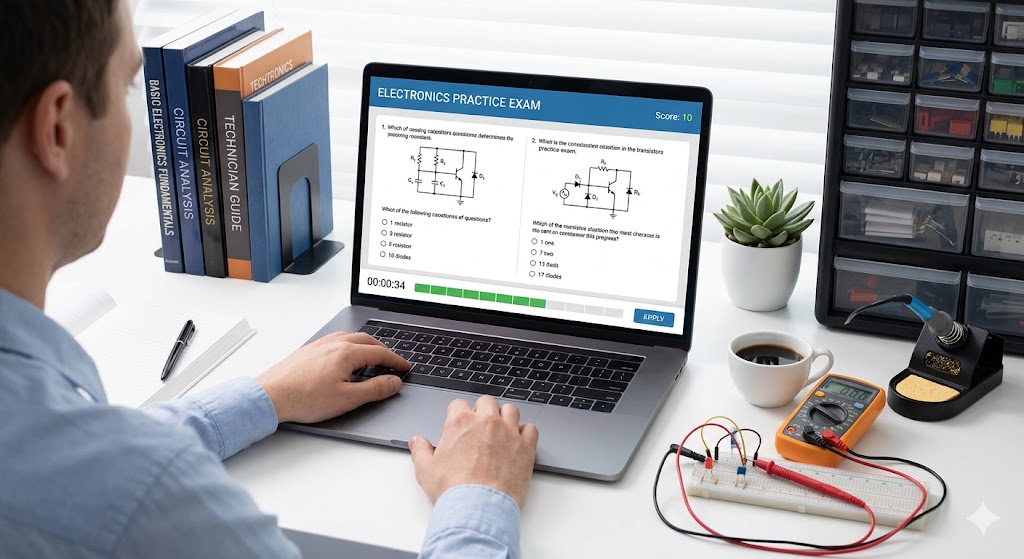
Additional Information
What the Course Entails and Exam Details
The content covers all the essential topics you need for success in foundational electronics. You can expect a deep dive into core areas including: Ohm's Law, current, voltage, and resistance. DC and AC circuit theory and analysis. Key passive components like resistors, capacitors, and inductors.Active semiconductor devices, including diodes and transistors. Understanding basic electronic test equipment, especially multimeters and oscilloscopes. Essential safety practices when working with circuits and components. Troubleshooting techniques and reading electronic schematics. Digital logic fundamentals might also be included in some comprehensive assessments. The structure of practice tests often mirrors typical certification structures.
What to Expect in the Final Exam
The final certification exam typically consists of multiple-choice questions. While practical, hands-on tests do exist for some certifications, general foundational tests are often theoretical and computer-based. You should be prepared for a set number of questions to be completed within a specific time limit. Common time limits are around one to two hours, and the number of questions can vary, typically from 50 to 100. Passing scores also fluctuate but are often in the 70% to 80% range, depending on the certifying body. The actual final exam environment is structured and proctored. Be sure to check the specific requirements and formatting of your chosen certification provider (like ETA, ISCET, or others).
How to Study and Exam Centers
Effective study strategies are crucial for success in any technical exam. Take practice tests like this one repeatedly to identify your strengths and weaknesses. Review all incorrect answers and ensure you understand the correct concepts. Supplement your study with foundational electronics textbooks and comprehensive online courses. Use flashcards to memorize formulas, symbols, and component values. Hands-on practice by building and troubleshooting simple circuits is highly recommended. Participating in online forums and study groups can provide additional support and clarity. For the final certification, registration and scheduling are done through the certifying organization. Exam centers for the final test often include Pearson VUE, certifying body online proctoring portals, local community colleges, vocational schools, or authorized test sites. Your specific certification body will provide you with options for scheduling and locating a test center.
Job Opportunities from the Course
A solid foundation in electronics and subsequent certification open numerous doors in diverse industries. These are typical job opportunities that these skills and credentials make accessible:Electronics Technician: The general entry-level role involved in installing, maintaining, and repairing electronic systems. Bench Technician: Specializes in testing, repairing, and calibrating electronic equipment in a workshop setting. Field Service Technician: Travels to customer locations to install and repair larger electronic systems or machinery. Electronics Tester: Focuses specifically on inspecting and testing completed electronic products to ensure they meet quality standards.Production Assistant (Electronics): Works in manufacturing, assisting in the assembly and testing of electronic circuits and products. Maintenance Technician: Responsible for the general upkeep and repair of electronic equipment and systems within a facility or plant. The knowledge you gain forms the bedrock for specialized advancement into fields like telecommunications, automation, engineering technology, and many other high-demand technical sectors. A certification not only validates your knowledge but also demonstrates your commitment and practical skill.
Frequently Asked Questions
Reviews
5.0
Based on 0 reviews
Leave a Review
No reviews yet. Be the first to review!